
Cadillac EV Pivot Could Extend Gas Performance Lineup Life
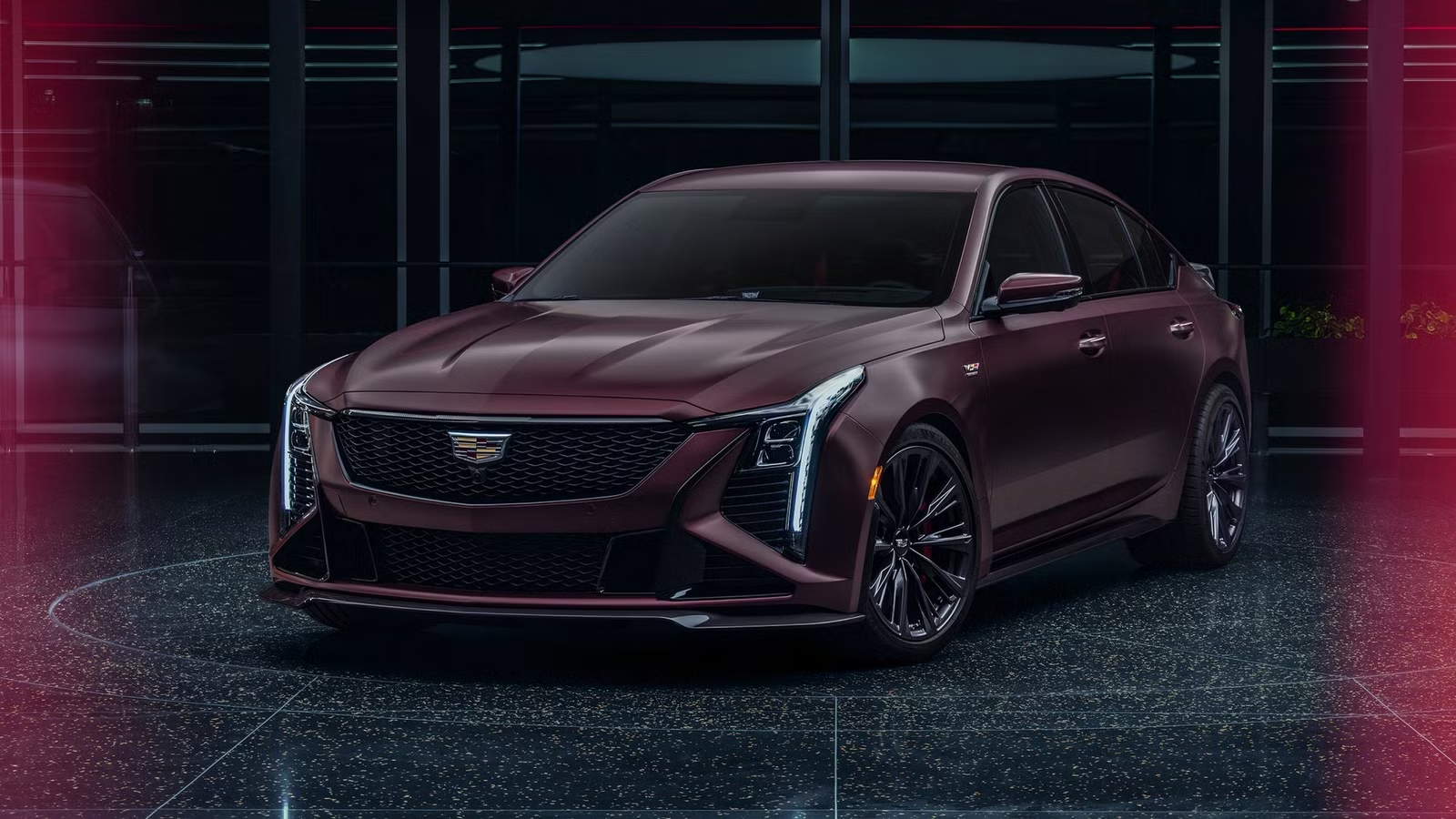
Cadillac spent the better part of the last decade telling the world it was going all-electric. Now it’s walking that back — and the cars fans feared were doomed may have just bought themselves more time. The brand’s retreat from its fully electric lineup target by 2030, reported by Automotive News, has reshuffled priorities in ways that matter directly to anyone who cares about the V-Series badge.

The pivot doesn’t come without pain. Cadillac’s sales dropped 22 percent in the first half of 2026 compared to the same period a year prior, and dealers are staring down a two-year stretch with real holes in the lineup — the XT4 and CT4 are gone, and midsize crossover replacements are still years out. But buried inside that difficult transition is an unintended gift for performance-car loyalists: the combustion-powered models that looked like dead men walking now have a reason to stick around.
The EV Retreat Creates Space For Gas Performance To Breathe
When Cadillac committed to an all-EV future, the logical read was that high-output gasoline engines were on a countdown. Investment dollars would flow toward battery architecture, software, and electric motors. The supercharged V8s, the six-speed manuals, the rear-wheel-drive platforms — all of it looked like it was being managed toward an exit.

The reversal changes that calculus. Cadillac vice president of global operations Kristian Aquilina confirmed the brand is now explicitly building a portfolio that supports both powertrains, stating the company will “continue to deliver leading EVs while updating our ICE portfolio to the same high standards.” That last phrase — updating the ICE portfolio — is the one worth circling. It’s not the language of a brand winding something down. It signals renewed investment in combustion models rather than an accelerated phase-out.
Sam Fiorani, vice president of global vehicle forecasting at AutoForecast Solutions, put it plainly: Cadillac still has customers who will expect a gas-powered vehicle well into the 2030s, and finding a way to serve them is the challenge the brand now has to solve. Solving it means keeping combustion models competitive, not letting them coast to the finish line.
The CT5-V Blackwing Situation Is More Complicated Than It Looks

Here’s where the story gets layered. The CT5-V Blackwing — the last V8, manual, rear-wheel-drive four-door sedan sold in America — is confirmed to end production in December 2026. That clock hasn’t changed. The supercharged 6.2-liter LT4 making 668 horsepower and 659 lb-ft of torque, mated to a Tremec TR6060 six-speed, is going away on schedule. The final-year F1 Collector Series, limited to 26 units and bumped to 685 horsepower, is the send-off.
What the EV strategy reversal does affect is what comes next. Cadillac has confirmed the CT5 nameplate will return with gasoline engines — a next-generation CT5 sedan is slated to arrive as a 2029 model, reportedly sharing architecture with a next-gen Chevrolet Camaro and a new Buick sedan. Whether a Blackwing variant rides along on that platform is the question nobody at GM has answered yet. Under the old all-EV roadmap, the silence would have been a death sentence. Under the new one, it reads differently — there’s at least a world where a high-performance V-Series version of the next CT5 makes business sense again.
For now, Cadillac isn’t saying. But the absence of a “no” matters more than it did six months ago.
Dealers Want More Gas Inventory, Not Less

On the ground, Cadillac dealers aren’t waiting for corporate strategy memos to tell them what customers want. Ed Williamson, CEO of Williamson Auto Group in Miami, has been vocal about GM’s slow response to the lineup gaps, and his prescription is straightforward: more gasoline models, more inventory, more XT5s. “I don’t mind paying the carrying costs to stay in the ICE business,” he said — which is dealer-speak for “the demand is there, give us the product.”
Fiorani echoed the point, advising Cadillac to ramp up production of gasoline models beyond what it might otherwise anticipate, specifically to bridge the gap while the EV transition plays out at a pace the market will actually accept. The concern isn’t that EVs don’t sell — Cadillac has legitimately led U.S. luxury EV sales — it’s that the brand moved too fast to abandon the segments and powertrains that still drive volume. Paul Waatti, director of industry analysis at AutoPacific, framed the risk cleanly: losing a customer today to Genesis or another rival isn’t just one lost sale — it’s potentially a lost customer who won’t automatically return once Cadillac’s lineup is whole again.
For V-Series loyalists, that dealer pressure is actually good news. The louder dealers are about needing performance-capable ICE product, the harder it is for GM to let the segment go dark.
The irony of Cadillac’s situation is hard to miss. The brand’s aggressive EV push was supposed to modernize its image; instead, it created gaps that competitors are happily filling while Cadillac scrambles to reload. But for gearheads who’ve been watching the Blackwing’s obituary get written in real time, the strategy reversal at least reopens a door. Whether GM walks through it with a next-generation V-Series is the question worth watching — and right now, the answer isn’t no.

Related posts


Latest Post


No Comments