How Much It Costs To Replace A 2026 Ford Maverick Hybrid Battery
8 minutes reading
Monday, 5 Oct 2026 12:30 0 46 autotech
The demand for hybrid cars in the U.S. reaches new heights in 2026 as buyers seek practical electrification without charging anxiety. Fuel economy figures drive foot traffic to dealerships, but secondary market consumers still harbor persistent fears regarding long-term high-voltage battery replacement expenses.
There is a common anxiety that an out-of-warranty battery failure will instantly render a car unworthy of repair. This continues to affect resale projections across the hybrid segments. Many prospective owners assume every hybrid battery replacement mirrors the massive bill of a full electric vehicle, creating an unnecessary barrier for budget-conscious buyers evaluating multi-year ownership costs and long-term vehicle equity.
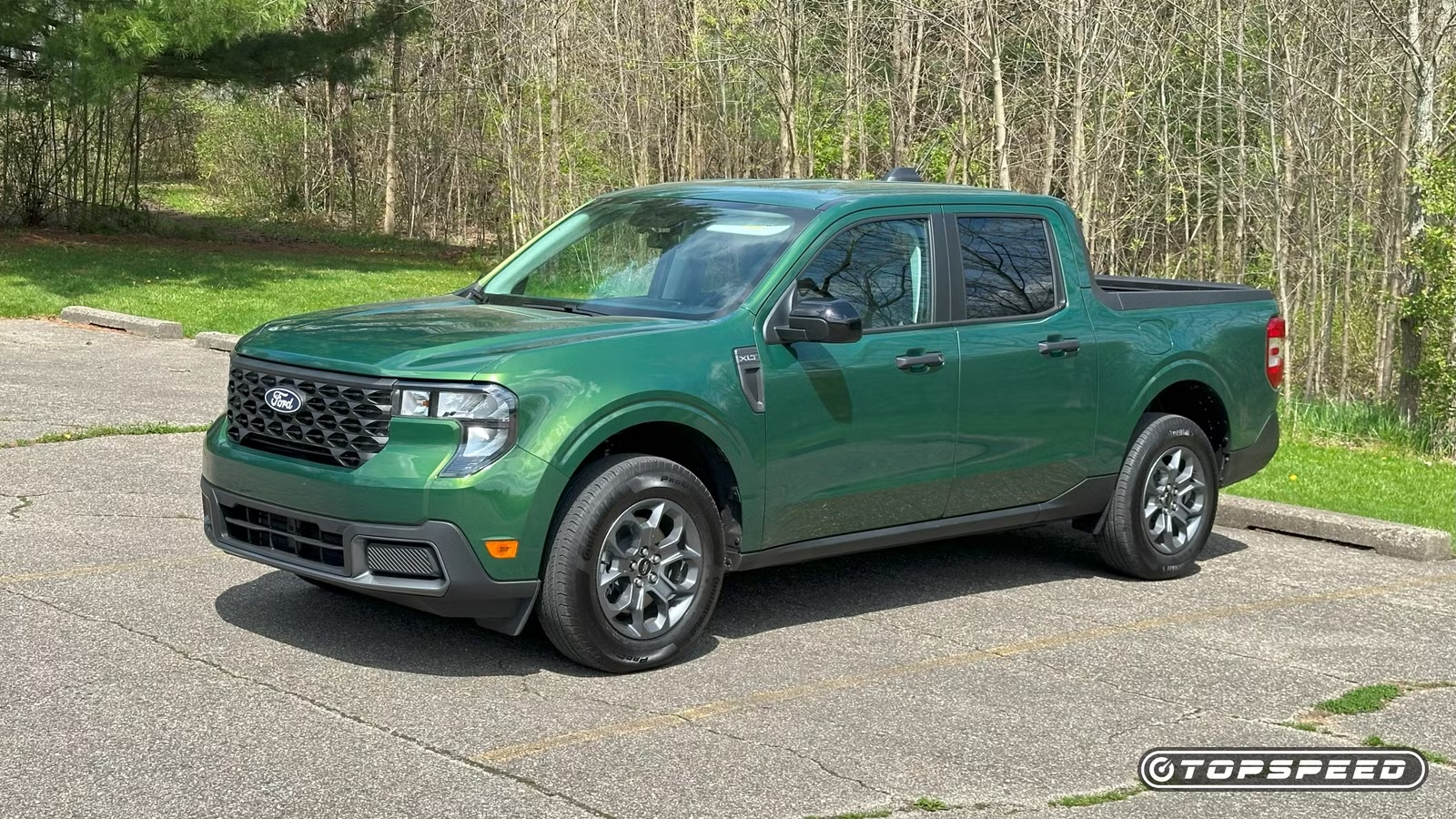
The 2026 Ford Maverick Hybrid occupies a critical position within Ford’s broader utility catalog. It serves as a primary entry point for suburban commuters, practical trade workers, and urban fleet managers who require open-bed versatility. Its hybrid drivetrain makes it a unique proposition that doesn’t suffer from the poor fuel consumption one would typically experience in a traditional body-on-frame truck. Ford positions the Maverick Hybrid beneath the mid-size Ranger. The base-model hybrid’s MSRP starts at $28,145, which is a highly competitive price point that appeals directly to value-minded consumers.
Ford’s national sales figures through mid-2026 demonstrate that the compact hybrid pickup remains a runaway commercial success. Demand consistently outperforms regional dealer stock, minimizing floor-plan turnaround times, and effectively capturing market share from legacy compact sedans and mid-size crossovers. Ford’s sales reports reveal that it has sold a total of 110,931 units of the Maverick, but this includes both powertrain options.
Strong Market Reception Keeps Maverick Demand High
2025 Ford Maverick XLT All-Wheel Drive Hybrid Front Three-QuarterCraig Cole | TopSpeed
A key reason why the Ford Maverick Hybrid remains compelling is its low operational cost and strong value retention. It also continues to earn strong consumer ratings in its segment. J.D. Power awards the 2026 model an 82/100 overall consumer rating, which breaks down to 85/100 for quality and reliability, 72/100 for driving experience, 88/100 for resale, and 80/100 for dealership experience.
While iSeeCars does not provide a full overall rating, it gives the 2026 Maverick Hybrid an 8.1/10 for value retention and 8.4/10 across all Maverick trims. Joining this is a 7.0/10 safety rating. Its five-year depreciation data shows the model retains roughly 62.7 percent of its value, experiencing an average 37.3 percent loss from MSRP.
Ford’s High-Voltage Replacement Costs
Craig Cole | TopSpeed
RepairPal‘smetrics estimate the Ford Maverick Hybrid’s total high-voltage battery replacement will cost between $3,175 and $3,340. Raw component parts account for $2,821, while specialized shop labor ranges from $354 to $519. Independent service operations regularly quote replacement parts as low as $1,941, whereas dealer-average totals referenced across major industry publications often settle near $2,200. This figure depends on regional labor dynamics and warranty markup structures.
Specialized third-party rebuilders such as Greentec list unit-only replacement packs at $3,499 paired with a 36-month nationwide warranty. These varied pricing levels represent distinct operational scopes as opposed to a direct market contradiction. Crate-part acquisition, remanufactured packs, and complete shop installations follow completely different cost models. A typical Toyota Prius battery swap remains marginally cheaper at $1,000 to $2,600, but the Maverick pack easily avoids the financial strain associated with luxury hybrid setups. Ford’s design ensures long-term maintenance feels comparable to a standard major mechanical service.
Engineering Built For Battery Longevity
Front 3/4 shot of 2026 Ford Maverick XL 2.5L Hybrid drivingFord
The main reason behind the Maverick Hybrid’s manageable replacement cost lies in its compact 1.1 kWh lithium-ion pack architecture and conservative electronic power management strategy. Ford powertrain engineers specifically programmed the vehicle’s onboard battery management system to cycle the traction pack strictly within a narrow 40 to 60 percent state-of-charge window during normal driving scenarios. The control software systematically eliminates the extreme thermal stress and cell degradation that typically shortens battery lifespans over extended service intervals.
It achieves this by preventing full voltage charge peaks and avoiding deep discharging. This controlled operating environment drastically reduces internal cell fatigue compared to larger plug-in hybrid or full-battery electric vehicle configurations. As a result, severe out-of-warranty traction pack failures remain remarkably rare. This effectively turns the high-voltage battery into a durable, heavy-duty component engineered to match the operational lifespan of the internal combustion engine itself.
Ford’s Comprehensive Factory Warranty Protection
Front 3/4 shot of a 2025 Ford Maverick Hybrid is driving off-road. Ford
Ford actively mitigates early buyer uncertainty by backing every high-voltage hybrid powertrain component with a comprehensive standard factory warranty. This coverage lasts eight years or 100,000 miles, but increases to 10 years or 150,000 miles in regions adhering to California Air Resources Board emissions mandates. Because every Ford Maverick model year driving on American roads remains well within these original factory warranty parameters, out-of-pocket high-voltage battery replacement expenses represent a purely theoretical future consideration for primary and secondary owners today.
Furthermore, comprehensive extended warranty service contracts covering specialized hybrid system architecture are available starting at roughly $69 per month through reputable vehicle protection providers. This reasonable financial safeguard grants risk-averse, high-mileage drivers complete peace of mind as their vehicles gradually accumulate significant highway odometer readings over extended ownership periods.
How Much You’ll Pay For The 12V Battery Replacement
2025 Ford Maverick XLT All-Wheel Drive Hybrid ProfileFord
The primary real-world ownership frustration actually stems from the Ford Maverick Hybrid’s conventional 12-volt auxiliary system. Factory-installed flooded lead-acid 12V batteries are known to frequently trigger the vehicle’s automated deep sleep power-saving mode. This randomly disables keyless entry functions, turning off remote FordPass app connectivity, and occasionally causing unexpected starter hesitation after short driving trips.
Fortunately, this widely documented operational nuisance requires a simple aftermarket resolution rather than a costly multi-thousand-dollar shop diagnostic visit. Replacing the factory-installed unit with a high-capacity Absorbent Glass Mat battery costs between $200 and $300 at any local auto parts retailer. This permanently eliminates the unwanted parasitic voltage drop issues and restores reliable electronic performance across all vehicle modules.
Resale Superiority Through Financial Logic
Craig Cole | TopSpeed
The surprisingly reasonable real-world cost of a future high-voltage battery replacement serves as a foundational pillar supporting the Ford Maverick Hybrid’s extraordinarily resilient resale performance in the pre-owned truck market. Rather than suffering the severe, sudden depreciation hits that typically afflict high-tech vehicles when buyers fear an imminent five-figure repair bill, secondary market consumers quickly recognize that a complete pack replacement costs roughly the same as a standard automatic transmission overhaul or major engine service.
This logical financial framing keeps used market values firmly elevated, transforming the compact pickup into a secure personal investment rather than a rapidly depreciating disposable asset. By combining high-utility bed space and exceptional fuel efficiency with entirely predictable long-term maintenance liabilities, the Maverick Hybrid proves that sensible engineering protects consumer equity far better than overly complex or unnecessarily expensive alternatives.
Additional Ownership Costs Associated With The Maverick Hybrid
2025 Ford Maverick XLT All-Wheel Drive Hybrid Front Three-QuarterCraig Cole | TopSpeed
Ownership and efficiency metrics for the 2026 Ford Maverick Hybrid reflect recent platform additions and current market adjustments. CarEdge projects a total five-year ownership cost of approximately $46,648 over 60,000 miles. This figure accounts for $14,325 in depreciation, $12,240 for insurance, $11,000 for fuel, $5,742 in financing interest, and $3,341 for combined maintenance and repair expenses. Meanwhile, Edmunds True Cost to Own data estimates five-year total ownership of the base XL Hybrid at roughly $45,866, with line items comprising $10,924 for depreciation, $5,070 for standard maintenance, $966 for unexpected repairs, and $10,926 for fuel over a 75,000-mile duration.
Environmental Protection Agency ratings for the standard front-wheel-drive 2026 Maverick Hybrid remain at 42 MPG city, 35 MPG highway, and 38 MPG combined. Utilizing its 13.8-gallon fuel tank alongside the 1.1 kWh lithium-ion battery, the front-wheel-drive model yields an estimated maximum range of 524 miles on a single fill-up. The agency calculates this model saves owners up to $2,250 in fuel costs over five years compared to the average new vehicle, running an annual fuel cost of approximately $1,350, a cost of $2.25 per 25 miles driven, and a complete tank fill-up expense near $47. The available all-wheel-drive hybrid powertrain delivers a slightly reduced 40 MPG city, 34 MPG highway, and 37 MPG combined, lowering total range to 511 miles per tank. This configuration yields an estimated $2,000 in fuel savings over five years, requires roughly $1,400 annually to refuel, and carries a driving cost of $2.31 per 25 miles.
A Drivetrain That Focuses On Efficiency
Ford Maverick Hybrid towingFord
The Ford Maverick Hybrid features the brand’s naturally aspirated 2.5-liter four-cylinder engine with one permanent-magnet motor. This generates a combined 191 horsepower and 155 pound-feet to the front wheels via a direct-drive eCVT system. The all-wheel-drive model produces an identical output because the brand has opted for a conventional driveline rather than a secondary electric motor.
As per the brand’s claims, you can expect the front-wheel-drive Maverick Hybrid to cover a 0 to 60 MPH sprint in eight seconds and hit a 110 MPH top speed. Tests by MotorTrend estimate that the all-wheel-drive model can cut this down to about seven seconds. If you fit the optional tow package, you get access to a 4,000-pound towing capacity.
Base Trim Engine
2.0-liter 4-Cylinder EcoBoost
Base Trim Transmission
8-Speed Automatic
Base Trim Drivetrain
Front-Wheel Drive
Base Trim Horsepower
250 hp
Base Trim Torque
277 lb-ft
Make
Ford
Model
Maverick
Segment
Compact Pickup Truck
Sources: Ford, Greentec Auto, MotorBiscuit, J.D. Power, iSeeCars, RepairPal, and the EPA.












No Comments