
The Sport Bike That Proves Performance And Practicality Can Coexist
Sportbikes are all about grin-worthy performance and sensitive handling. But these features aren’t well suited to daily riding. You can only use a sportbike’s full potential on racetracks. However, most riders don’t have the time or budget for frequent track days. Most sportbikes are ridden on public roads, so a certain degree of practicality helps a lot.

Motorcycle makers are finally understanding the potential of this balance. It is also why we are seeing a recent surge of comfortable, practical sportbikes, even from exotic names like Ducati. But a special Honda middleweight sportbike had been at it long before this shift, offering the best balance of performance, comfort, daily rideability, and practicality without losing excitement.
Sportbikes Have Always Been Synonymous With Performance And Aggression
A sportbike is designed to be adrenaline-pumping. It achieves this with high-revving, powerful engines paired with wildly engaging underpinnings. Features like a demanding rider triangle, limited steering lock, and a very sensitive throttle add to the aggression.

Taming these beasts requires a different skill set, so they aren’t quite suited for practical, daily use. That is also why most aggressive sportbikes, like the Ducati Panigale V4, the BMW S 1000 RR, and the Yamaha YZF-R1, aren’t quite cozy for daily riding. Their aggressive ergonomics and sharp forward torso lean can cause significant wrist and back pain if you’re not properly positioned.

The limited steering range even makes normal U-turns and tight urban riding challenging. Furthermore, their high-revving engines tend to heat up in slow-moving traffic and can make the rider uncomfortable. These factors limit sportbikes to controlled environments like racetracks. That was fine a few years back, when the economic conditions were more favorable.
But The Market Demands More Balanced Options Today

Having separate motorcycles for leisure is proving expensive. So demand for balanced sportbikes that can do more than just track days is rising. These motorcycles retain the core sportbike formula but soften the ergonomics and deliver a more linear surge of performance for a friendly everyday riding experience.
Motorcycle makers have realized the potential for such versatile sportbikes, which is why even Ducati has gone soft with its latest Panigale V2 series. We now have a red-hot Ducati with a fairly relaxed rider triangle, more accessible performance, and commendable practicality. Other examples include the new Triumph Daytona 660, which purists didn’t love when it replaced the drool-worthy Daytona 675R. But the added practicality makes this Triumph a more comfortable daily motorcycle, and the general audience appreciates it.

Suzuki and Yamaha also take a toned-down approach. The former brought in the GSX-8R to replace the GSX-R750. The latter gives us more versatility with the YZF-R7, which succeeds the iconic YZF-R6. While all these middleweight sportbikes add a certain degree of practicality to the mix, none match the balance the Honda CBR650R E-Clutch offers.
The 2026 Honda CBR650R E-Clutch Is The Most Practical Sportbike
Priced From $9,199

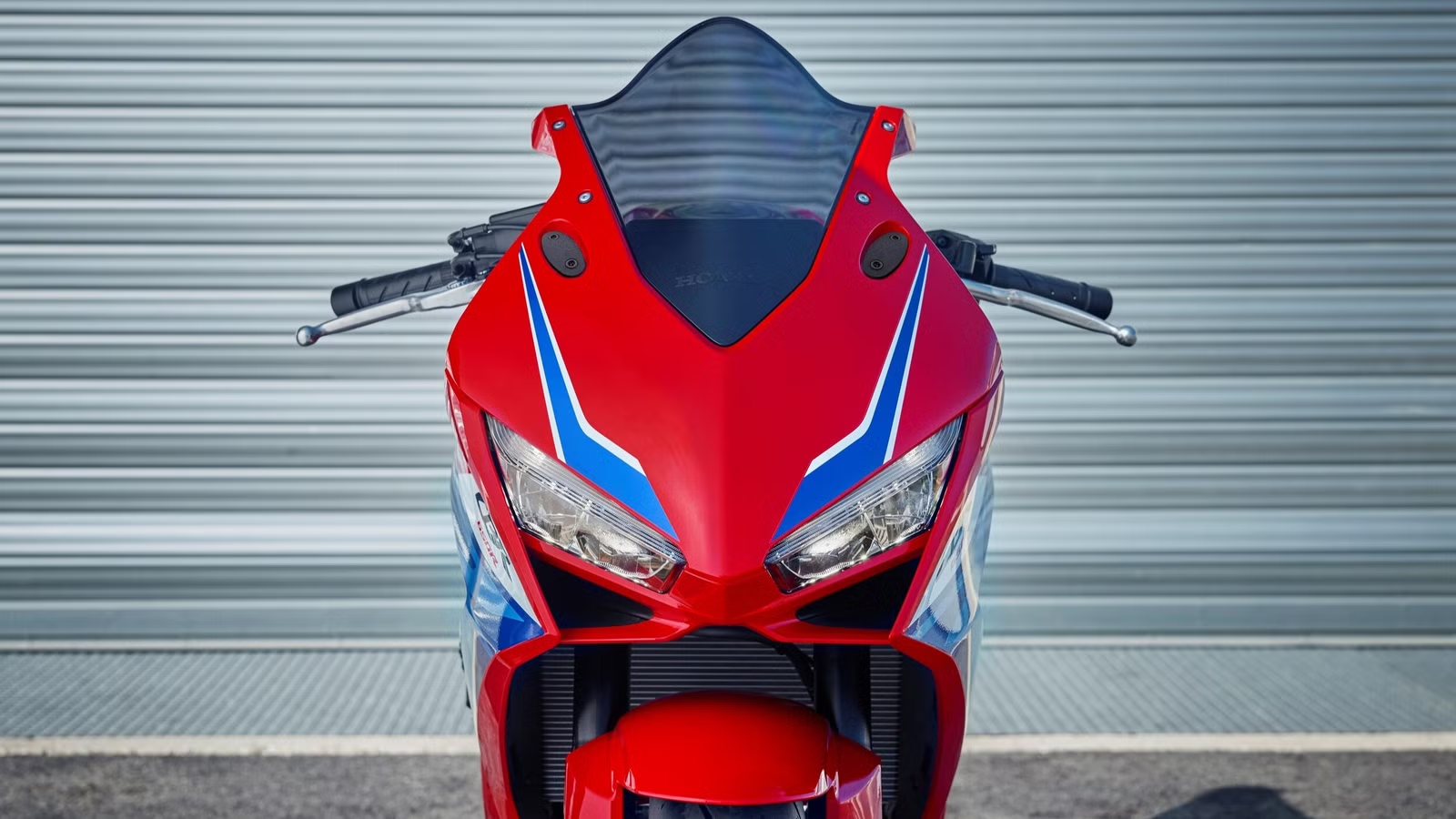
The Honda CBR650R E-Clutch is the perfect do-it-all sportbike. On the outside, it looks intimidating, with sharp, angular body panels and an angry front fascia. The practical side is well camouflaged under the bright Grand Prix Red color scheme, which mimics Honda’s flagship sportbike—the Fireblade. But underneath the clothing sits a now-rare middleweight engine configuration, a straightforward chassis, and flexible ergonomics that can work well on both public roads and racetracks.

The tech suite isn’t overwhelming and includes just what you need to improve daily riding comfort. It also packs a special drivetrain component that gives it a serious edge over rivals in daily riding comfort. Despite all these features, Honda still prices the CBR650R aggressively at just $9,199. Most rivals cost more, making this Honda the most value-packed middleweight sportbike on sale today.
Powered By A Four-Cylinder Engine Tuned For Everyday Riding

The CBR650R is powered by one of the last remaining middleweight inline-four engines. Most rivals have phased out the inline-four layout in favor of safer parallel-twin engines. The 649 cc liquid-cooled mill produces 93 horsepower at 12,000 RPM and 46 pound-feet of torque at 9,500 RPM.
Adding to its practical riding appeal is a linear, spread-out performance curve that translates to a strong mid-range. This helps create a predictable riding experience on urban roads, wide-open highways, and even racetracks. Power goes to the rear wheel through a six-speed manual gearbox. What makes it special is its unique electronic clutch system.
The Secret To Its Practicality Lies In Its Electronic Clutch System

This core feature highlights the CBR650R’s all-around appeal. The electronic clutch system simplifies the riding experience and even makes this middleweight sportbike more approachable for newbies than entry-level options. This clutch system uses two electric motors to engage the clutch. Riders only have to shift gears and can forget about manually actuating the clutch lever. This feature helps a lot in tight urban riding conditions, where riders would otherwise have to keep toggling the clutch.
The E-Clutch system also doubles up as a quickshifter and a hill-hold control. Stop-and-go traffic and uphill rides therefore require little mental preparation. Other advantages of this automated clutch system include no stalling, reduced rider fatigue, and smooth, assisted gear shifts at all times. If this setup sounds a bit too boring, Honda also offers an “off” switch to disable the e-clutch completely. Riders can then ride the CBR650R the old-fashioned way.
Underpinnings As Versatile As The Engine

The CBR650R E-Clutch sits on a diamond-type steel main frame that Honda claims balances weight and rigidity. This helps greatly with high-speed stability and riding comfort. The chassis is suspended on 41 mm inverted forks up front with 4.7 inches of travel.
The front setup comprises Showa’s Separate Function Big Piston forks, which separate the spring and damper functions for more versatile suspension tuning. The rear gets a preload-adjustable monoshock with 5.1 inches of travel. Dual 310 mm discs and radial four-piston calipers handle braking up front.

The rear gets a 240 mm disc coupled to a single-piston floating caliper. Tubeless 120-section front and 180-section rear tires wrapped around lightweight 17-inch alloy wheels deliver confidence-inspiring grip. Together, these hardware choices deliver a predictable, tamed riding experience.
Forgiving Ergonomics And Elevated Accessibility Add To Its Practical Side

The four-cylinder engine and added clutch complexity make the Honda CBR650R one of the heaviest in its class, which isn’t surprising. But despite its 466-pound curb weight, Honda has made it beginner-friendly. This is thanks to a relatively low seat height of 31.9 inches and a compact wheelbase of 57.0 inches.
The rider triangle is also fairly relaxed, which should put less stress on the back and wrists than more aggressive counterparts. This Honda sportbike can also be a formidable highway companion. Its touring-friendly accessory lineup reinforces this, with tank bags and rear seat bags for added storage.
Just The Right Sprinkle Of Technology

The technology suite is comparatively simple but includes the most impactful features. The cockpit is lit up with a crisp color TFT that gets Bluetooth for smartphone connectivity via Honda RoadSync. This lets riders access calls, music, messages, and even navigation via dedicated handlebar buttons.
Safety-wise, it is sorted with features like traction control and dual-channel ABS. A six-axis IMU would clearly have elevated the package. But is its absence really a deal-breaker here? Absolutely not, especially for the balanced and unique package it offers for under $10,000.
Rivals Fail To Outclass The All-Around Honda CBR650R

Despite going soft, the Honda CBR650R still offers commendable track-ready performance and dynamics that put a wide grin on the rider’s face. The cherry on top is its competitive price of $9,199. Even its rivals with no gearbox gizmos cost more. The only direct rival to edge the CBR in power ratings is the Triumph Daytona 660 with 95 horsepower. But it costs more, at $9,395.

Its Japanese counterparts include the $8,199 Kawasaki Ninja 650, the $9,399 Yamaha YZF-R7, and the $9,699 Suzuki GSX-8R. The only rival that is more affordable than the Honda CBR650R is the Kawasaki Ninja 650. However, it is much less powerful, packing a 649 cc parallel-twin engine that produces 67 horsepower. The Yamaha and Suzuki offerings struggle to reach even 85 horsepower, despite their premium appeal.

They are lighter than the CBR, but even with two fewer cylinders, the weight difference isn’t substantial. The Yamaha R7 weighs 417 pounds, while the Suzuki GSX-8R is heavier at 452 pounds. Taking all these factors into account, we applaud Honda for having created the most balanced middleweight sportbike that rivals have yet to outclass.
Sources: Honda Powersports, Kawasaki, Triumph Motorcycles, Suzuki Cycles, and Yamaha Motorsports.

Related posts


Latest Post


No Comments