
Mazda And Suzuki Built A Gullwing Mini-Supercar And Only 4,392 Sold
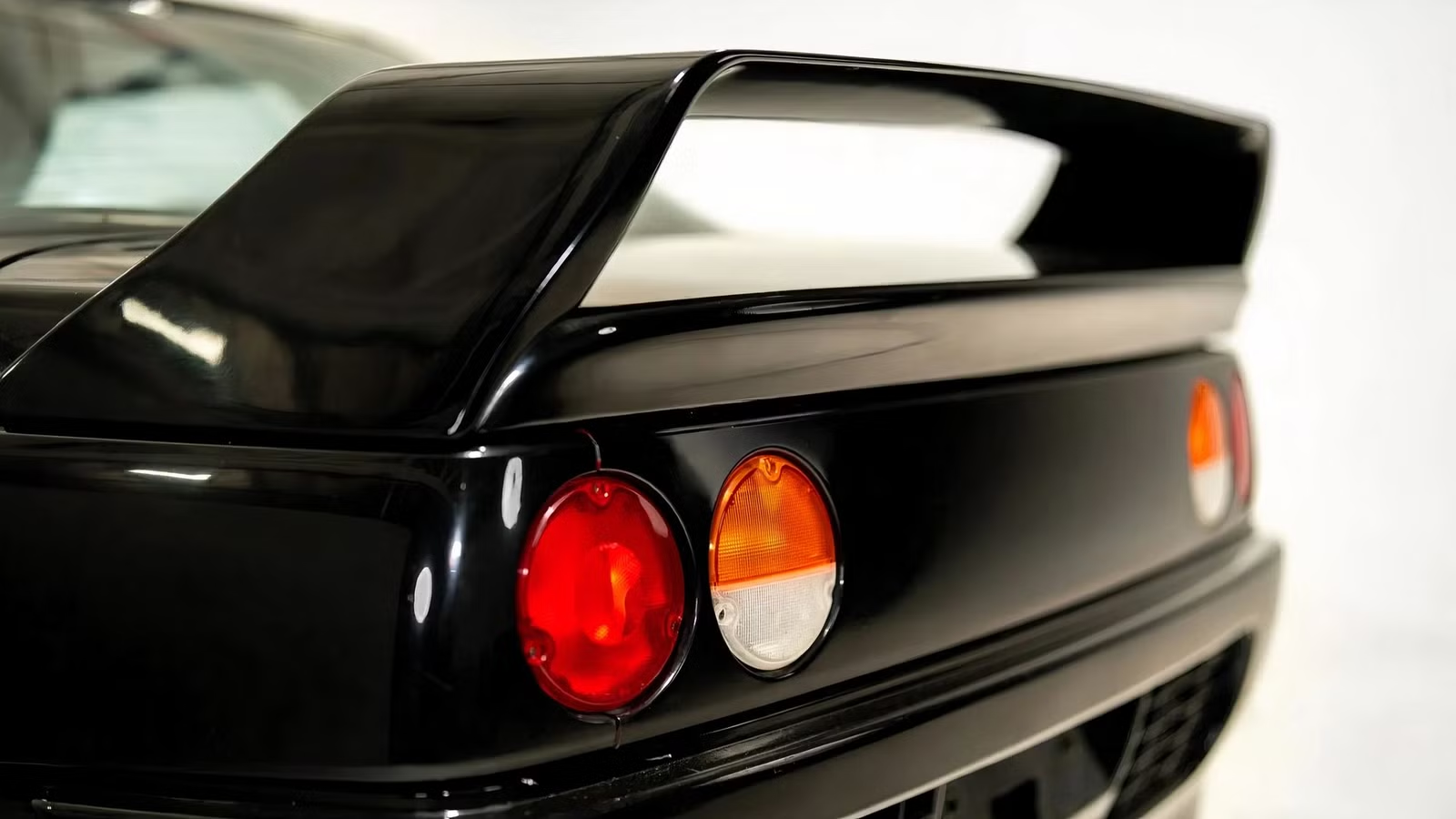
Japan produced plenty of strange performance cars during its economic boom, but one project pushed the idea of a tiny sports car into wonderfully unreasonable territory. It had a mid-mounted turbo engine, rear-wheel drive, a five-speed manual, plastic body panels, and doors normally associated with six-figure exotics. Engineers even sent much of its development work to England. Three decades later, those same odd decisions explain why enthusiasts care so much.
Japan’s Bubble Economy Made A Tiny Supercar Seem Completely Reasonable

Japan’s late-1980s bubble economy gave automakers room to experiment in ways that would terrify a modern product planner. Buyers had money, manufacturers expected growth, and Japanese brands chased increasingly narrow slices of the market. Mazda expanded to a five-channel domestic sales system and created identities such as Eunos and Autozam. The company launched more than 25 new models in roughly five years as it tried to give those channels distinctive products. A car could now be a halo model, engineering experiment, or rolling advertisement for an entire showroom.
The kei-car rulebook looked like the worst possible place for that thinking. Under the rules introduced for 1990, a kei car could measure no more than 3.3 meters, or 10.8 feet, long and 1.4 meters wide, while engine displacement stopped at 660cc. Engineers therefore faced a tiny box, a tiny engine, and roughly 63 SAE horsepower. Ferrari probably wasn’t checking the rearview mirror.
That restriction created an interesting problem. If engineers could not add huge power, the excitement had to come from somewhere else. Low mass could sharpen every response, a low seating position could make normal speeds feel faster, and a mid-engine layout could give the chassis real sports-car balance. Short gearing, direct steering, and very little insulation could make 40 mph feel far more interesting than the number suggested. The rules that seemed to kill the supercar idea ended up shaping a very different kind of one.

Mazda’s Wildest Kei Project Took An Unexpected Detour Through England

The story gets strange well before production. A common version says Suzuki developed a small mid-engine sports car, abandoned it, and Mazda simply picked it up. Detailed histories place Mazda’s own W140 work in early 1985, followed by clay models and, by 1987, a running mid-engine prototype using a Daihatsu Mira engine. Suzuki developed its own RS/1 and RS/3 concepts around the same period.
Suzuki still became essential. Mazda eventually chose Suzuki’s F6A, a 657cc turbocharged three-cylinder that suited the new kei regulations and made the class-standard 64 hp. Suzuki also became closely tied to the program through manufacturing cooperation and later sold a related version of the finished car. Final assembly, however, went to Kurata Co. in Hiroshima, now known as Keylex.
Then England entered the picture. Mazda sent substantial engineering and durability work to Hawtal Whiting in Basildon, Essex. Engineers tested body stiffness, ran prototypes on a four-post road simulator, collected road-load data, and used Millbrook Proving Ground for development. The production cars still came from Japan, but Britain helped turn the idea into something that could survive real roads. That gives the project an odd résumé: Japanese regulations, Mazda development, Suzuki power, British engineering, and Hiroshima assembly.
The Autozam AZ-1 Was A 64-HP Supercar In Miniature

The mystery car reached customers in 1992 as the Autozam AZ-1, sold through Mazda’s small-car Autozam network. Its specification still sounds like someone left a supercar in the dryer – a Suzuki F6A 657cc turbocharged three-cylinder sat behind the seats and sent 64 hp and 63 lb-ft of torque through a five-speed manual to the rear wheels. The whole car weighed about 1,587 pounds, or 720 kilograms. It measured roughly 11 feet long and stood only 45.3 inches tall.
Then came the doors. Mazda gave the AZ-1 proper gullwings, instantly turning a tiny kei car into something that looked far more exotic than its power figure suggested. The layout backed up the drama – it had a mid-mounted engine, rear-wheel drive, four-wheel disc brakes, and a driver sitting only inches from the pavement.

Nobody needed to fear its straight-line performance. Contemporary testing put 0-62 mph at roughly nine seconds – plenty of modern crossovers can beat that without waking the kids. The AZ-1 made speed feel faster instead – the engine buzzed and whistled just behind the cabin, steering was quick, and there was very little mass between the driver and the road. Mazda development chief Toshihiko Hirai, who also led the original MX-5 program, focused on response and involvement rather than horsepower.
The AZ-1 completed what enthusiasts now call Japan’s ABC kei-sports trio: the Autozam AZ-1, Honda Beat, and Suzuki Cappuccino. Each took a different route. Honda gave the Beat a high-revving naturally aspirated engine and mid-engine roadster layout. Suzuki followed the classic front-engine, rear-drive formula with the turbocharged Cappuccino. Mazda chose maximum theater with a turbo engine behind the seats, a fixed roof, and those gullwing doors.
The Flop Became The Rarest Member Of Japan’s Kei-Sports Holy Trinity

The timing could hardly have gone worse. Mazda priced the AZ-1 at about ¥1.498 million, equivalent to roughly $29,000 in 2026 dollars, putting it above the Honda Beat and close to the Suzuki Cappuccino. More painfully, Mazda’s larger Eunos Roadster — the Japanese-market MX-5 — was not dramatically more expensive. Buyers looking at a cramped 64-hp kei coupe could stretch a little further and get one of the world’s most usable small sports cars.
Japan’s asset bubble had also collapsed. The optimism that financed Mazda’s sprawling dealer network and niche projects disappeared just as the AZ-1 reached showrooms. Only 4,392 AZ-1s entered the generally accepted production total before the program ended. Sources differ slightly on the exact build timeline, and unsold cars reportedly remained available into 1995.
Suzuki added an even rarer sibling called the Cara. It used the same basic formula with Suzuki branding and a few detail changes, and only 531 were produced.

Time eventually solved one problem: getting an AZ-1 into the United States. NHTSA allows vehicles at least 25 years old to enter under the federal age exemption, so every original AZ-1 now clears that threshold. State registration rules can still vary.
Scarcity and internet fame have done the rest. In 2026, driver-quality examples generally sit around $18,000 to $25,000, while cleaner or more original cars can reach roughly $30,000 to $45,000. Exceptional cars and desirable Mazdaspeed versions can climb beyond $55,000. Recent auction results show ordinary cars selling in the low-$20,000s and a very low-mile Mazdaspeed example reaching $63,000 in 2026.
The days of treating the AZ-1 as a cheap weird JDM car are over.
The AZ-1 Makes More Sense Today Than It Did In 1992

The AZ-1 failed for reasons that looked perfectly sensible in period. It asked buyers to spend serious money on a car with two seats, little luggage room, 64 horsepower, awkward access, and dimensions associated with basic city transportation. Much of its expensive engineering could not be appreciated at a glance.
Thirty-plus years later, enthusiasts value almost the exact things that hurt it when new. The mid-engine layout now seems wonderfully excessive. The gullwing doors make every drive feel like an occasion. Hirai’s involvement links it to Mazda’s finest sports-car period. Suzuki supplied the turbo heart, while outside engineering in England added another unusual chapter to its story.

More importantly, the circumstances that created the AZ-1 look nearly impossible to repeat. Japan’s bubble economy gave Mazda money for niche brands and low-volume halo cars. Kei regulations forced engineers to chase lightness and sensation rather than displacement. Mazda and Suzuki cooperated on a deeply specialized machine that made almost no business sense once the economy changed.
Only 4,392 AZ-1s were built. That figure made the car a commercial failure when Mazda wanted volume. Today, it makes the AZ-1 the unicorn of the ABC trio — and proof that bad business decisions can sometimes create the best enthusiast cars.
Source: Mazda, Autozam, Suzuki, Bring a Trailer

Related posts


Latest Post


No Comments