
America’s First Turbocharged AWD Car Nobody Remembers Anymore
When you think about America’s contributions to the world of turbocharged all-wheel-drive cars, the list is… well, pretty short. Europe had the Audi Quattro. Japan brought the Skyline GT-R, the WRX, the Evo, and a handful of other turbo terrors. But what about the U.S.? Surely there had to be at least one factory-backed, street-legal AWD turbo machine that came out of Detroit or somewhere nearby, right?

As it turns out, there was. And it showed up way earlier than you probably think. Before the rise of the Subaru WRX in the States or the Mitsubishi Evo’s eventual U.S. debut, America had its own AWD boost junkie ready to tear up gravel roads and high school parking lots alike. The only problem? Almost nobody remembers it today.
The Unlikely Partnership That Changed American Sports Cars Forever
In the 1980s, long before turbocharged all-wheel-drive sports cars became mainstream, an unlikely collaboration between Chrysler and Mitsubishi Motors quietly set the stage for a revolution. At the time, a financially unstable Chrysler needed smaller, fuel-efficient cars to add to its lineup, while a fast-rising Mitsubishi was eager to expand its footprint in the lucrative U.S. market. Chrysler was already selling rebadged Mitsubishi models in the U.S. by the ‘80s, and with both companies already having a great relationship, they decided to turn it into something far more ambitious.

In 1985, the two companies formalized their partnership under a new joint venture called Diamond-Star Motors (DSM). This wasn’t just a handshake deal; with a purpose-built factory in Illinois, DSM blended two distinct engineering philosophies with the aim of co-developing affordable performance cars in the U.S. to avoid import costs. What emerged from this collaboration wasn’t just another sporty coupe. It was a sleek, affordable machine that combined turbocharged power with advanced all-wheel-drive technology in a way few American cars had attempted, setting the stage for the performance compacts that would dominate the decades that followed.
The Eagle Talon Is An Underappreciated American Icon

The car in question? The 1992 Eagle Talon TSi AWD — a turbocharged, all-wheel-drive coupe that absolutely deserves more love than it gets.
Built as part of the Diamond-Star Motors (DSM) joint venture between Chrysler and Mitsubishi, the Talon shared its platform and powertrain with the Mitsubishi Eclipse GSX and the Plymouth Laser RS Turbo. But the Eagle version had its own vibe going on. With a sharp, almost exotic rear roofline, angular headlights, and that massive black wraparound rear wing, the Talon looked the part of a serious sports coupe.
America’s Affordable, Rally-Adjacent Option

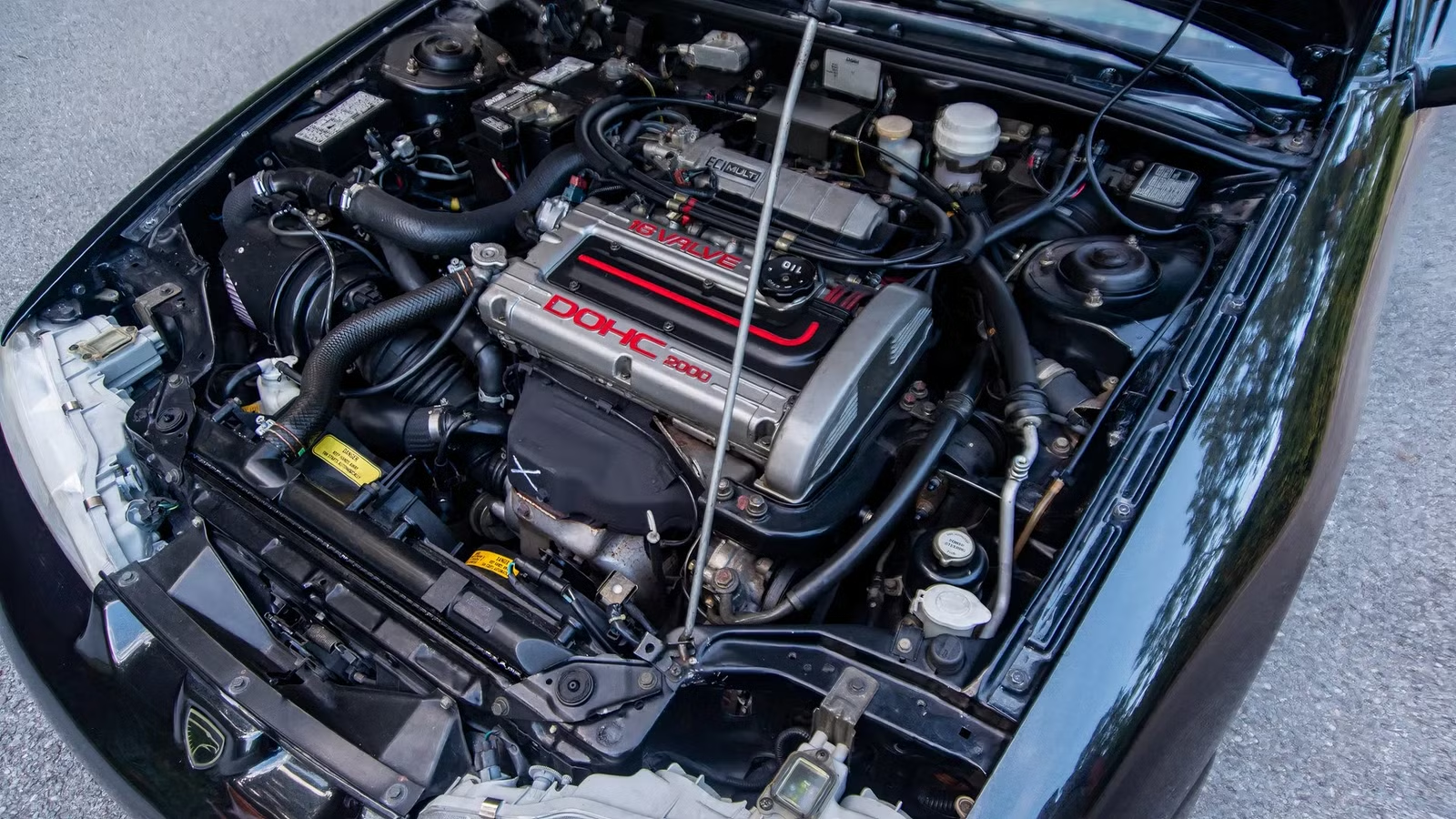
Under the hood, the TSi AWD packed Mitsubishi’s proven 2.0-liter 4G63 turbocharged inline-four, good for 195 horsepower and 203 lb-ft of torque (though these numbers would bump up slightly in later years). Mated to a five-speed manual and hooked up to a viscous coupling all-wheel-drive system with a limited-slip rear diff, this car was built to put power down in places where front-drivers would just spin.
The Talon TSi AWD wasn’t just America’s first real turbocharged AWD street car — it was also one of the earliest affordable ways to get into a boosted, rally-adjacent platform without going European.
The 4G63 Engine Was Built For Boost

|
Engine |
Power |
Torque |
Transmission |
|---|---|---|---|
|
2.0-liter inline-four |
195 hp |
203 lb-ft |
5-speed manual |
1992 Eagle Talon TSi AWD Key Specs
The heart of the Talon TSi AWD was its 4G63 turbo-four, an engine that gained legendary status thanks to its Mitsubishi Evo ties and ridiculous aftermarket potential. Even in stock trim, the Talon felt properly quick for the early ‘90s, with 0-60 mph times dipping under seven seconds if you knew how to launch it right.
But the real charm was how effortlessly this engine handled more boost. With a few bolt-ons and a tune, you could easily get these cars pushing 300+ horsepower without cracking open the block. Some DSM diehards even squeezed four-digit power figures out of these mills — though by that point, you’re not exactly daily-driving it.
And while the Talon wasn’t officially designed for rally, the combination of AWD grip and turbo grunt meant it could play in the dirt with the best of them. This was a true enthusiast platform before “enthusiast platforms” were even really a thing.
A Proper AWD Coupe Before Subaru And Mitsubishi Owned The Game

Today, when people talk affordable AWD performance, the conversation usually jumps straight to the Subaru WRX or Mitsubishi Lancer Evo. But the Talon TSi AWD was already there, years before either of those cars became household names in the U.S.
Easy, Accessible Performance For The Masses

The Talon might not have had the rally pedigree or WRC posters on every teenager’s wall, but it had the bones of a proper AWD performance car. More importantly, it was accessible. This wasn’t some limited-run homologation special or unattainable exotic — it was a regular production car that you could actually find on a dealer lot.
The handling was sharp for its day, thanks to independent suspension front and rear. Combine that with the grip from the AWD system, and the Talon had a playful, planted character that let you get away with a lot more speed than you probably should have. On dry pavement or slick backroads, it was confidence-inspiring in a way most American cars of the era simply weren’t.
The Talon’s Styling Still Holds Up (Kind Of)

Look, we’re not going to argue that the Eagle Talon is the best-looking car of the ‘90s. But there’s something undeniably cool about the styling, especially on the early first-gen models like the 1992 TSi AWD.
Angular, aggressive lines? Check. Big wraparound wing that feels straight out of an early arcade racing game? Double check. The Talon had a stance and shape that stood out without trying too hard. And in an era where “sporty” often meant some half-baked stripe package on a rental-spec sedan, the Talon looked like it meant business.
Sure, the interior was classic ‘90s Chrysler plastic, but there was a simplicity to the layout that worked. You got proper analog gauges, supportive seats, and not much else to distract you from the task at hand.
The Death Of Eagle Helped Turn The Talon Into A Forgotten Hero

Part of what makes the Eagle Talon so overlooked today has very little to do with the car itself. It has everything to do with the badge sitting on its nose.
Eagle was a short-lived Chrysler brand created after Chrysler absorbed American Motors Corporation in 1987. The company positioned Eagle as a more import-focused division, aimed at buyers who wanted something sportier and a little more distinct than a typical Dodge or Plymouth. While Eagle sold everything from rebadged sedans to practical commuters, the Talon quickly became the brand’s real enthusiast halo car.
The problem was that Eagle itself never had a long future. Chrysler officially killed the Eagle brand in 1998, and with it, the Talon disappeared as well. Meanwhile, its DSM sibling, the Mitsubishi Eclipse, continued building stronger recognition into the 2000s, which helped keep it more visible in tuner culture and the collector world.
That brand extinction quietly hurt the Talon’s legacy. Despite sharing much of the same turbocharged AWD hardware, 4G63 tuning potential, and performance DNA as the Eclipse GSX, the Talon never got the same long-term name recognition. Ironically, that’s also why it remains one of the more underrated bargains in the DSM world today.
Used Values Are Still Shockingly Reasonable

|
Condition |
#1 Concours |
#2 Excellent |
#3 Good |
#4 Fair |
|---|---|---|---|---|
|
Valuation |
$24,700 |
$16,600 |
$7,800 |
$4,200 |
Source: Hagerty
Despite its place in turbocharged AWD history, the Talon TSi AWD remains criminally undervalued in the collector car world. According to Hagerty’s valuation tools, you can still find decent examples for well under $10,000, with “Good” condition cars averaging around $7,500. Even cleaner examples in “Excellent” condition rarely crack the $15,000 mark.
For reference, first-gen Mitsubishi Eclipse GSXs and Plymouth Lasers of similar spec also hover in the same price range — but the Eagle badge tends to keep prices a bit softer. That’s good news if you’re looking to get into the turbo AWD game without spending WRX money.
The downside? Finding one that hasn’t been beaten within an inch of its life can be tough. These cars were cheap, fast, and mod-friendly — which means a lot of them were raced, rallied, or poorly “upgraded” at some point. A stock, unmolested TSi AWD is a rare bird today.
What To Look For When Buying One

Even if you’re lucky enough to stumble upon a stock Eagle Talon TSi AWD, there are a few things you need to keep in mind before you even think of buying it. For one, you need to be aware of the visual differences between different model years and generations. If you’re a fan of pop-up headlights, you’ll need to find models built before the 1992 facelift. And what about that signature “power bubble” hood bulge that cleared the 4G63’s DOHC cam gears and gave the Talon a more aggressive look? Well, stick to first-generation models only for that.
But more importantly, you should be aware of some of the things that could go wrong, especially considering that these cars are decades old. The biggest red flag is the infamous “crankwalk,” a failure tied to later 7-bolt 4G63 engines, where the crankshaft shifts and destroys internal components. Pre-1992 and some early 1992 models had the stronger 6-bolt setup, widely considered to be far more durable and tuner-friendly. Other common problems include failing ECU capacitors, worn vacuum lines, aging timing belts, and transfer case leaks that can compromise the AWD system entirely.
The Eagle Talon Deserves A Spot In The Turbo AWD Hall Of Fame

The Eagle Talon TSi AWD isn’t just America’s first turbocharged AWD production car — it’s one of the most overlooked performance bargains of its era. It showed up before Subaru made turbo AWD cool. It had the power, grip, and tunability that would later define the import tuner scene. And it did it all without the attention or acclaim it deserved.
How The Talon TSi AWD Stacked Up Against Early AWD Rivals

What made the Talon TSi AWD especially impressive in the early 1990s was that it offered serious all-weather performance at a price point far more accessible than many of its AWD rivals. Cars like the Toyota Celica All-Trac Turbo and Audi Coupe Quattro offered similar traction-focused performance, but they often carried stronger brand prestige or higher ownership costs. The Talon’s biggest advantage was balance. It paired Mitsubishi’s durable 4G63 turbo-four with a proven AWD system, strong aftermarket support, and relatively simple tuning potential. While some rivals had stronger motorsport pedigree, the Talon gave buyers a faster path into affordable turbocharged AWD performance without stepping into a far more expensive European coupe or a rarer homologation-style import. That’s part of what made the Talon such an underappreciated performance car. It may not have had the rally fame of later WRXs or Evos, but it delivered much of the same boost-fed grip and tunability years before those cars became mainstream names in the U.S.
The Ideal Budget Project Car?

These days, the Talon rarely makes anyone’s list of iconic performance cars. But maybe that’s what makes it so special. It’s a forgotten gem that quietly paved the way for the AWD turbo wave that followed.
If you’re hunting for a project car with real history, real potential, and real driving fun — and you’re not afraid to dig through some classifieds or rescue one from a life of questionable mods — the Talon TSi AWD might just be the boost-fed underdog you’ve been missing.
The Eagle Talon TSi AWD’s Legacy Lives On In Modern American Performance Cars

As successful as the Talon was, with total production surpassing 200,000 units, it still wasn’t enough to save Eagle. Its Plymouth sibling also disappeared after Chrysler discontinued the brand in 1999, leaving the U.S. market without a turbocharged AWD performance car for a while.
Fast-forward to 2026, and gearheads who want to enjoy the AWD turbocharged configuration that the Talon TSi AWD pioneered decades ago have plenty of domestic options. Detroit has a long list of turbocharged AWD models, and even though the vast majority of them are SUVs and pickup trucks, there are several performance-focused models that offer the same kind of experience the Talon foreshadowed.
Detroit’s Best 2026 Turbo-AWD Performance Cars That Owe Everything To The Talon

|
2026 Chevrolet Corvette ZR1X |
2026 Dodge Charger SIXPACK (Scat Pack) |
2026 Cadillac CT5-V |
|
|
Engine |
5.5L twin-turbo LT7 V8 + front electric motor |
3.0L twin-turbo Hurricane inline-6 |
3.0L twin-turbo V6 |
|
Output |
1,250 hp / 973 lb-ft combined |
550 hp / 521 lb-ft |
360 hp / 405 lb-ft |
|
Drivetrain |
Electrified AWD |
AWD with rear-drive mode |
RWD standard, AWD available |
|
0–60 MPH |
1.89 sec (claimed) |
Under 4.0 sec |
4.6–4.8 sec |
|
Top Speed |
233 mph |
177 mph |
156 mph |
|
MSRP |
$207,395 |
$56,990 |
Starts around $58,000 |
The most visceral example of a turbocharged AWD American performance car on the market in 2026 is the new Chevrolet Corvette ZR1X, though it has an interesting way of spinning all four wheels. This track monster takes a 5.5-liter twin-turbocharged V8 engine and pairs it with an electrified front axle to create an advanced eAWD system. The result is a mind-numbing 1,250 horsepower that can rocket the car from 0 to 60 mph in under two seconds, beating multi-million-dollar hypercars.
The turbo-AWD blueprint has also breached Detroit’s most sacred territory: the muscle car. The new Dodge Charger Sixpack ditches the traditional Hemi V8 for a high-tech, 3.0-liter twin-turbocharged “Hurricane” inline-six engine sending 550 hp to all four wheels via a more traditional AWD system.

Cadillac similarly weaponized this approach with its luxury V-Series. The CT4-V deploys a punchy 2.7-liter turbocharged four-cylinder paired with an available advanced AWD system. Meanwhile, its larger sibling, the Cadillac CT5-V, comes with a wicked 3.0-liter twin-turbo V6 that utilizes all-wheel drive to effortlessly put 360 horsepower straight to the pavement.
These modern cars offer far better performance and capability than the Talon TSi AWD ever could, but they probably wouldn’t exist today without the trailblazing Eagle paving the way. Every time a modern turbo-AWD machine launches hard off the line without a hint of wheelspin, you are witnessing the Talon’s legacy in real time.
Sources: Hagerty, Edmunds.

Related posts



Latest Post


No Comments