
The Insane Two-Stroke Diesels That Created The Most Iconic Muscle Car Engine Upgrade
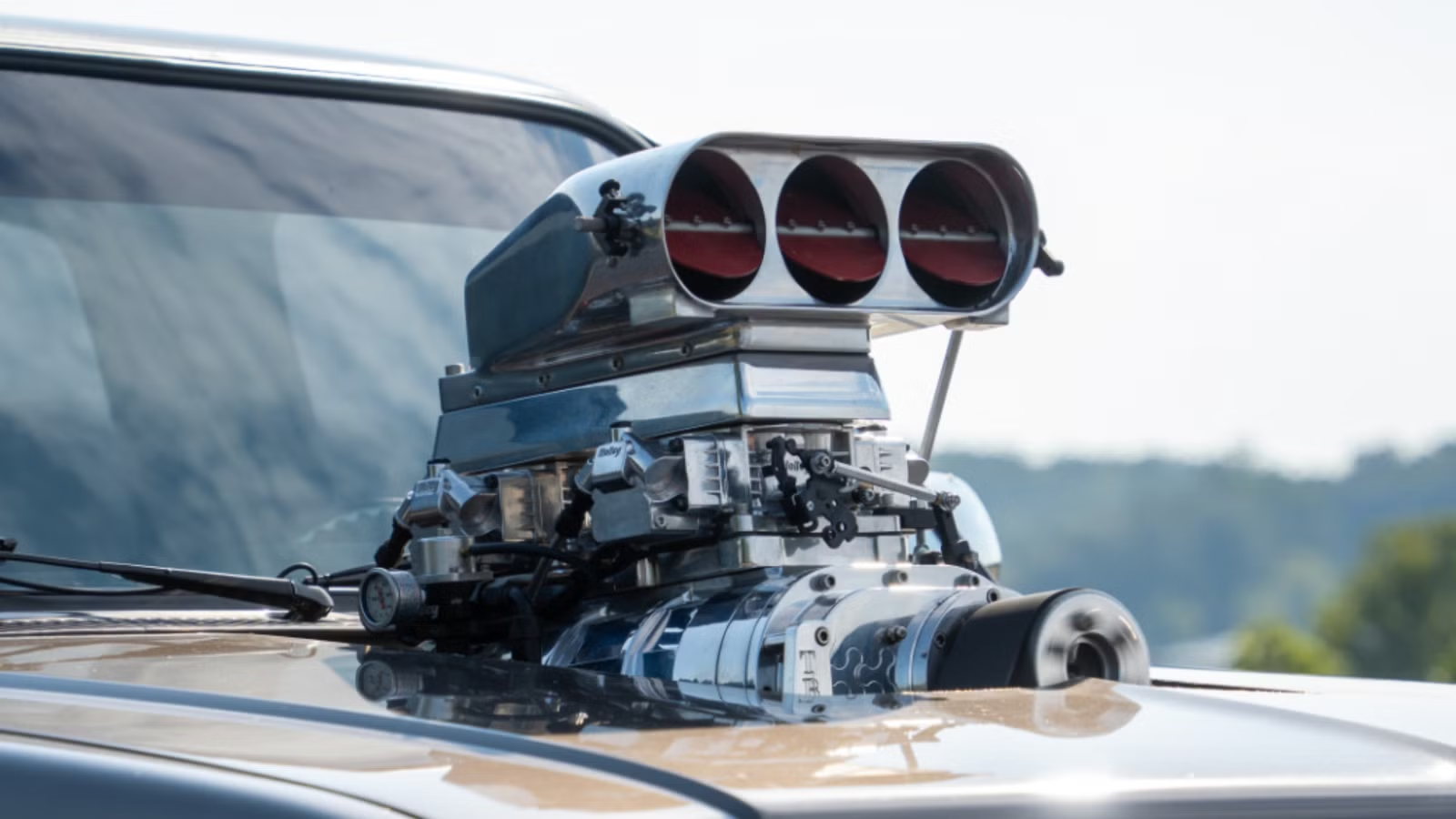
One iconic image spans the hot rods of the 1950s and modern franchises such as The Fast and the Furious. It has come to represent American ingenuity and the supremacy of the infinitely tunable Detroit V8. I’m referring to a huge, shiny supercharger towering far above a car’s hood. The “blower” may be the most iconic muscle car engine upgrade of all time. But this tower of power might never have existed without a pioneering family of two-stroke diesels that seemed to break physics and helped power a World War victory.
Two-Stroke Diesels Had A Breathing Problem

In 1899, engineer Hugo Güldner began developing an unorthodox diesel prototype in Augsburg, Germany. Unlike the four-stroke diesels of its day, his engine aimed to complete its entire cycle every time the crankshaft turned. That promised a power stroke from each cylinder during every revolution. His target was 12 horsepower, the output of an engine nearly twice its size. The only problem was that his engine barely worked.
The prototype was running under its own power by 1900, but produced only about seven horsepower. Its central problem was simple: a four-stroke engine devotes one piston stroke to pushing exhaust out and another to drawing fresh air in. A two-stroke diesel has only an upward compression stroke and a downward power stroke.
Near the bottom of that power stroke, the exhaust outlet opens, and intake ports are uncovered. Fresh air must arrive under pressure, sweep the burned gases from the cylinder, and leave enough clean air behind for the next compression stroke. But unlike carbureted two-stroke gasoline engines, infamous for a wasteful fuel-air scavenging process, fuel is only injected after the ports have closed.

Güldner added a second reciprocating cylinder whose sole job was pumping air through the working cylinder. It proved the basic concept, but the extra hardware undermined the two-stroke’s promised compactness while fuel consumption remained high. He abandoned the project in 1901.
GM Shrunk The Solution With A Compact Air Pump

The two-stroke diesel did not remain a failed experiment for long. A company named Sulzer built a directly reversible two-stroke marine diesel in 1905, and MAN offered single-acting marine two-strokes by 1908. But because size and weight mattered relatively little aboard a ship, these manufacturers could install a separate scavenging pump or even an annular pumping piston beneath each combustion cylinder. Those pumps forced air through the combustion chamber and made the cycle practical. But General Motors knew that improving this system promised to open up entire market segments.
GM acquired the Winton Engine Company and Electro-Motive during 1930, then put research chief Charles Kettering’s organization to work on lightweight diesel power. The resulting Winton 201A combined uniflow scavenging, unit fuel injectors, and a gear-driven Roots-type supercharger. The Roots supercharger was not primarily a horsepower modification. It was the engine’s mechanical lung.

General Motors’ breakthrough was not inventing forced scavenging. It was packaging the idea compactly enough for fast-moving machinery. Production began in 1933, and an eight-cylinder 201A powered the streamlined Burlington Zephyr, completed the following year.
In 1938, GM formed an all-new Diesel Division in Detroit to produce the new Series 71 for construction equipment, military machinery, and standby generators. The Series 71 was not merely a Winton wearing a different badge. It was a new, smaller modular family that applied the same GM formula to a much broader range of jobs and put Detroit Diesel on the map.
Early inline versions included one-, two-, three-, four-, and six-cylinder engines, with V configurations arriving later. The family took its name from its 71 cubic inches of displacement per cylinder, making the original inline 6-71 a 426-cubic-inch diesel. In 1943 alone, Detroit’s 4,300 workers produced 57,892 Series 71 engines. That enormous production run would have side effects no GM engineer could have predicted.
Detroit Diesel Accidentally Created Hot-Rodding’s Wildest Power Upgrade

In 1948, Barney Navarro fitted a war-surplus GMC 3-71 “Jimmy” blower to a 176-cubic-inch Ford flathead V8 in his dry-lakes roadster hot rod. Four V-belts drove the blower. Navarro advertised his speed equipment in the inaugural issue of Hot Rod magazine, then ran 139.75 mph at El Mirage that September.
On the diesel, the blower moved the air required to scavenge the cylinders. On a gasoline V8, racers spun it fast enough to force more air into the intake manifold than the engine could swallow naturally. The resulting pressure, or boost, allowed the engine to burn more fuel and make far more power.

For decades, automotive superchargers had been expensive equipment far beyond the average hot rodder’s budget. Suddenly, tough GMC Roots blowers were plentiful enough for backyard mechanics to experiment with.
Navarro did not invent the automotive supercharger. He helped democratize it. Once racers proved that a surplus diesel air pump could feed a gasoline V8, the hot-rod community knew exactly what to do next.
Junkyard Series 71 Parts Became The Face Of Detroit Muscle

The partnership between Detroit Diesel and America’s shade-tree mechanics lasted far beyond bolting military-surplus blowers onto Ford flatheads. The GMC 6-71 was especially well-suited to the new generation of overhead-valve V8s pouring out of the Motor City. Soon, other aftermarket equipment manufacturers were building their own version of the “6-71.” Within decades, they would push the engineering even further with the “8-71.”
Speed shops cast intake manifolds, machined stronger cases, improved the rotors, and sold complete belt-drive kits. Dragsters, gassers, and eventually Pro Street muscle cars began wearing polished blowers through their hoods like chrome monuments to speed itself. Other superchargers could make power, but none announced it from half a block away. A 6-71 did not merely improve an engine. It changed the car’s entire silhouette: the automotive equivalent of a skull and crossbones.
Then came the 8-71: a bigger, more powerful descendant of the classic Jimmy blower. Aftermarket manufacturers stretched the basic GMC-style architecture to move even more air. Hot Rod traces the 8-71’s development to the 1970s. By that point, the original Detroit Diesel scavenging pump had evolved into something Detroit itself had never built: a purpose-made hot-rod weapon carrying the old “-71” name like a family crest. The 8-71 became a favorite wherever a 6-71 simply was not outrageous enough.

The outlaw modification eventually came home to Detroit. Modern factory muscle cars such as the Dodge Challenger SRT Hellcat, Chevrolet Camaro ZL1, and Ford Mustang Shelby GT500 turned compact, intercooled positive-displacement superchargers into showroom equipment. Their Eaton and IHI-built units are not shrunken 6-71s. Modern rotor profiles, sealing, packaging, and cooling make them quieter and far more efficient. But the family resemblance remains: a belt-driven blower moves fixed pockets of air and delivers boost immediately, rather than waiting for exhaust gases to spin a turbocharger. What once required a junkyard and a cutting torch now arrives with a window sticker and a factory warranty.
That may be why the OG, the GMC 6-71 blower, became more than a speed part. It became shorthand for American horsepower.
The Detroit Icon Powered A War And Survived Until 1995

It is tempting to remember the Series 71 only for the part hot-rodders borrowed from it. But the engine beneath that blower had already lived a heroic life.
Detroit introduced the engine family in 1938, just in time for the largest industrial mobilization in American history. Series 71 engines powered landing craft, generators, and support machinery. Twin 6-71 installations also powered vehicles such as the M4A2 Sherman tank and M10 tank destroyer. The modular design could be adapted to countless jobs, and its compact size made it useful anywhere a massive marine diesel would have been impossible.
When peace returned, the Series 71 simply changed uniforms. It went to work in buses, trucks, fishing boats, construction machinery, and stationary equipment. Generations of mechanics learned its peculiar two-stroke rhythm and unmistakable scream. Eventually, quieter and more efficient four-stroke diesels, along with tightening emissions requirements, made the old design difficult to justify.
Factory manuals and service literature show inline and V-type Series 71 engines still being offered in 1995, 57 years after the engine’s introduction.
GM developed the compact Roots-blown two-stroke to move America into a new diesel age. The engine helped move armies, freight, and industry. Then its surplus parts helped move the hot rod from a backyard hobby into an American legend. The iconic superchargers inspired by this diesel—whether a 6-71 or the bigger, more powerful 8-71—still tower proudly above muscle car hoods today.
Sources: How Stuff Works, DIY Repair Manuals, Hot Rod magazine, Detroit Diesel, Google Patents, The American Hot Rod Foundation

Related posts





Latest Post


No Comments