

Audi’s New Nuvolari Supercar Went From Sketch To Running Prototype In 405 Days — And The Design Boss Had One Non-Negotiable
4 minutes reading
Saturday, 8 Aug 2026 23:00 0 66 autotech
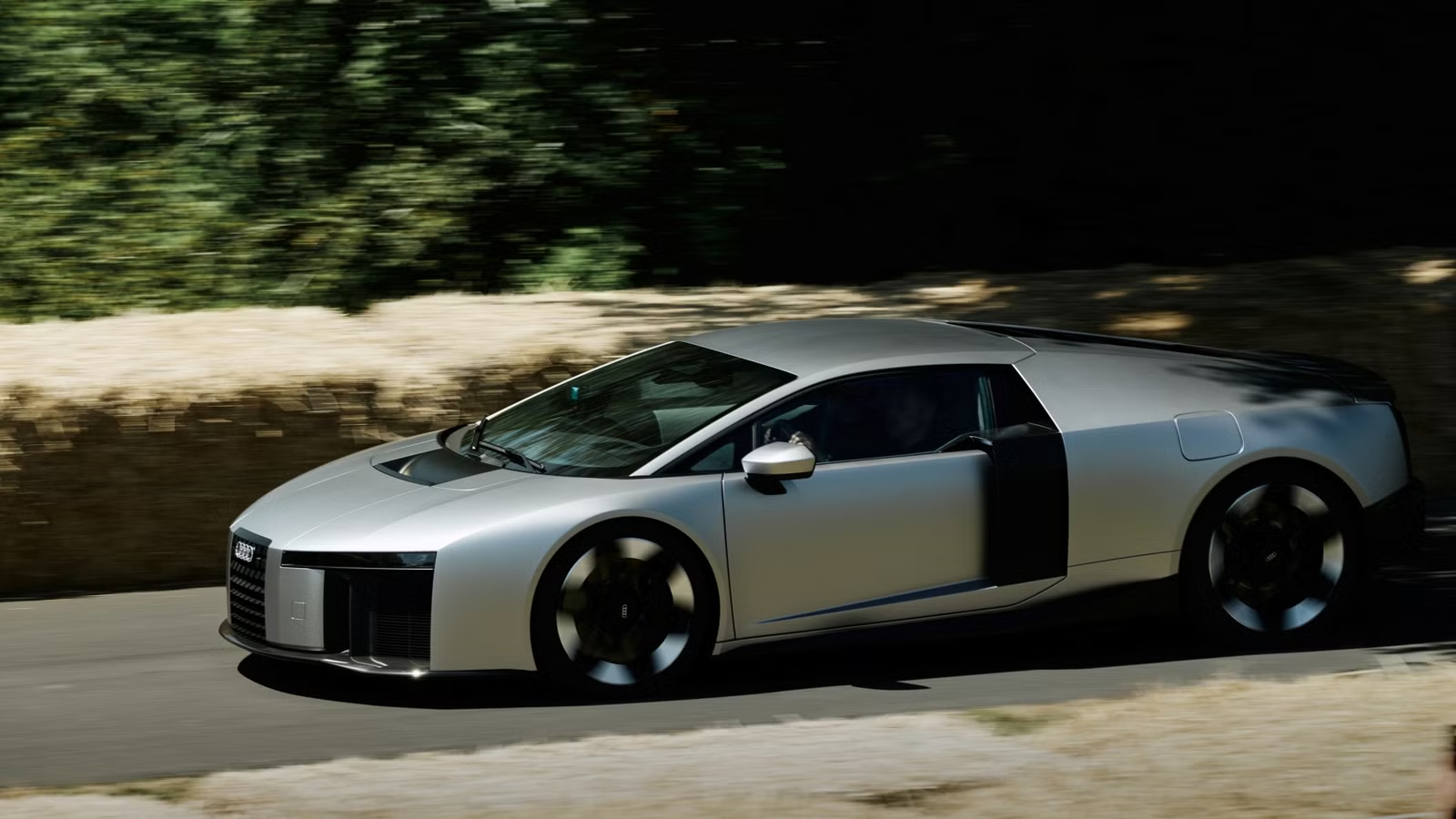
A behind-the-scenes video published by Motor1 on August 6 pulls back the curtain on one of the more remarkable development sprints in recent supercar history: Audi took the Nuvolari from a first sketch to a fully drivable prototype in exactly 405 days. That’s an unusually compressed timeline for a production supercar, and the video makes clear that speed alone wasn’t the story — it was what Chief Creative Officer Massimo Frascella refused to compromise on along the way.

17 autotech
Limited to 499 units and targeting first-half 2027 deliveries, the Nuvolari is Audi’s first production car wearing the brand’s new design language. It’s also the spiritual successor to the R8, built on the same Lamborghini Temerario platform that connects it to Sant’Agata Bolognese — just as the R8 was rooted in the Huracán and Gallardo before it. But the design story is distinctly Audi’s, and it starts with a four-word declaration from the man in charge.
The Rear Wing That Never Was
Early in the Nuvolari’s development, a large rear wing was on the table. Frascella killed it without hesitation. “I don’t know if you can record this,” he says on camera, “but I said: ‘Over my dead body.'” His reasoning was straightforward: a prominent wing would undercut the smooth, composed lines he was chasing for what Head of Concept Development Jürgen Meurle describes as a “gentleman racer.” A big blade sticking off the tail belongs on a track-day machine. The Nuvolari was meant to look like something else entirely.

71 autotech
That conviction shaped the engineering solution that followed. Rather than scrapping downforce altogether, Audi developed an adaptive rear spoiler that sits flush with the body when it isn’t needed — minimizing drag and improving fuel economy on the straights. In low-downforce mode it allows for higher speeds and better stability. Under braking and through corners, it deploys to a high-downforce position to keep the car planted. The result is a car that reads as clean and uncluttered at a glance but works aerodynamically when it matters.
An F1 DRS Button and a 217-MPH Claim

The adaptive spoiler isn’t the only aerodynamic tool in the Nuvolari’s arsenal. Audi fitted a DRS button directly to the steering wheel — a drag reduction system borrowed conceptually from Formula 1 — that the driver can activate manually to flatten the spoiler and chase higher straight-line speeds. Audi says the Nuvolari can exceed 217 mph (350 km/h), which would make it the fastest production car the brand has ever built. That figure is tied directly to the DRS system’s ability to reduce aerodynamic drag on demand, a meaningful payoff for Frascella’s insistence on keeping the bodywork clean.
Cooling Problems and the Evolution of the Design

The 405-day timeline wasn’t without friction. Early sketches show the Nuvolari’s carbon-fiber body with a largely closed rear section — visually tidy, but thermally problematic. The twin-turbocharged 4.0-liter V8 generates significant heat, and the original design didn’t leave enough room for it to escape. Audi’s engineers worked through the problem by adding vent slats to the rear bodywork, improving airflow and keeping temperatures in check under hard use. It’s a small but telling detail: even a design chief with a firm aesthetic vision has to negotiate with physics, and the final car reflects that back-and-forth.
What 405 Days Says About Audi’s New Design Direction
The development program stretched across Europe — cold-weather testing in Lapland, suspension tuning in Spain, high-speed runs at the Nardo Technical Center in Italy, where Formula 1 driver Gabriel Bortoletto tested prototypes alongside Nico Hülkenberg, who worked at Audi’s facility in Neustadt an der Donau. The car was unveiled at the Hotel du Cap-Eden Roc in Antibes ahead of the Monaco Grand Prix. For a program that compressed years of typical development into just over a year, the geographic and logistical scope is striking.
The Nuvolari matters beyond its own 499-unit run because it’s the first production vehicle to carry Audi’s new design language into the real world. A road-going version of the Concept C electric sports car with a retractable targa roof is also due in 2027, but it will be a niche model. The design direction won’t reach volume production until the electric A4 sedan arrives in 2028. That makes the Nuvolari something of a proof of concept — a high-stakes, low-volume test of whether Frascella’s vision holds up under the pressures of a real development program. Based on the 405-day sprint, and the conviction behind it, the answer looks like yes.

Related posts


Latest Post

25 minute ago
3 autotech

No Comments