
1963 Chevy Biscayne L80: The Fleet Car That Beat the GTO

Back in the day, when the Pontiac GTO ruled the streets as the top drag racing option, Chevrolet didn’t mean to accidentally beat it with a sleeper build no one saw coming. The 425-horsepower Chevy car was designed to be an affordable fleet option, not a high-performance race car. But sometimes, as Bob Ross would say, happy accidents make the final product even better.

Suddenly, monster cars like the Pontiac GTO Tri-Power and Ford Fairlane Thunderbolt were getting outraced by a plain-looking fleet car. They were left in the dust. This Chevy gave more expensive, racing-oriented cars a serious run for their money, making it one of the decade’s great surprises.
This historic car is actually credited for contributing to a number of later successful models despite not getting the true respect it deserves. It has unfairly been left out of the record books and carries a modest price compared to its fellow rare Chevy siblings. However, some collectors don’t want its secret to get out, so it continues to be an affordable alternative.
The Pontiac GTO Tri-Power and Ford Fairlane Thunderbolt Ruled The Drag Strips

In the early 1960s, the Pontiac GTO Tri-Power and Ford Fairlane Thunderbolt stood among the fastest drag strip race cars available. The 1964 Pontiac GTO Tri-Power engine is a 389 cubic-inch (6.5-liter) V8 with 348 hp and 428 lb-ft of torque. It can accelerate from 0 to 60 mph in about 6.1 seconds and completes a quarter mile in around 14.1 seconds with a top speed of 132 miles per hour.
Then the 1964 Ford Fairlane Thunderbolt entered the scene with a 427 cubic-inch (7.0-liter) High-Riser FE V8 engine that delivers 425 hp and 480 lb-ft of torque. This muscle car accelerates from 0 to 60 mph in around 4.3 seconds while completing a quarter mile in 11.6 seconds with a top speed of 130 mph.

The GTO is attributed to starting the entire muscle car craze by dropping incredible big-block power in an affordable body. It offers a refined, comfortable ride with bucket seats and an attractive, aggressive style. Meanwhile, the Fairlane Thunderbolt was designed to win the NHRA Super Stock championship with a radical street-legal drag design. They were the top dogs to beat, and Chevy did it by accident.
The Chevrolet Muscle Car Built In Numbers So Low They Barely Exist Today
This budget family sedan packed a 425-hp big block and remains one of the rarest muscle cars ever built.
The Chevy Biscayne Was Built Differently

Instead of being a high-performance race car, the humble 1963 Chevy Biscayne was designed to be a no-frills, entry-level model. It was lightweight and practical as it sat under the luxurious Bel Air and premium Impala in the lineup. The car served as an affordable full-size two-door and four-door option for fleets and families.
The Chevy Biscayne is known for its crisp, squared-off style without many bells and whistles. It didn’t feature exterior chrome accents or brightwork like its more expensive siblings. To keep its price as low as possible, it could be ordered with basic gauges and manual windows to cover the basics and not much else.
The interior includes basic rubber floor mats instead of carpeting, a deep-dish steering wheel, dual sun visors, an ashtray, durable cloth-and-vinyl bench seats, a built-in glove box, and a steel dashboard. Convenience features such as air conditioning, power steering, and brakes were available as expensive factory options.
But The Biscayne L80 Packed Muscle Car Power

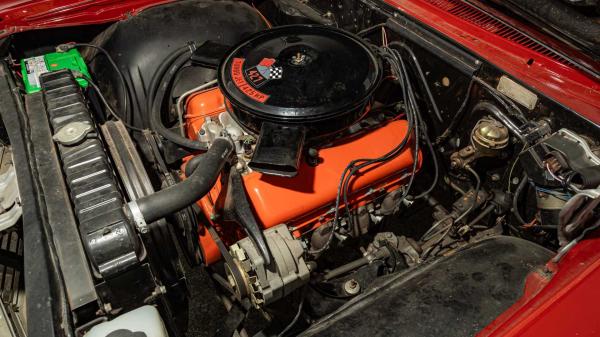
However, the 1963 Chevy Biscayne could be ordered with big-block V8 power. The Chevy Biscayne L80 features a 409 cubic-inch (6.7-liter) Turbo-Fire V8 engine that churns out 425 hp and 425 lb-ft of torque. It can accelerate from 0 to 60 mph in about 5.8 seconds and covers a quarter mile in about 14.6 seconds with a top speed of 130 mph.
Because it lacked chrome trim and was essentially stripped of luxury features, this car weighed about 200 pounds less than its fancier rivals, giving it a significant advantage in straight-line acceleration and an improved power-to-weight ratio. Many spectators watched as it beat the Pontiac GTO in quarter-mile acceleration and at the drag strip.
|
Car |
Engine |
HP |
Torque |
0 to 60 MPH |
|
1963 Chevy Biscayne |
409 ci (6.7-liter) V8 |
425 |
425 LB-FT |
5.8 seconds |
|
1964 Pontiac GTO Tri-Power |
389 ci (6.5-liter) V8 |
348 |
428 LB-FT |
6.1 seconds |
The engine could be paired with a heavy-duty Muncie M20 four-speed manual transmission, a Borg-Warner T-10 four-speed manual transmission, or a two-speed Powerglide automatic transmission. Also, it was fed by dual Carter four-barrel carburetors with an 11.0:11 compression ratio. Non-assisted finned drum brakes came standard and robust coil springs sat in all four corners.
The Biscayne L80 Doesn’t Get The Respect It Deserves

This underrated muscle car sits in the shadows of more popular options such as the Chevy Impala SS. The Biscayne L80 is left out of the record books despite managing to outrace high-performance rivals by accident. Also, it has plenty of historical achievements and innovations to celebrate.
Its design heavily influenced Chevy police cruisers and inspired the development of street-sleeper pursuit vehicles that could outrun high-performance muscle cars on the highway. The stripped-down platform became the preferred choice for fleet buyers seeking inexpensive power.

Police officers also enjoyed the Biscayne L80 because of its durable interior that was easy to clean thanks to vinyl and rubber. The heavy-duty steel wheels and other components are extremely durable and can withstand the high-stress demands of interceptor vehicles. Its raw power was viewed as a tactical necessity, and it continued to influence police interceptors through the mid-1970s.
The Biscayne also jump-started the sleeper, or plain-Jane, muscle car era, defined by putting a race-bred engine into an entry-level, lightweight body. This template was copied by competitors and was adopted by many later muscle cars in the lineup, such as the lightweight and potent Chevelle 300 L79.
The 1963 Biscayne L80 Is Still A Sleeper Car

Unfortunately, General Motors didn’t release official production numbers for the number of cars such as the Impala, Bel Air, or Biscayne built with the L80 V8 engine. However, historians estimate that about 4,400 muscle cars got the L80 engine in 1963. So, it is a bit of a rare find that can be scooped up at an affordable price.
For example, the 1963 Chevy Biscayne L80 has a market value of about $35,000 to over $100,000. Models with the proper setup average between $35,000 and $55,000. Pristine examples with matching numbers or a documented drag racing history fetch between $75,000 and over $100,000.
Meanwhile, the 1963 Chevy Impala SS with the 409 engine can be found for between $43,000 and over $115,000, depending on mileage, documentation, and condition. Despite being able to outrace the Impala SS, the Biscayne L80 is not as popular, due to its basic style and lack of Super Sport package amenities such as bucket seats and distinctive exterior badging.
Source: Hemmings, Classic.com

Related posts



Latest Post


No Comments