
The Four-Door Family Car That Hid A Racing Engine
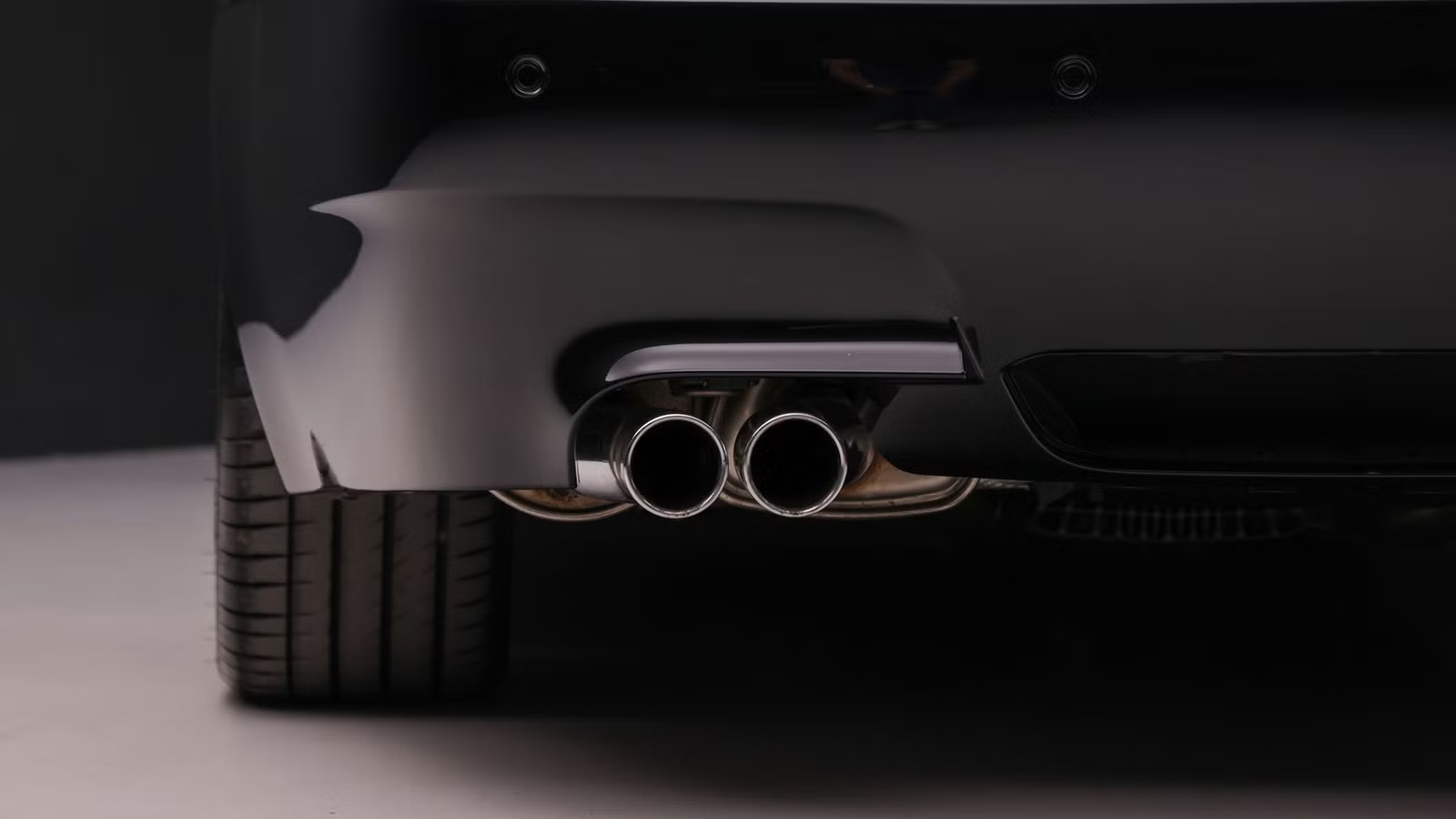
Twenty-one years ago, BMW unveiled a performance sedan that took everyone by surprise. At the time, Mercedes-Benz offered the Mercedes-Benz E55 AMG, fitted with a 5.4-liter supercharged V8 engine (469 bhp), and Audi offered the RS6. The latter, which was only launched in 2007, was fitted with a twin-turbocharged 5.0-liter V10 (572 bhp). The first-generation Cadillac CTS-V offered a 5.7-liter V8 engine (400 bhp).

These were all impressive cars in their own way and offered excellent performance, but BMW was stubborn and wanted to offer something truly unique… and we have never again seen anything quite like it.
The Executive Sedan That Secretly Wanted To Be A Race Car
Whereas most of the competitors were using V8 engines, as was the case with BMW’s outgoing E39 M5, BMW wanted to offer a product that reflected BMW M’s motorsport philosophy at the time.

When development of the E60 M5 began, BMW’s engineers believed that a high-revving, naturally aspirated engine would provide a more emotional and technically advanced experience than simply increasing displacement or adding forced induction. There was another important reason BMW did not choose another V8 engine, but instead something even bigger and more special.
The Formula 1 Connection That Shaped The M5’s Engine

At the time, Formula 1 engines were naturally aspirated units. BMW entered F1 in 2000 and, at the time, the rules dictated that the engine size must be 3.0 liters, with 10 cylinders, and there was no limit on maximum engine speed. From 2000 to 2005, BMW, together with Williams Grand Prix Engineering Ltd, had moderate success, while the BMW engine became known for its extreme rev capability.
Between 2000 and 2005, this relationship paid dividends, as in 2003 they achieved second place in the Constructors’ Championship. The BMW P83 V10 of that year is regarded by many as one of the most powerful F1 engines of that era. Keep in mind that BMW was responsible for engine development, while Williams was responsible for the chassis. By the time the E60 M5 was launched, BMW Motorsport already had several years of V10 racing development behind its name.
A Naturally Aspirated V10 That Screamed To 8,250 RPM

|
Displacement |
Power |
Torque |
|
5.0-Liter |
500 HP |
384 LB-FT |
Formula 1 engines lived at extremely high engine speeds – during this era, BMW’s F1 engine could rev to 19,000 rpm. The S85 engine followed the same philosophy by offering an 8,250 rpm redline, which was an extraordinary engine speed for a luxury family sedan. As was the case with racing engines, the S85 was equipped with individual throttle bodies. This provided a more immediate response between the driver and the engine.
The V10 layout also provided part of the smoothness of a V12 engine while remaining almost as compact as a V8. Furthermore, it offered four valves per cylinder and a compression ratio of 12.0:1. The E60 M5’s 5.0-liter V10 engine was therefore not an F1 engine in disguise, but it was born from the same era of BMW thinking: maximum performance through engineering precision rather than forced induction like its main competitors.
500 BHP Sent Through The Rear Wheels
It is also important to note that this engine (S85B50 to give it its full name) came with a Double VANOS system. This system continuously varied the timing of both the intake and exhaust camshafts. This allowed for a broader usable powerband, better fuel efficiency, as well as allowing for maximum power at high engine speed.
The result was 500 bhp at 7,750 rpm and 384 lb-ft of torque at 6,100 rpm. This really encouraged a driver to use as much of the rev range as possible. The claimed 0-60 mph time was only 4.5 seconds, and the top speed was limited to 155 mph. However, BMW did offer the M Driver’s Package, which basically removed the limiter and let the car run to its full top speed of 190 mph. Some YouTubers have been able to achieve higher speeds than 190 mph, though. Needless to say, for a family sedan, this was truly impressive.
The Gearbox That Could Not Match The Engine’s Brilliance

As was the case with the E46 BMW M3 at the time, the E60 M5 was mainly available with an SMG transmission, called SMG III. Although it was one of the most advanced transmissions at the time, it was also one of the car’s most controversial elements. It was technically a manual gearbox that used an electronically controlled clutch as well as hydraulic actuators that made the shifts possible.
Being a seven-speed transmission, it allowed for shorter lower gears, which improved acceleration, while the higher gears helped keep cruising engine speeds low. However, in the gearbox’s fastest setting and under full acceleration, the racing nature of the drivetrain was evident, as the system was quite aggressive. Owing to pressure from buyers and enthusiasts, BMW finally offered a six-speed manual gearbox option for the North American market for the 2007 model year.
The V10’s Greatest Strength Was Also Its Biggest Weakness

There are a few important maintenance issues to be aware of before taking the plunge on one of these cars. The connecting rod bearings are designed to maintain a thin layer of oil between the crankshaft and connecting rods. Some S85 engines experienced accelerated bearing wear due to tight factory tolerances and the engine’s high-revving nature. If the protective coating wears away, the bearings can develop excessive clearance, potentially leading to a loss of oil pressure and, in severe cases, catastrophic engine failure. Because replacing rod bearings is far cheaper than rebuilding a V10, many owners treat it as preventative maintenance.
The S85 uses ten individual electronic throttle bodies, while two electronic throttle actuators control the throttle butterflies. Over time, internal gears and electronic components can wear. Finally, the S85 uses high-pressure hydraulic VANOS units, and failures can involve solenoids, seals, pressure accumulators, or the VANOS pump. Overall, regular maintenance is of the utmost importance with this engine.
The Luxury Sedan That Could Cross Continents At Supercar Speed

Offering 500 bhp and 384 lb-ft of torque, a seven-speed transmission, and a luxurious cabin, the M5 was capable of crossing states and countries at speed. Like any other 5 Series BMW, it had all the necessary luxury and comfort features you would expect, with even more equipment owing to the fact that it was the top-of-the-range model.
It offered, for example, iDrive, Bluetooth connectivity, voice control, and adaptive headlights. There was enough space in the rear for adults, while the trunk offered enough luggage space for long-distance travel.
Why BMW’s V10 M5 Will Never Be Repeated

The E60 BMW M5, whether in a sedan or Touring version, offered the rare combination of being one part high-performance car and one part luxurious family sedan. Since production of the E60 ended, its successors have all been turbocharged V8 models, while the latest version is a hybrid.
It is clear that a high-revving, naturally aspirated V10 engine is unlikely to ever find its way back into the nose of a BMW M5, leaving the E60 as one of the pinnacle cars in BMW M’s heritage.
Sources: BMW M, Carfolio

Related posts


Latest Post


No Comments