
The Forgotten Ugly Nissan That Was More Expensive Than The GT-R
What if we told you the Skyline GT-R wasn’t the absolute apex of the Nissan lineup in the late 1980s? What if we told you there was an altogether different sports coupe from an obscure Nissan sub-brand that did whatever the ’80s equivalent of one-upmanship was on the entire Skyline lineage while being significantly more expensive? It sounds utterly ridiculous, like something an AI LLM made up in a state of complete hallucination. Make no mistake though, it was all too real.

In the mid-to-late 1980s, it was thought the Japanese economy would never slow down. Money was flowing through Tokyo like water from just about everywhere, be it electronics, music, anime, aerospace, and, of course, the automotive sector. There, Nissan was riding high on a wave of immense corporate hubris, funneling massive piles of cash into bespoke engineering projects just to see what would stick to the wall.
Among the highlights, there was the famous Pike factory lineup of retro cars like the Figaro and the Pao, which predated the equivalent American trend by a decade. There was also the MID4 supercar concept that teased a mid-engine future that ultimately never came for Nissan, as well as the mighty R32 Skyline GT-R, one of the most advanced automobiles ever made to that point.

During these years, Nissan was essentially printing money, and their executives were desperate to prove they could compete with the absolute highest echelons of European luxury. That’s right, for a hot second in the ‘80s, and right as the Infiniti brand was launching in America, Nissan tried to be BMW. This era of limitless ambition and equal budgets birthed some of the most technologically advanced sports cars the world had ever seen, but it also created a massive blind spot for basic common sense.

A Downright Weird Italian Partnership

Considering that Nissan figured the gravy train really would never stop in the late ‘80s, why not link up with a historic Italian automotive designer and see what the heck the two could come up with? You know, just for the fun of it. At least, that was the logic when Nissan dispatched their internal tuning and special vehicles division, Autech, across the globe to partner with the legendary Italian coachbuilder Zagato.
At the time, Zagato was deep in the midst of helping Alfa Romeo design the RZ, using CAD software for one of the very first times in history. They’d also wrapped up helping Aston Martin build the highly exclusive V8 Zagato a couple of years prior. So to speak, this was an Italian design firm at peak styling weirdness, and it lined up perfectly with Autech showing up at the front door.

You would naturally assume that pairing disciplined Japanese mechanical engineering with wildly eccentric Italian styling cues would result in a stunningly beautiful masterpiece. Instead, the end results looked genuinely strange, and not in a way that everyone would call attractive. Then again, it was still peak .com bubble intrigue.
Enter the Autech Zagato Stelvio AZ-1: Weird Even by Japanese Standards

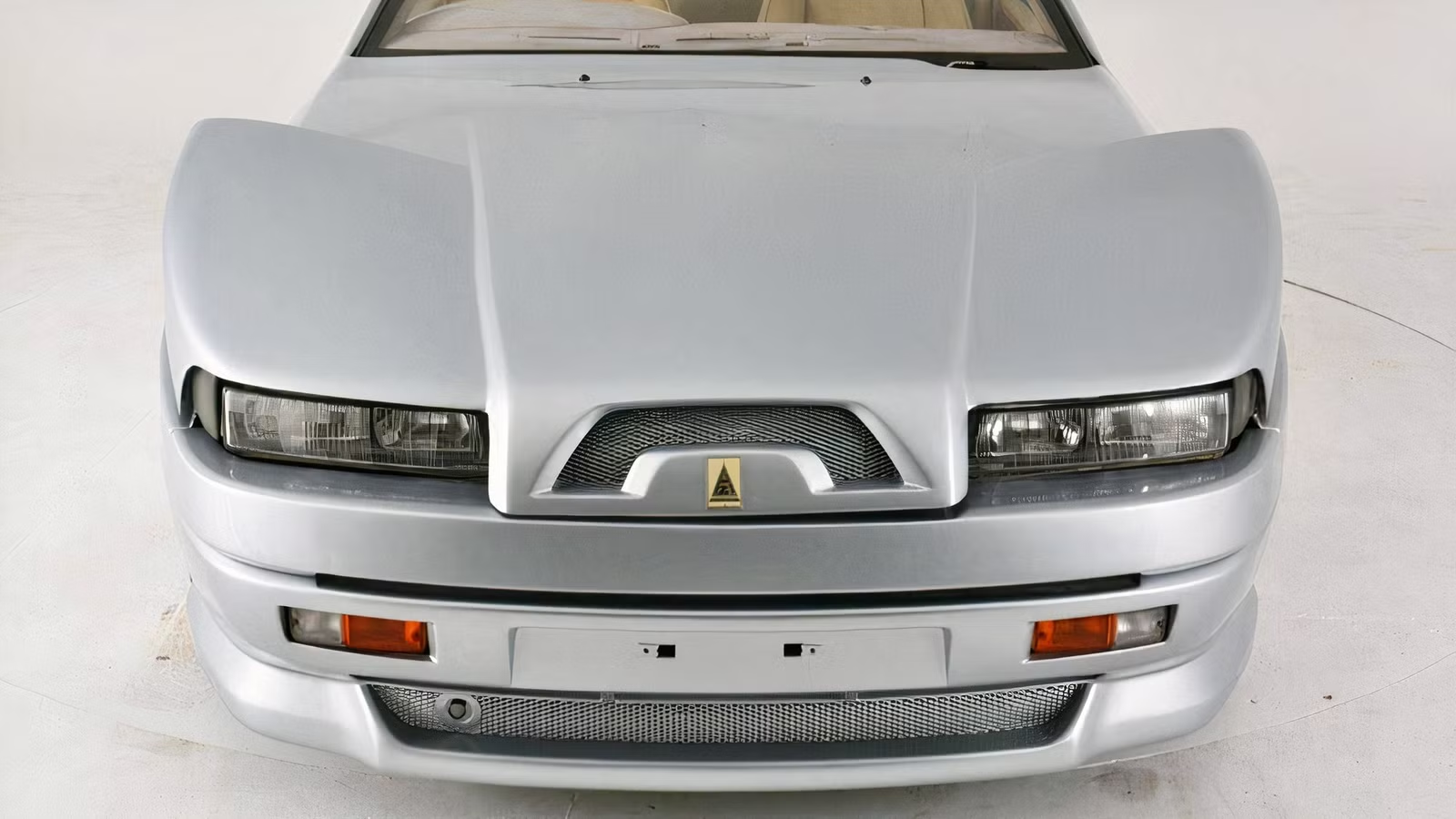
What Autech and Zagato actually cooked up was the Autech Zagato Stelvio AZ1. At first glance, it looks less like a high-end grand tourer and more like a Blade Runner prop that never finished rendering in CAD. The bespoke aluminum bodywork was incredibly bold, completely abandoning the sleek, understated lines of the donor Nissan Leopard for a brutalist wedge-shaped profile that aggressively assaulted the eyes.
In America, that same Leopard platform would form the basis for the deeply unexciting Infiniti M30. One is yin, and the other is yang, but at least it is fair to say the Zagato Stelvio AZ1 was memorable in a way the M30 was not. Under the hood sat a heavily tuned version of Nissan’s 3.0-liter turbocharged VG30DET V6 pushing out 280 hp and 296 lb-ft of torque to the rear wheels only.

A capable engine, to be sure, but the powertrain was clearly secondary to the visual cues Autech and Zagato worked into every nook and cranny of this car. Instead of mounting the side mirrors on the doors like rational engineers, Zagato decided to integrate massive, bulbous mirror housings molded directly into the front fenders. Imagine a late ‘60s Pontiac hood-mounted tachometer, just more ridiculous, and then you’ll get the idea. Of course, it all came at a price.
Absurd Cost, Crazy Looks, A Product of the Time

When the Stelvio AZ1 finally hit the Japanese market, it carried a staggering retail price that easily doubled the cost of a brand new, technically superior R32 Skyline GT-R. We’re talking 18 million yen, which equated to roughly $130,000 back then, or well over $300,000 in today’s money. In short, you could’ve bought a brand new Ferrari Testarossa, or even a Lamborghini Countach 5000 QV if you were a shrewd enough negotiator.
Perhaps it would be harsh to say Autech was completely out of touch if they thought the Stelvio AZ1 was worth anywhere near that kind of money. But then again, they were operating in a financial reality where rational thinking had stopped working sometime in the mid-’80s. Of course, the Japanese economic bubble did wind up popping in the end.

Well, more appropriately, it sort of just deflated into absolute nothingness, instantly vaporizing the limitless wealth that justified the existence of the Stelvio in the first place. As a result, production was halted after only roughly 100 units were built. Today, the Stelvio AZ1 remains a completely forgotten artifact of corporate arrogance. To prove the point, when one wound up being shipped to the US and sold on Cars & Bids back in 2020, it fetched just $25,000.
Source: Cars & Bids

Related posts


Latest Post


The Forgotten Ugly Nissan That Was More Expensive Than The GT-R
What if we told you the Skyline GT-R wasn’t the absolute apex of the Nissan lineup in the late 1980s? What if we told you there was an altogether different sports coupe from an obscure Nissan sub-brand that did whatever the ’80s equivalent of one-upmanship was on the entire Skyline lineage while being significantly more expensive? It sounds utterly ridiculous, like something an AI LLM made up in a state of complete hallucination. Make no mistake though, it was all too real.

In the mid-to-late 1980s, it was thought the Japanese economy would never slow down. Money was flowing through Tokyo like water from just about everywhere, be it electronics, music, anime, aerospace, and, of course, the automotive sector. There, Nissan was riding high on a wave of immense corporate hubris, funneling massive piles of cash into bespoke engineering projects just to see what would stick to the wall.
Among the highlights, there was the famous Pike factory lineup of retro cars like the Figaro and the Pao, which predated the equivalent American trend by a decade. There was also the MID4 supercar concept that teased a mid-engine future that ultimately never came for Nissan, as well as the mighty R32 Skyline GT-R, one of the most advanced automobiles ever made to that point.
During these years, Nissan was essentially printing money, and their executives were desperate to prove they could compete with the absolute highest echelons of European luxury. That’s right, for a hot second in the ‘80s, and right as the Infiniti brand was launching in America, Nissan tried to be BMW. This era of limitless ambition and equal budgets birthed some of the most technologically advanced sports cars the world had ever seen, but it also created a massive blind spot for basic common sense.

A Downright Weird Italian Partnership
Considering that Nissan figured the gravy train really would never stop in the late ‘80s, why not link up with a historic Italian automotive designer and see what the heck the two could come up with? You know, just for the fun of it. At least, that was the logic when Nissan dispatched their internal tuning and special vehicles division, Autech, across the globe to partner with the legendary Italian coachbuilder Zagato.
At the time, Zagato was deep in the midst of helping Alfa Romeo design the RZ, using CAD software for one of the very first times in history. They’d also wrapped up helping Aston Martin build the highly exclusive V8 Zagato a couple of years prior. So to speak, this was an Italian design firm at peak styling weirdness, and it lined up perfectly with Autech showing up at the front door.
You would naturally assume that pairing disciplined Japanese mechanical engineering with wildly eccentric Italian styling cues would result in a stunningly beautiful masterpiece. Instead, the end results looked genuinely strange, and not in a way that everyone would call attractive. Then again, it was still peak .com bubble intrigue.
Enter the Autech Zagato Stelvio AZ-1: Weird Even by Japanese Standards
What Autech and Zagato actually cooked up was the Autech Zagato Stelvio AZ1. At first glance, it looks less like a high-end grand tourer and more like a Blade Runner prop that never finished rendering in CAD. The bespoke aluminum bodywork was incredibly bold, completely abandoning the sleek, understated lines of the donor Nissan Leopard for a brutalist wedge-shaped profile that aggressively assaulted the eyes.
In America, that same Leopard platform would form the basis for the deeply unexciting Infiniti M30. One is yin, and the other is yang, but at least it is fair to say the Zagato Stelvio AZ1 was memorable in a way the M30 was not. Under the hood sat a heavily tuned version of Nissan’s 3.0-liter turbocharged VG30DET V6 pushing out 280 hp and 296 lb-ft of torque to the rear wheels only.
A capable engine, to be sure, but the powertrain was clearly secondary to the visual cues Autech and Zagato worked into every nook and cranny of this car. Instead of mounting the side mirrors on the doors like rational engineers, Zagato decided to integrate massive, bulbous mirror housings molded directly into the front fenders. Imagine a late ‘60s Pontiac hood-mounted tachometer, just more ridiculous, and then you’ll get the idea. Of course, it all came at a price.
Absurd Cost, Crazy Looks, A Product of the Time
When the Stelvio AZ1 finally hit the Japanese market, it carried a staggering retail price that easily doubled the cost of a brand new, technically superior R32 Skyline GT-R. We’re talking 18 million yen, which equated to roughly $130,000 back then, or well over $300,000 in today’s money. In short, you could’ve bought a brand new Ferrari Testarossa, or even a Lamborghini Countach 5000 QV if you were a shrewd enough negotiator.
Perhaps it would be harsh to say Autech was completely out of touch if they thought the Stelvio AZ1 was worth anywhere near that kind of money. But then again, they were operating in a financial reality where rational thinking had stopped working sometime in the mid-’80s. Of course, the Japanese economic bubble did wind up popping in the end.
Well, more appropriately, it sort of just deflated into absolute nothingness, instantly vaporizing the limitless wealth that justified the existence of the Stelvio in the first place. As a result, production was halted after only roughly 100 units were built. Today, the Stelvio AZ1 remains a completely forgotten artifact of corporate arrogance. To prove the point, when one wound up being shipped to the US and sold on Cars & Bids back in 2020, it fetched just $25,000.
Source: Cars & Bids


No Comments