
2027 Honda CBR1000RR-R Fireblade SP First Look: Racing Roots
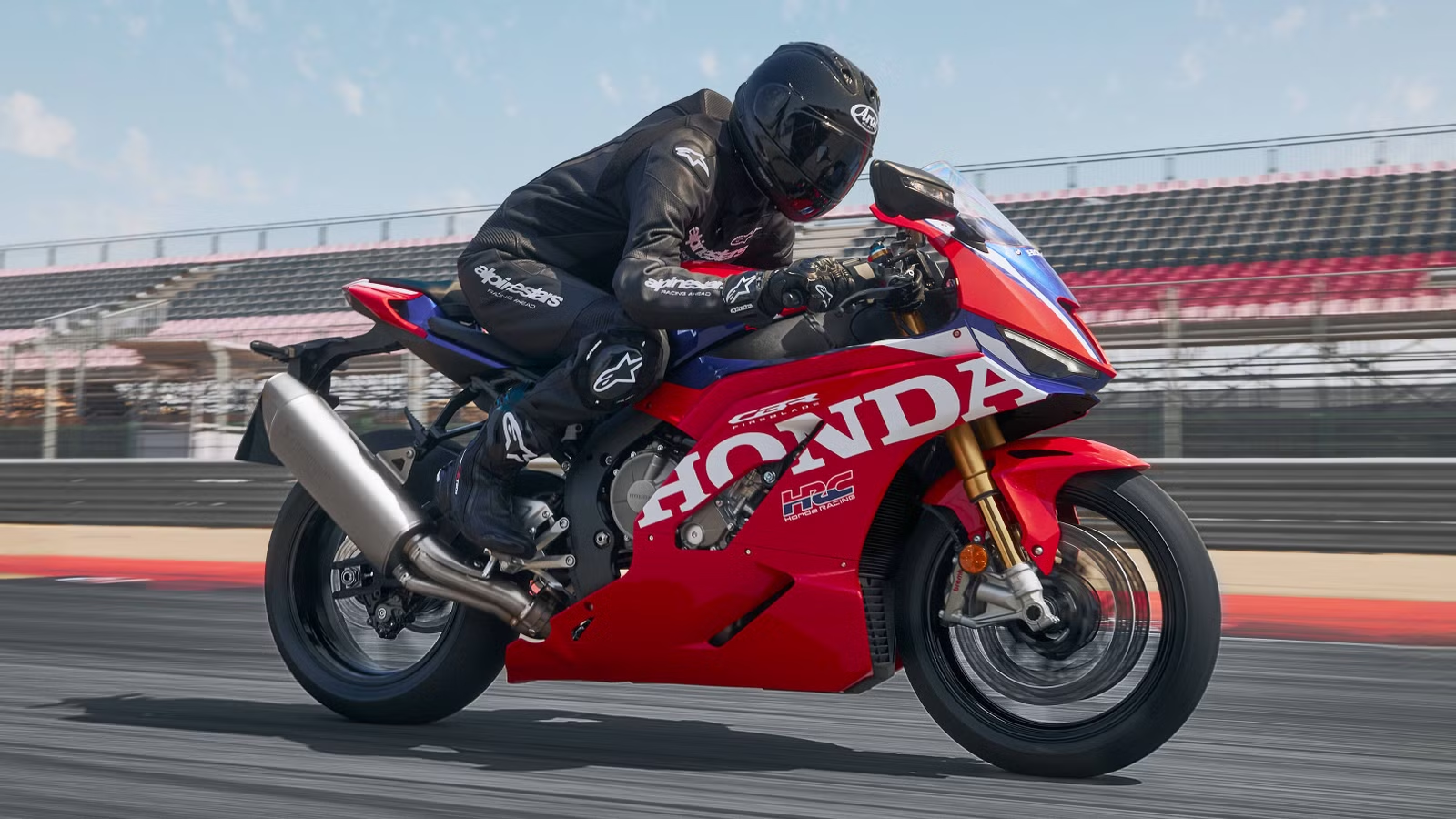
Honda used to maintain a street-first mentality with its CBR superbikes: less aggressive engine character, more relaxed ergonomics, and a gentler overall approach. Well, all that went out the window when the CBR1000RR-R Fireblade SP was introduced in 2020, designed with World Superbike glory in mind. Big Red is still hunting for success on the world stage and has unveiled its latest-generation superbike in Europe, the 2027 Honda CBR1000RR-R Fireblade SP, featuring direct input from the HRC World Superbike team. What’s new? Well, there’s quite a lot. The 2027 CBR1000RR-R Fireblade SP has an all-new frame and swingarm, revised geometry, a thoroughly reworked 1,000cc inline-four-cylinder engine, and now features a fairing that sheds its winglets without giving up downforce.
The new Fireblade is part of a three-bike lineup announced in the European market, which includes a base model, the up-spec SP, and the even higher-spec HRC Works Edition that’s destined for racetracks worldwide as its new homologation special. American Honda has not confirmed any of the updated Fireblades for the U.S. market currently, and we’ll update this story accordingly if any of these models are confirmed Stateside. For now, let’s dive into the Fireblade SP, as American Honda brings that machine into the country. We’ll be giving the HRC Works Edition its own coverage shortly.
Engine: Still A Screamer

The CBR1000RR-R Fireblade platform is still powered by a 1,000cc inline-four-cylinder engine, producing the same claimed 214.6 horsepower at 14,000 rpm and 84.1 lb-ft of torque at 10,500 rpm performance figures as last year. The short-stroke engine architecture is still in play with an 81mm bore and 48.5mm stroke, yet where Honda UK says it’s made big strides is with greater midrange power delivery and rideability, while also reducing weight. Those peak numbers are guaranteed to be lower in the United States, where EPA noise compliance rules have caused manufacturers to use hindered ECU tunings for some time now.

The key addition is a two-stage Variable Air Funnel system, said to be a first for a Honda mass-production motorcycle. The intake funnels maintain an elongated position below 11,750 rpm to boost midrange performance. At high rpm, the funnels adjust to a shortened length in order to increase air velocity and maintain equal top-end performance. This system works in conjunction with the split 2-motor throttle bodies that were added during the last major Fireblade update in 2024 (2025 United States), to help smooth low-rpm power delivery.

Other internal changes include a new piston crown and combustion chamber design, increasing compression from 13.6:1 to 13.8:1. The cam timing is also revised, featuring a new cam sprocket that widens the range of timing adjustments, and the valve train has been strengthened for durability. Digging deeper into the bottom end of the engine, Honda says that the gap between the transmission’s mainshaft and countershaft grows 3mm to 68mm, opening up more gear ratio options for racers, and first gear is 5 percent taller. While most owners would never mess with internal gearbox ratios, it does speak to where Honda’s mind is at with respect to its racing endeavors.
In terms of weight savings, the ’Blade uses magnesium for the cylinder head cover, right crankcase cover, clutch cover, ACG cover, and oil pan, while 35 aluminum bolts replace steel ones. All told, the changes save 2.4 pounds, not including the lighter crankcases. A lightweight titanium Akrapovič muffler remains standard. Honda notes that altering valve timing or gear ratios is not permitted for road use and affects the warranty.
Chassis: Twin-Spar, As Is Tradition

One peek at the frame and swingarm, and it’s obvious that sweeping changes are afoot. Honda is seeking more feedback from its die-cast aluminum, reducing lateral stiffness by 20 percent when compared to the outgoing generation, allowing more feel when on the edge of the tire. For reference, Ducati made a similar change with its 2027 Panigale V4 and V4 S. Other notable tweaks include the engine hanger being a bolt-on fixture as opposed to a frame-integrated mount. Meanwhile, the linkage-type shock runs from the swingarm directly to the engine, instead of the frame.
That brings us to the new 1.2mm-shorter pressed-aluminum swingarm, following a similar strategy by reducing lateral rigidity by 12 percent, according to Honda. The brand also says it’s 200 grams lighter. What hasn’t changed is the torsional rigidity to match the frame. The pivot-point bolt is narrower in diameter, again, likely to encourage different flex properties while cornering.

Geometry is updated fairly significantly. Wheelbase grows 5mm to 57.1 inches (1,450mm), rake tightens from 24.1 to 24.0 degrees, and trail drops from 101.9mm to 101mm (4.0 inches). Those tweaks help shift distribution further toward the Fireblade’s nose, with a 53.3/46.7 weight distribution. Naturally, the crankshaft centerline rises 5.2mm, with what we assume is also a steeper swingarm angle. These updates have also raised the bike, as the seat height grows half an inch to 33.2 inches. Honda says that lifting the ’Blade and raising its center of gravity helps during direction changes, though riders with short inseam lengths might find it challenging.
The chassis also sees a handful of weight-savings initiatives. As mentioned before, the swingarm is 200 grams lighter, though moving to a lighter 520 chain shaves off another 270 grams, while the new seven-spoke hollow cast-aluminum wheels shed 190 grams up front and 590 grams at the rear. Honda lists the European-spec curb weight at 443 pounds.
Suspension and Brakes: A Swedish and Italian Pairing

Honda’s SP-badged superbike was the first to debut Öhlins Smart EC 3.0 semi-active suspension, with spool-valve internals. The 43mm NPX fork is held in place by SP-specific forged aluminum triple clamps, and is paired with a TTX36 shock. Per the usual, riders can adjust all damping settings via the dash, using the Öhlins Objective Based Tuning Interface (OBTi), which allows users to make suspension damping adjustments with terms like “braking support, acceleration support,” and other user-friendly terms to help riders understand their suspension changes. However, riders can still switch to a fixed-rate damping mode that uses conventional terminology such as compression and rebound damping. Preload is still set by hand, though a preload guide in the TFT provides suggested settings based on rider weight.
Brembo Stylema calipers give way to Brembo Hypure four-piston radial-mount units, paired with a new Brembo master cylinder and lever. Honda says the change is about consistent performance as temperatures climb during sustained track riding. The 330mm front discs are lighter, with a 4.5mm thickness.
Aerodynamics and Bodywork: A Sleek New Look

The most visible change is up front. The base model’s (we likely won’t get that here) and SP’s redesigned fairing drops the previous model’s winglets, yet Honda claims it produces the same downforce while reducing drag and improving wind protection. A layered midsection fairing and new sidepods on the lower cowl are responsible for keeping the same downforce figures. The sidepods generate an aerodynamic effect at lean, an idea pulled directly from MotoGP. The frontal area grows to give the rider more room to move. Honda says shaping offsets the efficiency cost, though it has published no drag figures.
The new LED headlight is, and read this again, quite literally designed to be removed as a single unit for racing preparation. The titanium fuel tank loses its plastic cover, saving 3.1 pounds (1.4kg) while holding 4.4 gallons (16.6 liters). The SP’s tank wears only clear coat over the brushed metal. A 5-inch TFT run by a four-way switch and SMART Key round out the equipment.
Electronics: Fully Adjustable

A six-axis Bosch IMU manages every system, starting with three fully customizable riding modes that allow riders to adjust power (five levels), engine braking (three), wheelie control (three, plus off), cornering ABS (three), and traction control (nine). Cornering ABS offers three settings: Standard, Track, and Race. Track doesn’t suppress rear-wheel lift during hard braking, and Race removes rear ABS entirely. An electronic steering damper is standard.
Availability: We’re Waiting

Honda has not released pricing, and again, American Honda has not confirmed the model for our market. In Europe, the SP comes in Ignition Red or Mat Ballistic Black Metallic. As always, we’ll update this story when pricing and availability information becomes available. For more EICMA coverage, keep your browsers open to TopSpeed.
2027 Honda CBR1000RR-R Fireblade SP Fire Look Photo Gallery:
2027 Honda CBR1000RR-R Fireblade SP Specifications:
Engine:
|
Type |
Inline 4-cylinder |
|
Displacement |
1000cc |
|
Bore x stroke |
81mm x 48.5mm |
|
Maximum horsepower |
214.6 horsepower at 14,000 rpm, claimed (European spec) |
|
Maximum torque |
84.1 lb-ft at 10,500 rpm, claimed (European spec) |
|
Compression ratio |
13.8:1 (up from 13.6:1) |
|
Valvetrain |
DOHC semi-cam gear train w/ finger-follower rocker arms; 4 valves per cylinder; 32.5mm intake valves, 28.5mm exhaust valves; 9-degree intake valve angle; revised cam timing and cam sprocket w/ expanded timing adjustment range (not permitted for road use) |
|
Fueling |
PGM-FI electronic fuel injection w/ 2-Motor Throttle By Wire, 52mm throttle bodies, ram-air intake through headstock; 2-stage Variable Air Funnels (long below 11,750 rpm, short above). Octane requirement Not Provided By Manufacturer |
|
Exhaust |
Four oval-section downpipes to titanium Akrapovič muffler. |
|
Cooling |
Liquid, w/ bottom-bypass cylinder cooling |
|
Transmission |
6-speed manual w/ quickshifter; first gear 5 percent taller; mainshaft-to-countershaft spacing 68mm (up 3mm) for wider ratio options |
|
Clutch |
Wet multiplate w/ assist and slipper function. |
|
Final drive |
Chain |
Chassis:
|
Frame |
Diamond twin-spar aluminum frame and swingarm |
|
Front suspension; travel |
Semi-active Öhlins 43mm NPX Smart EC 3.0 (SV) spool-valve inverted fork, electronic damping via Öhlins Objective Based Tuning Interface (OBTi), manual spring preload; forged aluminum triple clamps; 4.9 inches (125mm travel; Honda lists 90mm stroke) |
|
Rear suspension; travel |
Semi-active Öhlins TTX36 Smart EC 3.0 (SV) spool-valve monoshock w/ Pro-Link linkage, electronic damping via OBTi, manual spring preload; Honda lists 126mm stroke; 5.6 inches (143mm travel) |
|
Wheels |
Cast aluminum, seven-spoke hollow gravity die-cast |
|
Front wheel |
17 x 3.50 |
|
Rear wheel |
17 x 6.00 |
|
Tires |
Bridgestone Battlax Racing Street RS12 or Michelin Power GP2, radial ZR-rated |
|
Front tire |
120/70-ZR17 |
|
Rear tire |
200/55-ZR17 |
|
Front brake |
Dual 330mm x 4.5mm discs w/ Brembo Hypure radial-mount 4-piston calipers; new Brembo master cylinder and lever |
|
Rear brake |
220mm disc w/ Brembo 2-piston caliper (axial mount) |
|
ABS |
Standard; IMU-based cornering ABS w/ Standard, Track and Race modes; rear ABS disabled in Race mode; rear lift control (not suppressed in Track mode) |
|
Electronic rider aids |
Throttle-by-wire (2-Motor TBW); Bosch 6-axis IMU; 3 default ride modes (Race, Road, Rain) w/ adjustable 5-level Power, 3-level Engine Brake, 9-level Honda Selectable Torque Control (HSTC), 3-level Wheelie Control plus off; 4-level Start Mode (6,000, 7,000, 8,000, 9,000 rpm); 3-level HESD; quickshifter; rear lift control; Emergency Stop Signal; Öhlins OBTi w/ 3 rider-defined suspension modes and TFT preload guide; 5-inch TFT w/ four-way switch; SMART Key. |
Dimensions & Capacities:
|
Wheelbase |
57.1 inches (1450mm) |
|
Rake |
24.0 degrees |
|
Trail |
4.0 inches (101mm) |
|
Seat height |
33.2 inches (843mm) |
|
Ground clearance |
5.1 inches (130mm) |
|
Fuel capacity |
4.4 gallons (16.6 liters) |
|
Estimated fuel consumption |
35.1 mpg (US; WMTC, 6.7 L/100km), claimed (European spec) |
|
Curb weight |
443 pounds (201 kg) |
Price & Warranty:
|
Website |
powersports.honda.com |
|
Price |
TBA |
|
Warranty |
TBA |
|
Service interval |
TBA |
|
Color |
Ignition Red, Mat Ballistic Black Metallic (Europe) |
Source: Honda

Related posts

Latest Post


No Comments