
The Homologation Failure That Created The Most Violent Street Car Of The 1960s
As car enthusiasts, we all love homologation specials. The development of a homologation special has resulted in some of the coolest cars ever. Usually, they succeed in getting onto the racetrack. But, this particular homologation special didn’t. It’s part of the lineage of one of the most famous sports cars in history, and it’s had such an impact that original examples are some of the most valuable cars in the world. It’s also an example of the best of what can happen when two countries from across the Atlantic decide to work together.
AC Formed An Unlikely Transatlantic Partnership With Carroll Shelby

Around the early-1960s, AC Cars was doing fairly well producing good quality sports cars. One of those was the Ace, a small and quintessentially British sporting model with an inline-6 engine. While the Ace was a good car, it wasn’t going to set the world on fire. That is until American automotive legend Carroll Shelby wanted to get involved with it. In 1961, Shelby approached AC’s owner Charles Hurlock and proposed installing a Ford V8 in the Ace. Hurlock agreed, and an initial prototype was made that used a 221 cubic inch Ford small-block V8. This was known as the AC Ace 3.6. After some initial testing, this car was taken to the USA with its engine removed and the 289 cubic inch version of the V8 was installed in its place. This became the first ‘proper’ Cobra.
This first version of the Cobra with the 289 cubic inch engine immediately became a hit with enthusiasts. The combination of American V8 power and British sports car styling and dynamics turned out to be incredible. It made for a road car that was a bit difficult to handle, but the trade-off was a kind of performance that was unheard of back then. In fact, the Cobra was so good, that the original car it was based on ended up being phased out a year after the Cobra was introduced!
Carroll Shelby Wanted To Take The Shelby Cobra Racing


Despite how great the original Cobra turned out to be, just turning a quintessential British sports car into a fire-breathing V8 speed demon wasn’t enough for Carroll Shelby. He wanted to take this car racing. As Shelby was very much a racing man, that’s not surprising at all. But, his method of getting the Cobra competitive for the racetrack was downright insane even for him. He wanted a Cobra that was much more powerful, and much more uncompromising. The result of that is one of the Cobra’s most famous and most desirable variants.
The AC Cobra 427 S/C Is A Homologation Failure That Became One Of The Most Brutal Street Cars Ever

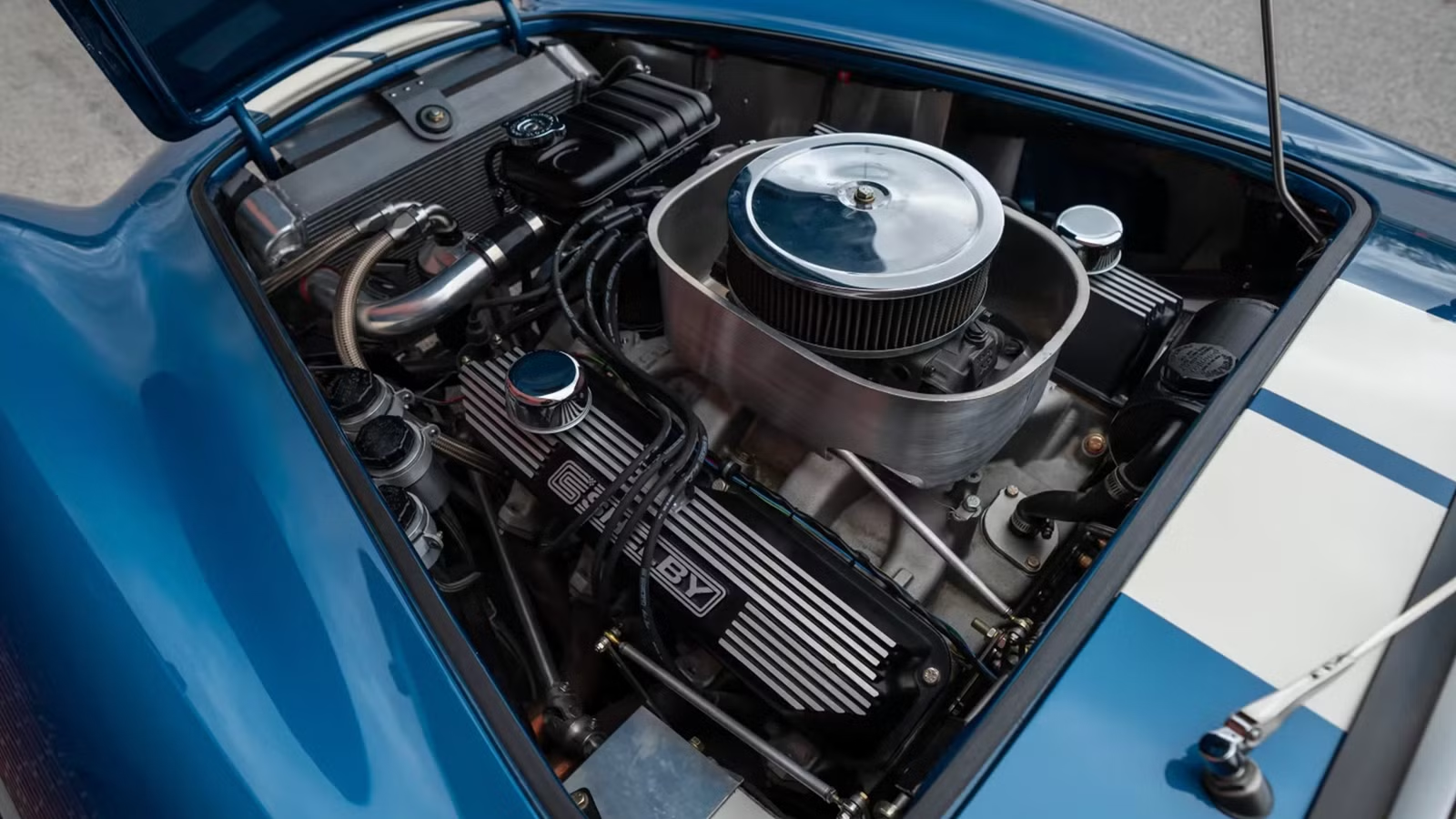
If you ever picture a Shelby Cobra in your head, the one you’re likely going to think of is the 427 S/C. This is one of the most powerful and most distinctive versions of the Cobra. Carroll Shelby completely threw away the original 289 V8, choosing to source another crazier motor from Ford. The one he chose was the 427 cubic inch “side-oiler” V8 that was originally designed to be used in NASCAR and was also used in the Ford GT40. This massive engine produces 485 horsepower in the Shelby Cobra 427 S/C – a quite frankly ludicrous amount of power for a car that weighs around 2,350 lbs! This was significantly more powerful than the 425 horsepower the regular Cobra 427 (which used the same Mark III chassis) produced.
All that extra power meant some seriously incredible performance. The regular Cobra 427 could go from 0-60 mph in just 4.3 seconds, and run a 1/4 mile of 12.2 seconds at 118 mph. Those are impressive by today’s standards, let alone the standards of the mid-1960s.
It Needed A Completely Redesigned Chassis To Fit The 427 Cubic Inch Engine
To fit such a huge engine into the tiny AC Cobra chassis, Carroll Shelby needed to have some serious modifications done to it. This is the whole reason why that Mark III chassis exists. It’s a total redesign from the original AC Ace chassis that Carroll Shelby used to build the initial Cobras with the 289 cubic inch engine. This redesign was done with help from Ford engineer Klaus Arning. The main chassis tubes were increased from 3 inches to 4 inches in size, it got coil-spring suspension, and the body was widened. All these changes were done so that the chassis could handle all the extra torque of the 427 engine, as well as leave space for wider tires.
It Was Denied Homologation Because Not Enough Cars Were Built
We now know that the Cobra 427 S/C was the result of a failed homologation attempt. So, why did it fail exactly? Well, Carroll Shelby just didn’t build enough examples of it in time. By the time the inspectors came around, they registered that only 56 out of the 100 427 Cobras needed to meet the homologation rules had been produced. So, the 427 Cobra (and the Mark III redesign that came with it) was barred from competing in any FIA-sanction series. Shelby was faced with a potential financial disaster because of this. So, as a way of recouping the costs, Shelby decided to make the rest of the racing cars that it planned to build street-legal. That means only around 31 427 S/Cs were ever built, making it one of the rarest Cobra variants.
The Cobra Super Snake Took The Concept To Its Most Extreme

For a lot of people, the Cobra 427 S/C is as mad as they’re willing to take it. But, Carroll Shelby clearly thought that he could go crazier. Taking that Mark III chassis with the 427 engine, he bumped up the power even more to create the Cobra 427 Super Snake. This car was based on that original racing chassis, built entirely to Carroll Shelby’s wishes. The biggest difference between it and the original 427 racer is that it has a twin-supercharged version of the 427 engine. This produces as much as 800 horsepower!
Only two Super Snakes were ever made. One was kept by Carroll Shelby himself, and another was sold to Bill Cosby. Cosby drove it once, deemed it to be too dangerous, and immediately gave the car back to Shelby. It then ended up in the hands of Tony Maxey, who drove it off a cliff into the Pacific Ocean after its throttle stuck. That’s left Shelby’s personal example as the only original Cobra Super Snake surviving.
Original 427 Cobra S/C’s Are Now Worth Millions
As you’ll no doubt expect from such a rare and unique car, the original Cobra 427 S/Cs now sell for crazy amounts of money at auction. In RM Sotheby’s Monterey 2024 sale, a 1966 427 S/C sold for $3,030,000. Another 1966 example sold for $2,947,500 in the Arizona 2018 sale, and a 1967 example sold for $2,007,500 in the Arizona 2013 sale. These cars are so special that only the big money collectors can afford them, and that’s been the case for years.
The 427 Cobra S/C’s Impact Is Massive
While barely any original Cobra 427 S/Cs were ever built, it’s safe to say this car had a huge impact. It captured the imagination of so many enthusiasts with how loud, uncompromising and crazy it is. It’s no surprise, then, that there have been a lot of attempts to make sure the spirit of this car carries on. There are a couple of ways how this has happened. One way is for the enthusiasts who would love one of these cars, but could never hope to ever afford one. The other way is other automakers taking the basic concept and putting their own spin on it.
Replicas Of It Exist Everywhere

For those of us who really, really want a Cobra 427 S/C but could never afford a real one in a million years, there are several companies who build replicas of them. A few of the most well-known are Superperformance, Kirkham Motorsports and Factory Five Racing. The Superperformance replicas are actually built under license from Shelby American itself, making their cars the most ‘official’. All these replicas are much cheaper to buy than any original Cobra, and they can actually be easier to live with thanks to using modern components.
It Set A Precedent For Other Sports Cars That Combined A Small Chassis With A Big Engine

As well as the various replicas that have been made of the Cobra, other regular automakers have taken the “small chassis, big engine” philosophy and made their own version of it. Perhaps two of the most famous examples of that are the Sunbeam Tiger and the original TVR Griffith. Both of these cars took an existing small, nimble chassis and shoved a big V8 into it. For the Sunbeam Tiger, the Rootes Group took the chassis of the Sunbeam Alpine and gave it a Ford V8. In the Tiger I, this was the 260 cubic inch engine that produces 164 bhp. In the Tiger II, this was the same 289 cubic inch V8 that was used in the original version of the Shelby Cobra. For the original TVR Griffith (known as the Griffith 200), TVR took the chassis of the Grantura and gave it a choice of two different variants of the Ford 289 V8. You could either have the regular version, which produces 195 horsepower, or the K-code version that produces 271 horsepower.
Sources: RM Sotheby’s, Shelby American, Sunbeam, TVR

Related posts


Latest Post


No Comments