
The Adventure Motorcycle Built For Riders Who Hate Compromises
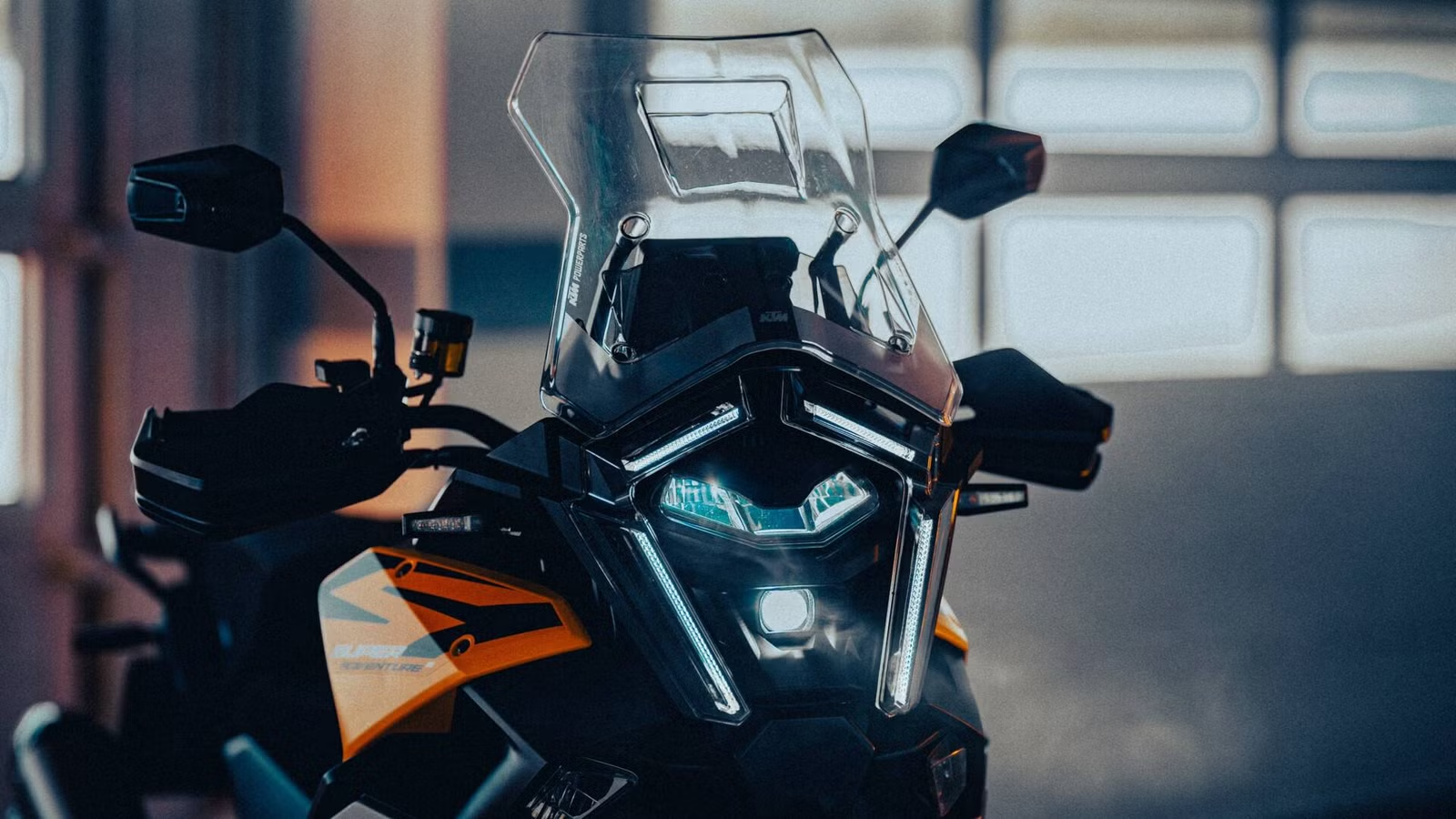
Large adventure bikes have always depended on compromises because it’s a genre of motorcycling that places incredible demands on engineering. A chassis that works beautifully on pavement isn’t necessarily the one you want on a rocky trail. And long-distance comfort that brings extra size and equipment will probably make the bike lazy to handle, while serious performance usually makes low-speed riding more challenging. Even increasingly sophisticated electronics can’t completely reconcile those contradictions.

What engineers resort to then, is give the rider more control over where and when those compromises appear. Engines can alter their behavior across the rev range, suspension can adapt without tools, and transmissions no longer have to remain strictly manual or automatic. That philosophy is particularly relevant at the expensive end of the ADV market, where the cost of the tech isn’t limiting, and riders aren’t unreasonable for expecting one motorcycle to cover several different jobs on uncharted routes.
Flagship Adventure Bikes Are Becoming Increasingly Adaptable
A traditional big ADV had to settle on one overall setup offering broadly one riding personality, partly to make it reliable and partly to meet a lower price tag. That made engineering priorities fairly constrained. More off-road ability generally meant accepting greater suspension movement at the expense of pavement precision, while road-focused machines would sacrifice some dirt capability for better high-speed manners.

High-tech electronic suspension has greatly helped in widening that operating window. Damping can now change according to road conditions and riding mode, while ride-by-wire allows the throttle response and power delivery to suit everything from rain to spirited pavement riding when the sun is shining. Variable valve timing tackles the same problem inside the engine by improving performance at different points in the rev range.

The final piece of the big ADV puzzle now seems to be addressed with the latest transmission technology. Borrowing a page from the four-wheeled world, an automatic gearbox simply makes more sense during traffic and long-distance touring to cut fatigue. But experienced riders may still want direct control when the road gets interesting. So, instead of deciding which behavior matters most, the latest systems increasingly let the rider make that choice on the move.
Several manufacturers are already heading down that path, albeit with different priorities. Honda has spent years refining its dual-clutch transmission technology, while BMW now offers Automated Shift Assistant on the R 1300 GS. KTM’s answer is more in keeping with its performance-first identity. It automates the clutch and gear changes when convenience matters, but keeps the rider fully involved whenever the road demands it, and its flagship ADV houses this tech to further eliminate compromises that keep a rider unhappy.
The 2027 KTM 1390 Super Adventure S EVO Is Built Around Flexibility

The $22,699 2027 KTM 1390 Super Adventure S EVO is the latest step in a line that has steadily moved away from the old idea of a big ADV being little more than a tall, powerful touring bike. Each generation has added more electronic control and broader road capability, but the S EVO pushes that evolution further by making adaptability central to the motorcycle rather than treating it as an extra layer of convenience. It is still unmistakably a Super Adventure, with long-travel suspension, upright ergonomics, and serious cross-country intent, but this version is designed to change its behavior far more readily around the rider and the road.
The V-Twin Broadens Its Usable Performance

The latest LC8 remains a 75-degree V-twin, but its displacement has increased from 1,301cc to 1,350cc. KTM rates it at 171 horsepower, while peak torque stands at 107 pound-feet. More importantly, KTM has widened the engine’s operating range with the help of Camshift variable valve timing, which uses two intake cam profiles.
Reduced valve lift and duration at lower revs favor cleaner, more manageable low-speed operation, while the cams shift laterally to a higher-lift, longer-duration profile as revs rise. KTM therefore doesn’t need to blunt the top end simply to make a 1,350cc V-twin pleasant at touring speeds. Valve-clearance inspections are also spaced 37,000 miles apart, which is more than welcome for a rider accumulating serious mileage between services.
The Suspension Changes With The Job At Hand

Both ends use the latest generation of WP Semi-Active Technology (SAT), including a new through-rod 48mm fork designed to reduce friction and improve sensitivity. Electronically controlled valves continuously alter damping, while Comfort, Street, Sport, and Rain ride settings let the rider establish the basic behavior they want at a given time and surface condition.
The optional Suspension Pro package expands those choices, but the useful part is already fundamental to the design. The same 8.66 inches of travel that helps absorb broken roads doesn’t leave the motorcycle permanently soft when the pace increases. To help this further, KTM has also revised frame stiffness and repositioned the footpegs 0.31 inch lower and 0.39 inch farther outward, improving the knee angle, especially useful when riding in a standing position.
AMT Adds Convenience Without Taking Away Manual Control
KTM’s Automated Manual Transmission eliminates the clutch lever and uses an actuator to perform gear changes, while a centrifugal clutch handles engagement. The rider can leave the six-speed gearbox in automatic mode or manually shift through the foot lever or handlebar switches. There’s also a Park position that mechanically locks the transmission. The AMT even allows the standard adaptive cruise control to support stop-and-go operation, integrating the transmission with KTM’s latest front radar rather than treating automation as an isolated convenience feature.
The 1390 Super Adventure S EVO Lets Riders Choose Which Compromises Matter

What KTM has really done to eliminate compromises is to focus on how much of the motorcycle can be tailored around the ride. The S EVO can be configured for long-distance comfort, quicker road riding, wet conditions, or lighter off-pavement work. Much of that adjustment is managed through the new eight-inch TFT, which brings ride modes, suspension settings, navigation, and other bike functions into one easy-to-use interface.
Adjustable comfort equipment includes a windshield that offers 2.8 inches of adjustment and a seat that can be set at either 33.3 or 34.1 inches. But KTM still draws a clear line at serious off-roading. The 19/17-inch cast wheels and Dunlop Meridian tires keep the 1390 Super Adventure S EVO firmly road-biased. And anyone placing off-road performance first has the Super Adventure R for exactly that reason.

Even the standard equipment supports the idea of minimizing compromises via eliminating multiple trim selections. One can have the semi-active suspension, front radar enabling adaptive cruise control, cornering ABS, traction control, tire-pressure monitoring, keyless operation, and the AMT as standard inclusions. Rally Mode and Suspension Pro remain optional, but KTM doesn’t make buyers start with a comparatively basic motorcycle and then add technology to build its touring character afterward.
The BMW R 1300 GS And Ducati Multistrada V4 S Take Different Routes

The BMW R 1300 GS remains the broadest alternative as well as the segment benchmark. Its 1,300cc boxer makes 145 horsepower and 110 pound-feet, while shaft drive strengthens its touring credentials. The $20,395 base price undercuts the KTM, but features such as Dynamic Suspension Adjustment, Active Cruise Control, and Automated Shift Assistant are optional, so matching the S EVO’s equipment level pushes the BMW further up the price ladder.

Ducati’s Multistrada V4 S takes a sportier route. Its 1,158cc V4 produces 170 horsepower and pairs with semi-active Skyhook Suspension EVO, but the radar-equipped Travel & Radar version starts at $29,995. Both are formidable rivals, yet the KTM bundles more of its core touring, performance, and convenience technologies into the standard package. That makes its $22,699 price far easier to justify for riders who want fewer compromises without leaning heavily on the options catalog.
Source: KTM

Related posts



Latest Post


No Comments