
The Roadster That Can Keep Up With The Adventure Bikes
Adventure bikes have quietly become the default answer for riders who want one motorcycle to do almost everything. They offer long-travel suspension, big fuel tanks, upright ergonomics, and enough electronic wizardry to make a long highway run feel easy. However, there is a trade-off. That versatility often comes with a tall seat, a large footprint and plenty of weight. Does a true do-it-all motorcycle really need a beak, giant tank and towering stance? Not necessarily. There is another way to approach the problem — one that mixes road manners, gravel-road ability and everyday usability without feeling like a small expedition vehicle.
Adventure Bikes Have Become The Default Answer For Do-It-All Riders

Walk into a motorcycle dealership, and the pattern is obvious: big, tall, loaded with electronics and priced accordingly. Take the Honda Africa Twin. Its seat sits at 34.3 inches in the standard position; it weighs 510 pounds with fuel, and the base model starts at $15,199 before destination. That’s a sensible bike by ADV standards. It’s also a lot of motorcycle to hold up on tiptoe at a gas station. And plenty of owners never leave the pavement, yet they carry that height, weight, and price tag every single day.
Plenty Of Riders Want Capability With More Character

There is another type of rider, though. This rider wants to take the scenic route, occasionally leave the pavement, and still have a motorcycle that feels special on a Sunday morning ride. A low-slung tank, exposed engine, twin-shock rear end, and a proper exhaust note can matter just as much as a giant TFT screen.
That is where the old scrambler idea still makes sense. The formula predates the modern adventure bike: start with a road-oriented motorcycle, add more suspension travel, fit a larger front wheel and give it enough ground clearance to deal with dirt roads. It is less about crossing continents at impossible speeds and more about refusing to stop when the pavement ends. The modern interpretation of that recipe has become surprisingly capable. And one motorcycle in particular takes the idea seriously without trying to become an ADV in disguise.

The Triumph Scrambler 1200 X Is The Roadster Crashing The Adventure Party
Base Price: $14,445

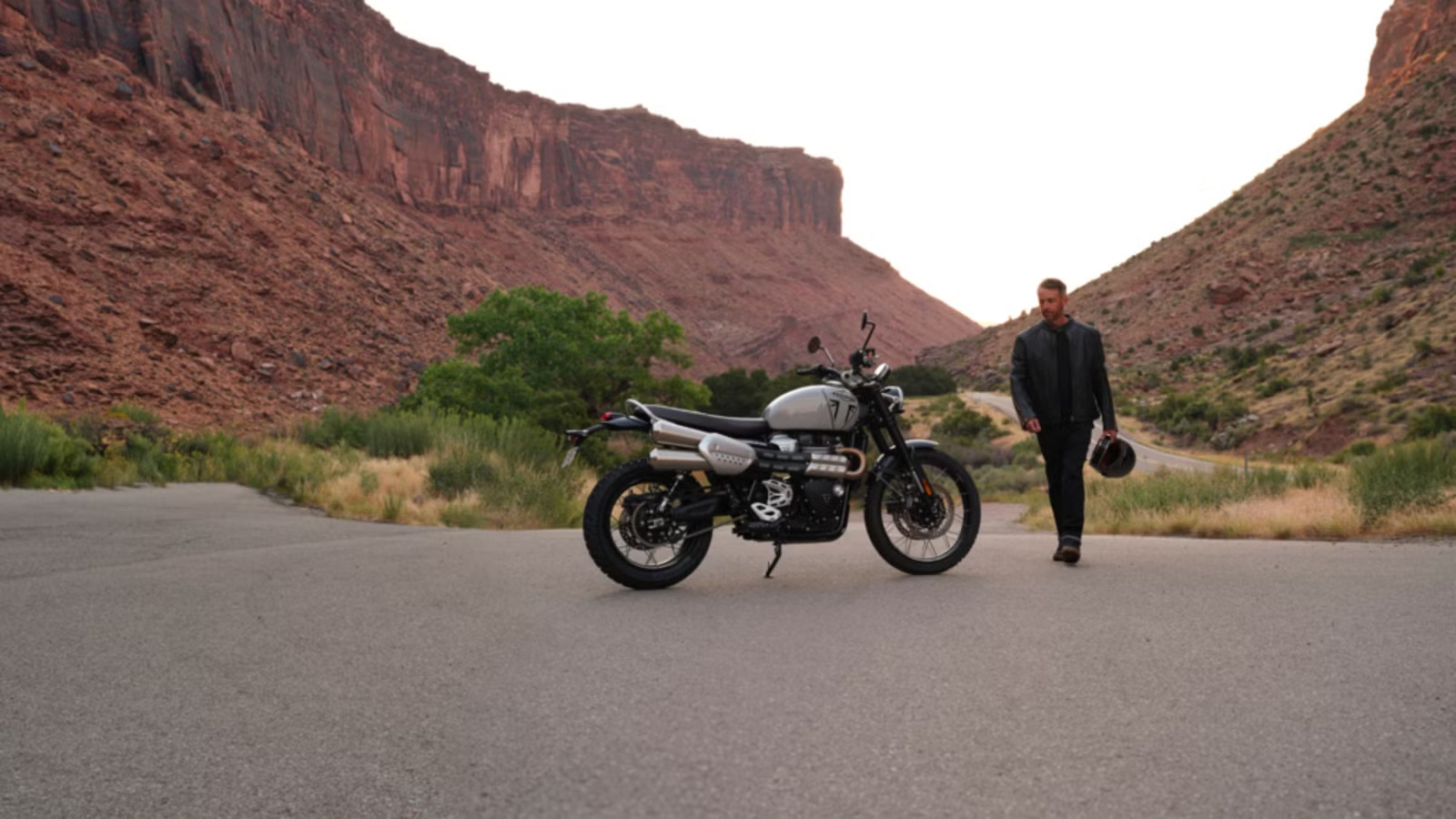
Meet the Triumph Scrambler 1200 X: a Bonneville-derived 1,200cc twin on a 21-inch front wheel, positioned as the more approachable Scrambler. The 2026 Scrambler 1200 X carries a U.S. MSRP of $14,445. For context, the Harley-Davidson Pan America 1250 Special starts at $19,999, and BMW’s R 1300 GS opens at $20,395 before destination.
Triumph’s own Tiger 1200 range begins around $22,000. That puts the Scrambler more than $5,000 under both the Harley and the BMW. Only the Moto Morini X-Cape 1200, at $12,999, comes in cheaper. The X also gets a two-year, unlimited-mileage warranty, with service due every 12 months or 10,000 miles, whichever comes first. Triumph lists three colors for the flagship scrambler — Carnival Red, Ash Grey and Sapphire Black.
Where It Sits In The Scrambler 1200 Lineup

Triumph sells the Scrambler 1200 in two flavors. The X is the road-biased, more accessible one, sitting below the XE. Compared to the XE, it gets a lower seat, shorter suspension travel, narrower handlebars, and a simpler hybrid LCD/TFT dash. It arrived in 2024 as a replacement for the XC, launching at $13,595, which was $1,150 less than the outgoing bike. The lineage runs back to the Bonneville, but the X is its own thing: the Scrambler for riders who’d rather not climb aboard a full-fledged ADV.
Powered By A 1,200cc Parallel-Twin That Favors Mid-Range Grunt Over Top-End

Triumph’s 1,200cc liquid-cooled parallel-twin comes from the Bonneville family, with a 270-degree crank, eight valves and 11:1 compression. In the Scrambler, it makes 89 horsepower at 7,000 rpm and about 81 lb-ft of torque, with a redline at 7,300 rpm. Nobody’s chasing revs here. Those numbers look modest next to a 145-hp R 1300 GS. However, this tune is about delivery, not bragging rights. A single 1.97-inch throttle body and a revised header help produce broad, usable torque, and that’s what matters on a trail or a back road. The high-level twin-silencer exhaust adds a rich, deep note, with a bit of crackle on downshifts.
Easy To Live With Day To Day

A six-speed gearbox and a slip-assist clutch keep the lever light, which matters more than it sounds in stop-and-go traffic or when you’re feathering the clutch up a loose climb. The tune is meant to be tractable off-road, and a broad torque spread is friendlier on loose surfaces than a sudden hit up top. It won’t out-sprint a big boxer twin, and it doesn’t need to. Its job is to be predictable.
Underpinnings That Take It Beyond The Tarmac

This is where the bike earns its scrambler badge. The front wheel is a tubeless, 36-spoke 21-incher wrapped in a 90/90-21 tire, while the rear is a 32-spoke 17-inch unit. Tubeless spokes make trailside puncture repairs far easier. Stock tires are Metzeler Karoo Streets, which lean toward road manners but keep some dirt ability. Want more bite? Triumph lists the Michelin Anakee Wild as a handbook-approved alternative. Rake is 26.2 degrees with 4.92 inches of trail, a geometry that leans toward stability.
Marzocchi Suspension Tuned For Road And Rough

Suspension too comes from Marzocchi, with a 45mm inverted fork up front and twin rear shocks with piggyback reservoirs. Travel is about 6.7 inches at both ends, plenty for gravel roads and washboard, though not what you’d call long-travel. Here’s the catch: the fork isn’t adjustable, and the rear gets preload only. That makes the setup road-leaning, a trade-off that suits a bike built around accessibility. Riders who want more travel and adjustability will probably end up looking at the higher XE trim.
Brakes And Weight

Stopping duties go to twin 310mm front discs with Nissin two-piston axial calipers, plus a 255mm rear disc, all with ABS. Then there’s the weight: 502.7 pounds wet on a 60.04-inch wheelbase. That’s close to the Africa Twin’s 510-pound curb weight, so the Scrambler isn’t heavier than a mainstream ADV, but it’s no featherweight either. The 4-gallon tank is a gallon short of the Honda’s. Triumph’s EPA-procedure figure of 4.4 L/100 km works out to roughly 53 mpg, which means a little over 200 miles on paper.
Rider Aids That Match The Adventure Crowd

The Scrambler 1200 X boasts a modern electronics package including five riding modes — Road, Rain, Sport, Off-Road and Rider — each one tailors throttle response, ABS and traction control. An IMU sits behind it all, feeding optimized cornering ABS and cornering traction control. Off-Road mode makes the strongest case for this bike. It allows more wheel slip, so on loose surfaces the electronics step back instead of cutting in at the first hint of a slide. ADV riders take that for granted.
A Cockpit That Mixes Retro And Modern

The dash is a round LCD cluster with an integrated color TFT screen, operated from bar-mounted controls. It looks classic, reads clearly, and doesn’t shout for attention. Illumination is full LED, and an underseat USB socket keeps the phone charged. Connectivity isn’t standard, though. The My Triumph Bluetooth module is an accessory, and once fitted, it adds phone, music and turn-by-turn navigation through the smartphone app. Heated grips are optional too, with three heat settings shown on the display. Honestly, skipping the giant screen is part of the charm.
Accessibility Is The Scrambler 1200 X’s Secret Weapon

At 32.28 inches, the seat sits 0.78 inches lower than the old XC’s and 1.96 inches lower than the XE’s. Next to the Africa Twin’s 34.3 inches, that’s roughly two inches closer to the ground. For plenty of riders, that’s the difference between flat-footed confidence and a nervous toe-tap. Add adjustable handlebars and a roomy rider triangle, with natural peg placement and an easy reach to the bars, and it should suit a wide range of body types. For shorter riders, Triumph offers an accessory low seat that drops the height by another 0.98 inch.
Accessories That Build The Adventure Case

Triumph offers more than 60 genuine accessories for the Scrambler 1200, and several go straight at the ADV brief. There’s Givi-partnered luggage, including a left-hand pannier, tank bag and tail bag, which together add up to as much as 19 gallons of capacity. A high screen helps on long highway days. For trail duty, you can add engine bars, a radiator guard, a headlight grille and a high-level front mudguard. Have them fitted at purchase, and they’re covered by the same two-year warranty as the bike.
So, does it replace a full-blown adventure bike? Not for everyone. If you’re crossing continents or tackling technical terrain, a dedicated ADV still wins on tank size, travel and adjustability. That said, if your idea of adventure is a bit of everything, with a bike that’s easy to live with and sounds the part, the Scrambler 1200 X makes a strong case. It keeps up on more of the list than you’d expect, and it does so with a lower seat and, most importantly, a smaller price tag.
Source: Triumph

Related posts





Latest Post


No Comments