
The 531-Unit Dodge Compact That Out-Ran The Z28 And Corvette In 1978
By the late 1970s, Detroit’s golden era of classic muscle cars was already in the rearview mirror; lower compression ratios, heavy catalytic converters, and reduced power output turned performance icons into sluggish cruisers. Chevrolet’s muscle car icons struggled as well; the base Corvette made just 185 horsepower, and so did the Camaro Z28 with its detuned 350-cubic-inch V8. However, in 1978 Dodge made a limited run of a compact car that quietly challenged the General Motors flagship machines. A V8-powered compact that punched above its weight.
How Malaise-Era Regulations Choked American Muscle

To understand how a compact car could challenge the flagship performance cars of the time, we need to step back to the American automotive industry in the late 1970s. Federal requirements forced manufacturers to add more weight to cars to improve safety and structural integrity. At the same time, growing environmental concerns choked engines with catalytic converters; the era of unrestricted power was over, replaced by smog pumps and restrictive exhaust systems. To keep buyers interested, manufacturers added bold decal packages, racing stripes, and large hood scoops to boost visual appeal, but offered no real performance or mechanical upgrades.
A Detroit manufacturer launched a standard compact chassis in 1976, designed to be a practical family commuter with a comfortable cabin and predictable road manners, powered by a reliable inline-six. The engineers recognized its capabilities, as the compact chassis had a lightweight advantage. Although the platform targeted a regular consumer rather than an enthusiast, they saw it as a solid mechanical base that could become an authentic performance machine at a time when rivals offered only visual packages.
A Compact Package To Take On The Competition


Chrysler wanted to be aggressive with its F-body compact car, so it added performance right out of the box and planned to turn the family commuter platform into a muscle car beater. Instead of relying on the standard commuter powertrain, the Mopar engineers dropped a heavy-duty 360-cubic-inch small-block V8 with a Thermo-Quad four-barrel carburetor into the lightweight F-body chassis. And rather than focusing on outright numbers to lure customers, the engineers focused on power delivery and drivability to maximize off-the-line torque.
The 360-cubic-inch V8 was paired with the A727 TorqueFlite three-speed automatic transmission, which sent power to the rear wheels through an 8.25-inch rear differential with an aggressive ratio of 3.2:1 or 3.55:1 gearing and a Sure-Grip limited-slip unit. To transform the platform into a true driver’s car, the suspension geometry was overhauled with heavy-duty front transverse torsion bars, stiffer rear leaf springs, a firm-feel steering box, and thick front and rear anti-roll sway bars that eliminated body roll during hard cornering. The vehicle rode on wide E60x15 Goodyear GT Radial tires wrapped around massive 15×8-inch GT painted steel wheels, offering a contact patch that could surpass almost everything in the compact segment.
The 1978 Dodge Aspen Super Coupe

The compact car that brought these high-performance components together was the 1978 Dodge Aspen Super Coupe, which could be ordered under Chrysler’s exclusive Option Code A67. Producing 175 horsepower and a factory torque rating of 260 lb-ft, the Aspen Super Coupe was a formidable package in a compact size that challenged Detroit’s established sports car hierarchy. The Chevrolet Camaro Z28, a flagship performance car of its time, had 185 horsepower and 280 lb-ft of torque from its 350-cubic-inch V8, but it also carried extra weight and rode on narrower 15×7-inch wheels, yet sold in massive volumes of 54,872 units.
Its elder sister, the Chevrolet Corvette L48, similarly produced 185 horsepower and 280 lb-ft of torque, rode on 15×8-inch wheels, and achieved commercial success with 46,776 units delivered. In contrast, the Dodge Aspen Super Coupe benefited from shorter rear-axle gearing and wider 15×8-inch GT wheels, but it still had an extraordinarily limited production run. Yet it could still keep up with those cars, which were essentially from a couple of segments above. The main debate around the Super Coupe has always centered on its straight-line acceleration. Period testing figures cited by Barn Find logged a 0-to-60 mph sprint of 8.1 seconds, which easily outdragged the stock Camaro Z28’s typical 8.5 to 9.0-second runs and beat the base Corvette’s 8.2 to 8.8-second times.
Conservative real-world estimates like those published placed the Super Coupe’s 0 to 60 mph time closer to 9.5 seconds. Yet, the vehicle consistently proved it could run neck-and-neck with the best performance cars America had to offer at the height of the Malaise Era. Furthermore, its heavy-duty sway bars and firm suspension let it carve through corners while staying flat and predictable, standing out among the softly sprung, underpowered domestic competition.
Built For Performance, In An Era Of Soft Cruisers

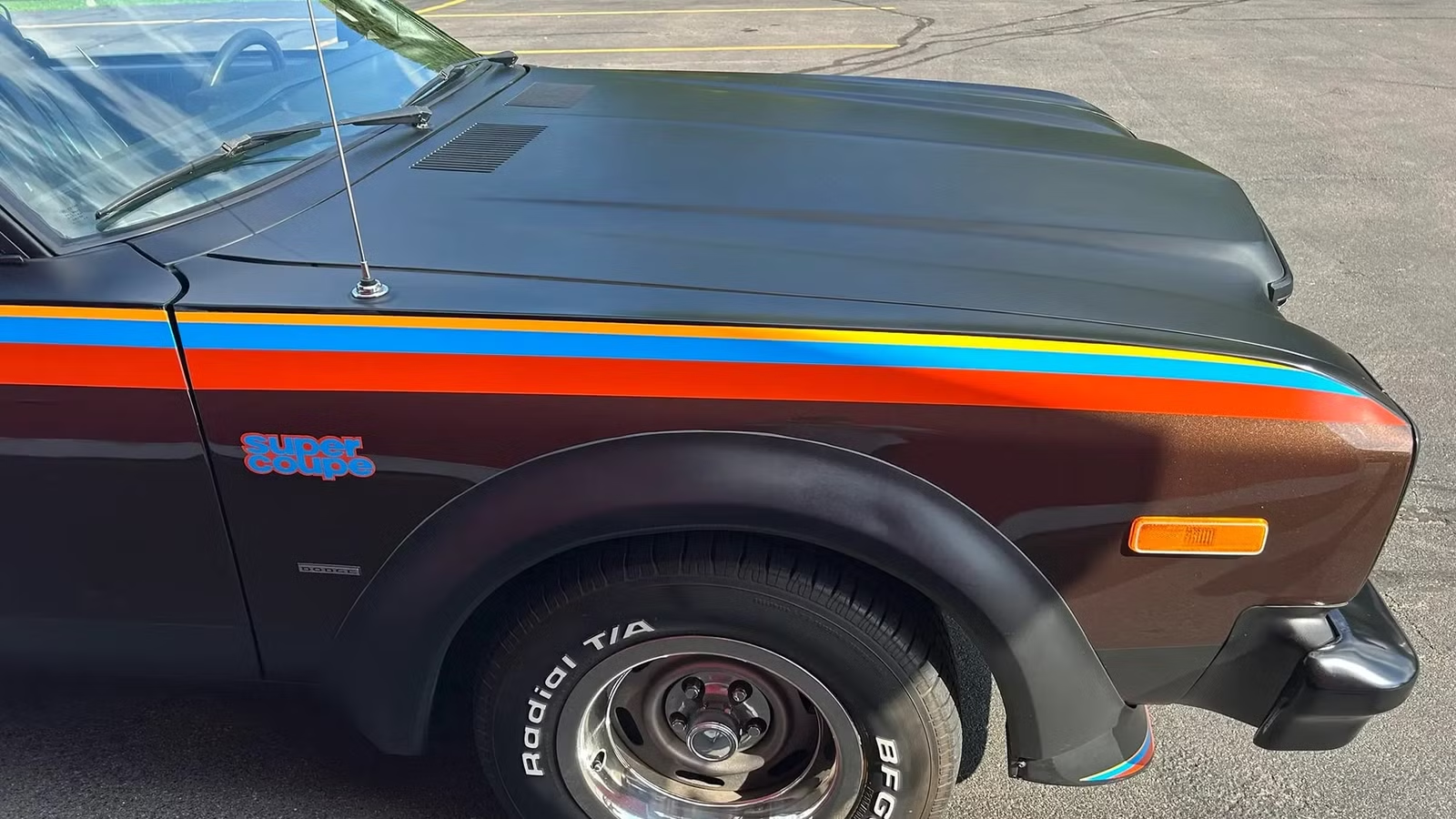
Dodge made sure that the Aspen Super Coupe’s visual styling matched its underlying mechanical capability, incorporating design cues directly from Chrysler’s iconic Richard Petty stock car. Dodge leveraged its NASCAR presence to drive more customers to the showroom, and its sister brand, Plymouth, also marketed its version of the F-body compact as the Volaré Street Kit Car, complete with Richard Petty’s famous No. 43 graphics, as a dealer-installed option. Dodge channeled that same stock-car heritage into the Aspen Super Coupe, giving it a track-focused stance with a deep front air dam, extended wheel arch flares, matte blackout hood panels, and a rear decklid spoiler.
The exterior package was defined by its exclusive Sable Tan Sunfire Metallic paint finish accented by bold yellow, orange, and red tri-color sunset striping that ran along the body sides. Rather than a mass-market machine, the Super Coupe was conceived as a one-year halo model designed to inject excitement into an F-body platform criticized early in production for its build quality. The production numbers reflect its ultra-exclusive nature: Dodge produced exactly 531 Aspen Super Coupes for 1978, while Plymouth built 494 Volaré Coupes with the street kit package. Of the 531 Dodge units, only 41 left the factory with removable T-tops.
A Forgotten Legend’s Modern Resurgence

Historical preservation has been brutal for Dodge’s F-body performance cars. Severe platform rust issues, coupled with Chrysler’s well-documented late-1970s financial difficulties, hit the model hard, causing most of the original 531 Super Coupes to rust away or end up in scrapyards over time. Because so few survived the 1980s and 1990s, the Super Coupe was largely written off as a forgotten chapter in Mopar’s history, buried under the shadow of many other iconic Dodge nameplates such as the Hemi-powered Chargers and 440 Six-Pack Challengers.
However, as collector interest in rare Malaise Era performance cars has surged, the Dodge Aspen Super Coupe has seen a major revival among serious automotive historians and Mopar enthusiasts. Modern collectors now recognize the vehicle for the anomaly it was and for Dodge’s refusal to surrender to tightening federal emissions standards.
It used smart gearing, rigid chassis tuning, and bold stock-car styling to defy the smog-era-plagued reputation of cars from that time. Finding an authentic, numbers-matching Option Code A67 Super Coupe today in good condition with the correct paperwork would be the holy grail for a Mopar enthusiast. The Aspen Super Coupe remains a lasting testament to the era when a humble Dodge compact went toe-to-toe with flagship performance cars like the Corvette and Camaro Z28.
Sources: BarnFinds, Bring a Trailer, Plymouth, Dodge

Related posts




Latest Post


No Comments