
The $10,000 Sportster Harley Is Reviving To Win Back The Riders It Lost
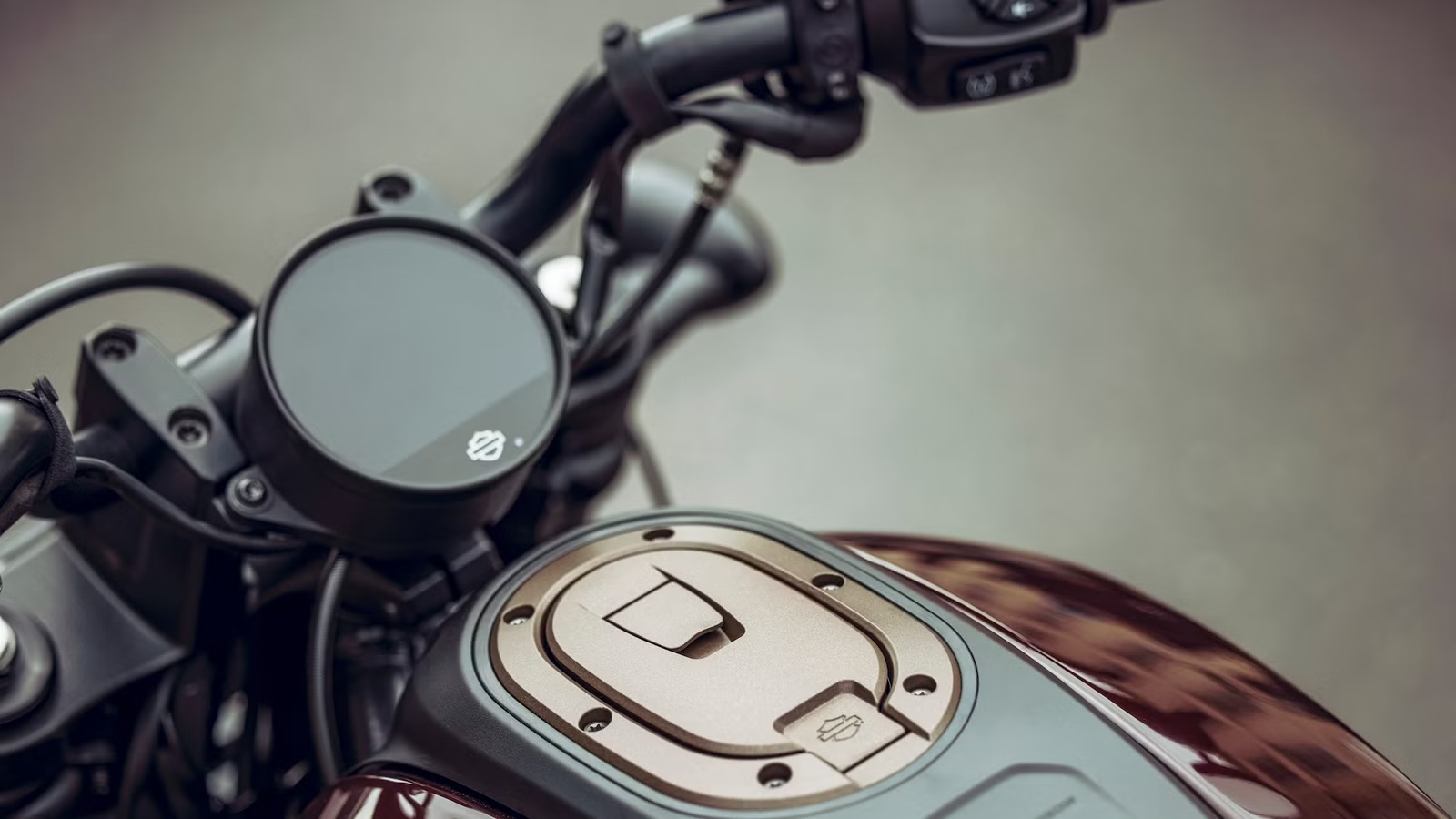
For the past few years, Harley-Davidson’s approach to entry-level motorcycles has centered on the liquid-cooled Revolution Max platform. Models like the Sportster S and Nightster brought modern engineering, significantly higher performance, and technology that the aging Evolution-powered Sportster family could never match. Yet if recent leaked reports prove accurate, Harley may now be preparing to add something very different to its lineup.
The Reports Suggest Harley Wants An Affordable Sportster Again

Rumors point to an affordable air-cooled Sportster inspired by the discontinued Iron 883, with a target price around $10,000. While Harley-Davidson has not officially confirmed the motorcycle itself, the company’s broader strategy offers important context. Under CEO Artie Starrs, Harley recently unveiled its “Back to the Bricks” strategy, signaling a renewed focus on attainable motorcycles, dealer profitability, and the riders who have long formed the backbone of the brand. If the leaks are true, the rumored Sportster could become one of the clearest examples yet of that evolving strategy by giving Harley another opportunity to reconnect with riders.

Among the rumored details are a traditional 45-degree pushrod V-twin, twin rear shocks, a circular air cleaner, and styling cues that closely resemble the outgoing Iron 883. Reports also place the motorcycle’s starting price at approximately $10,000, putting it alongside today’s Nightster as one of Harley-Davidson’s most attainable motorcycles. That would give Harley another attainable entry point into the brand, something that has become increasingly uncommon within its lineup.
The Bigger Story Is Harley’s Direction

Even if some of those reported specifications ultimately change, the broader story may prove more significant than the motorcycle itself. In May 2026, Harley-Davidson unveiled its Back to the Bricks strategy under CEO Artie Starrs’ leadership, outlining plans to strengthen dealer profitability, simplify the product portfolio, and place greater emphasis on attainable motorcycles.


That strategy shifts the conversation away from simply building more expensive motorcycles and toward expanding Harley’s appeal without abandoning its identity. An affordable Sportster would fit naturally within that vision, providing an accessible entry point into the brand while complementing Harley’s premium offerings.
It’s More Than A Nostalgia Play

Just as important, the rumored motorcycle should not be viewed simply as a nostalgic exercise. Harley has repeatedly shown a willingness to modernize its lineup when regulations, technology, and customer expectations demand it. If an air-cooled Sportster does return, it would likely reflect a careful balance between honoring the qualities that made the original successful and adapting those qualities to meet today’s engineering and emissions requirements.

The question is not whether Harley-Davidson can build another affordable Sportster. The more interesting question is why the company appears to believe the time is right to do so. The answer may lie in the fact that the Revolution Max platform and the traditional Sportster were never intended to satisfy the same rider.
This Rumored Sportster Wouldn’t Replace The Revolution Max

At first glance, introducing a traditional air-cooled Sportster alongside the Nightster might seem redundant. If both motorcycles occupy roughly the same price bracket, why would Harley-Davidson build two entry-level models instead of one? The answer may have less to do with engineering than with the riders Harley hopes to attract.

The Revolution Max platform was never intended to be an updated Evolution engine. From the beginning, Harley designed it as a thoroughly modern powerplant featuring liquid cooling, dual overhead camshafts, variable valve timing, and performance that far exceeded the outgoing Sportster family. By virtually every technical measure, it accomplished exactly what Harley-Davidson designed it to do.
Modern Performance Meets Traditional Character

Where the Revolution Max differs is in the audience it serves. Riders drawn to the Sportster S or Nightster are often looking for stronger performance, modern technology, and a contemporary riding experience. Traditional Sportster buyers, meanwhile, have historically valued affordability, mechanical simplicity, customization, and the unmistakable character of an air-cooled Harley V-twin. Those priorities are different, but neither is inherently better.
Two Entry Points Instead Of One

Harley-Davidson would not be replacing the Revolution Max platform. Instead, it would be broadening its lineup by offering two distinct entry points into the brand. The Nightster would continue serving riders who prefer modern engineering, while a traditional air-cooled Sportster could appeal to buyers seeking a more familiar ownership experience.

Viewed through that lens, the rumored motorcycle becomes less about reviving the past than broadening Harley-Davidson’s appeal. Giving buyers a choice between two interpretations of the Sportster would simply acknowledge what most manufacturers already understand: customers with similar budgets often prioritize very different qualities in the vehicles they buy.
Harley’s Strategy Is Evolving Alongside The Market

The rumored Sportster arrives at an interesting point in the American motorcycle market. According to Bureau of Transportation Statistics registration data, cruiser motorcycles remain the largest category of motorcycles on U.S. roads. At the same time, registrations have gradually declined since peaking around 2011, reflecting a mature market that has been slowly shrinking rather than rapidly expanding.

That distinction matters because Harley-Davidson has long been the manufacturer most closely associated with cruisers. While adventure bikes, dual sports, and naked motorcycles have attracted new buyers, cruisers continue to account for a significant share of the motorcycles Americans actually own. For Harley, success is no longer just about expanding the market. It is also about remaining relevant within its largest segment.
A Mature Market Rewards Customer Loyalty

Growing markets reward manufacturers for attracting new buyers. Mature markets place greater value on retaining existing customers while continuing to welcome new ones. That helps explain why reports of an affordable Sportster make strategic sense. Riders who appreciated the simplicity and accessibility of the Evolution-powered Sportster never represented a temporary trend. They remain part of the cruiser market today, even as the motorcycles available to them have evolved.
A Broader Lineup Makes Business Sense

If the leaked reports prove accurate, Harley-Davidson would not be revisiting the past simply for the sake of nostalgia. It would be responding to a market where broadening its appeal may be more valuable than asking one motorcycle to satisfy every buyer. Seen through that lens, the rumored Sportster becomes less about replacing an existing model than strengthening Harley-Davidson’s position within the cruiser segment. In a mature market, expanding the number of riders who can find a motorcycle that fits their preferences can be just as important as introducing a new category.
Back To The Bricks Provides The Missing Context

Viewed in isolation, rumors of an affordable air-cooled Sportster might look like a nostalgic return to one of Harley-Davidson’s best-known nameplates. Viewed alongside the company’s broader business strategy, however, they begin to tell a different story. The Back to the Bricks initiative, unveiled under CEO Artie Starrs, outlines a renewed focus on strengthening dealer profitability, simplifying the product portfolio, and attracting a broader range of riders.
An affordable middleweight cruiser would align naturally with those priorities, and that strategy extends beyond a single model. Harley has announced plans to introduce the Sprint, an entry-level motorcycle expected to start around $6,000, suggesting the company is pursuing a broader effort to rebuild its entry-level lineup across multiple price points.

Recent financial results illustrate the challenges Harley-Davidson continues to navigate. Reuters reported first-quarter revenue declined 12 percent year over year, reinforcing why the company is placing renewed emphasis on attainable motorcycles and dealer health. Reuters noted softer motorcycle sales amid a difficult retail environment, but the company’s response has focused on refining its product strategy and strengthening its dealer network rather than abandoning the technologies it introduced over the past several years.
Affordable Doesn’t Mean Basic

For much of the past decade, Harley-Davidson’s attention naturally gravitated toward premium motorcycles with higher transaction prices and stronger profit margins. Models like the Road Glide, Street Glide, and CVO family remain central to the company’s success, and there is little reason to expect that to change.

That does not diminish the importance of an attainable motorcycle. Entry-level models introduce new riders to the brand, strengthen dealer traffic, and often become the first step toward larger and more expensive motorcycles later in a rider’s ownership journey. For decades, the Evolution-powered Sportster filled that role. If the leaked reports prove accurate, Harley may be preparing to fill it again with a motorcycle designed to meet today’s regulatory and manufacturing realities.
A Strategy That Broadens The Lineup

The rumored Sportster would represent more than the return of a familiar name. It would demonstrate that Harley-Davidson’s long-term strategy includes expanding its entry-level lineup alongside its premium motorcycles, not replacing one with the other. Viewed through that lens, the rumored Sportster becomes less about revisiting the past than reinforcing Harley-Davidson’s future. Rather than signaling a reversal of course, it would represent another step in a broader strategy aimed at attracting more riders while strengthening the company’s dealer network.
Why This Sportster Could Win Back Riders

One of the easiest conclusions to draw from the rumored Sportster is that Harley-Davidson is reversing course after several years of investing in the Revolution Max platform. If the reports prove accurate, that interpretation likely misses the bigger picture. The Revolution Max engine remains one of the most advanced powerplants Harley-Davidson has ever produced, giving the company a competitive middleweight platform that meets modern performance expectations and increasingly stringent emissions standards.
Nothing about the rumored Sportster suggests Harley is moving away from that technology. Instead, the reports point to a broader strategy. Rather than relying on a single motorcycle to appeal to every rider, Harley-Davidson appears to be expanding the number of ways customers can enter the brand.

Ultimately, the rumored Sportster is compelling not because it recalls Harley-Davidson’s past, but because it suggests the company is refining its strategy for the future. If the reports prove accurate, Harley-Davidson would not simply be reviving a familiar name. It would be recognizing that one of motorcycling’s most enduring nameplates can continue to evolve without losing sight of the riders who helped make it iconic.
Source: Harley-Davidson, Reuters News, NTS Bureau of Transportation Statics (Data is supported by experience as a certified Harley-Davidson mechanic, adding practical insight into reliability trends, service intervals, ownership patterns, and long-term durability.)

Related posts


Latest Post


No Comments