
The Forgotten Kawasaki Superbike That Was Built To Destroy The Hayabusa
Anyone who knows motorcycles knows the Suzuki Hayabusa. Named after the Peregrine Falcon, it’s one of the most iconic bikes in motorcycling history, becoming the fastest production motorcycle of its era and helping trigger the so-called gentleman’s agreement around top speed. But the ‘Busa didn’t do so unchallenged. One bike tried to dethrone it, using cutting-edge technology and hardware to tackle it head on, but it soon found out why the Peregrine Falcon is predator, not prey.
When The 1990s Superbike Arms Race Changed Everything

Superbikes were entering a strange new era by the late 1990s. The World Superbike series, which started in 1988, helped to usher in a new era of homologation specials with race-bred power and pedigree, while road-specific designs were getting increasingly angular as the era of the jellybean came to a close. But for as much as design was important, one thing that mattered more was speed.
Every flagship bike seemed to have even more power, even sharper angles, and even more audacious performance claims. The technology behind these bikes was also rapidly advancing, with aluminum chassis, fuel injection, ram-air systems, and increasingly powerful four-cylinder engines that revolutionized what street bikes were capable of. But while this was partly done in the name of performance, marketing was the real driving force.
There can only be one king of the hill. One “fastest bike”. Bikes like the Honda CBR900RR Fireblade, the Kawasaki Ninja ZX-11, and the Yamaha YZF-R1 all brought fascinating innovations during this time, but each one fell just short of the ultimate marketing prize: becoming the first production motorcycle to break the 200 MPH barrier.

The Motorcycle That Made 200 MPH The New Benchmark

In 1999, Suzuki unveiled its Hayabusa and irrevocably changed the motorcycle world forever. This high-performance motorcycle wasn’t just another superbike that nudged the bar fractionally higher, but was a clear statement of intent from Suzuki. Its design, its power, and its engineering were unlike anything else seen before, and it was ready to win the arms race.
With a 1,298 cc inline-four with twin-stage fuel injection and SRAD ram air that made 175 HP, the bike was as close to the once-unthinkable 200 MPH mark as anyone had ever got. It achieved this partly through that immensely powerful engine, but also through an aerodynamic design that was both distinctive and slippery. By reducing the drag, it could extract that little bit more, and it suddenly turned into the benchmark by which all other performance bikes would be measured.
For Suzuki, the Hayabusa represented an incredible engineering achievement. For everyone else, it presented a problem. Could they even challenge the Hayabusa and, if so, how? Kawasaki, it transpired, had an idea.
Kawasaki’s Ninja ZX-12R Was Its Answer To The Suzuki Hayabusa

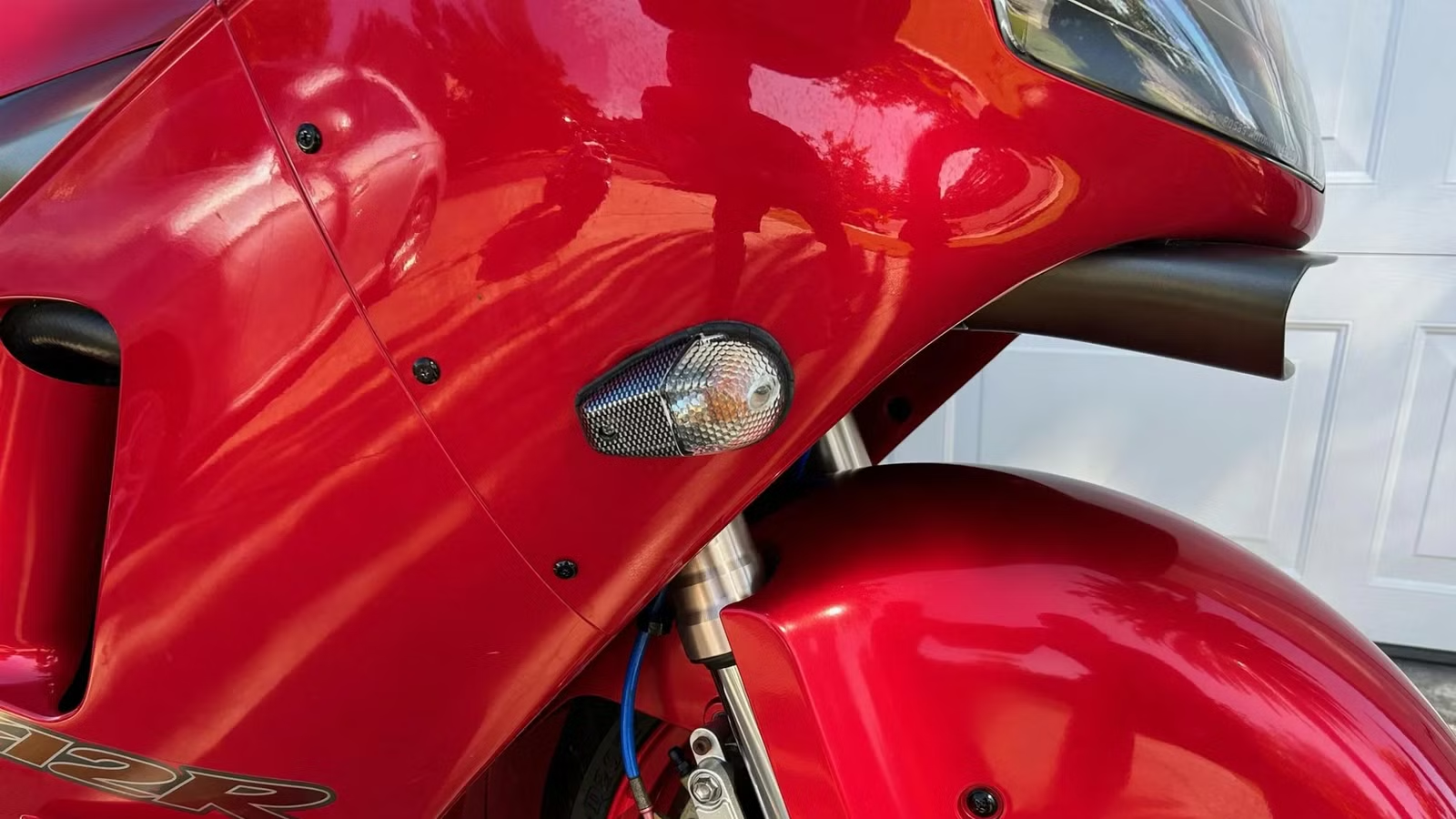
Kawasaki’s answer was the ZX-12R, and it had one goal in mind: to beat the ‘Busa. But, on paper, it was already at a disadvantage.
That’s because part of the Hayabusa’s prodigious power came from its 1,298 cc inline-four engine that made 175 HP in the first generation (though this would increase with subsequent bikes). Kawasaki opted for a 1,199 cc engine, giving it a smaller displacement from the off. It couldn’t simply throw a bigger engine into the ZX-12R and hope for the best, so it had to look elsewhere for that genre-defining performance. And part of that came from making less produce more.
See, while the 1,199 cc engine in the ZX-12R might have been some 98 cc fewer than in the Suzuki, the boffins behind the Ninja were able to extract some 178 HP from it, giving it (very) slightly more power from its smaller engine. It obviously wasn’t a huge amount of power, but marginal gains were what the bike dealt in. Plus, a smaller engine means less weight, and less weight to shift can lead to higher speeds. This contributed towards the ZX-12R being roughly 12 lbs lighter than the Hayabusa. But it didn’t stop there.

While the Suzuki used a conventional aluminum frame, the Kawasaki used an innovative aluminum monocoque chassis. It built this structure around the airbox, creating a rigid and compact design that not only kept weight down and centralized the weight, but heightened the impact of the ram-air system. Both the Hayabusa and the ZX-12R used a ram-air system (which become increasingly effective at high speeds), but this approach from Kawasaki meant it was, per contemporary reports, more noticeable with the Ninja. And it wasn’t the only way that the ZX-12R tried to use the air to its advantage, either.
The aerodynamic battle was well underway by the late 1990s/early 2000s, and was something that Suzuki had considered from the outset. It had designed the Hayabusa with the help of a wind tunnel and with inspiration from the Peregrine Falcon, trying to ensure the bike wouldn’t be slowed by the air itself. The design was polarizing, sure, but it worked. Kawasaki tried to emulate this, and paid a similar attention to how it would interact with the air it was pushing through.
In all, it was a different take on the same question. Where Suzuki went for displacement and aerodynamics, Kawasaki tried to solve it with marginally more power, marginally less weight, and marginally better technology. Both had the same goal of 200 MPH but, unfortunately, events would conspire to prevent both from reaching it.
The Speed War That The ZX-12R Never Got To Enter

For a brief moment, it looked like the ZX-12R and the Hayabusa were going to settle the question of which manufacturer could create the fastest production bike in the world. But the Hayabusa had caught the attention of more than just the motorcycling public, and ramifications were afoot.
That’s because as motorcycles got dangerously close to 200 MPH, concern about their performance was growing. In late 1999, European and Japanese manufacturers agreed to voluntarily limit the top speed of their high-performance bikes to 300 km/h (186 MPH), while also stepping back from competitive top speed marketing. This effectively ended the top speed era forever.
While the Kawasaki never got the chance to truly prove itself, it was, reportedly, very close to that number before release. In pre-production testing it supposedly hit 197 MPH, with factory rider Rickey Gadson running a 9.52-second quarter mile on a lowered pre-production bike in December 1999. When Cycle World tested the production ZX-12R, it recorded 187 MPH and noted that the bike still had roughly 700 rpm available before redline. The magazine reported that the motorcycle was electronically limited, meaning the production bike could not exploit the engine’s remaining rev range at maximum speed. The ZX-12R wasn’t a slow bike by any measure, but it was handicapped before it had the chance to hit its prime.
Why The ZX-12R Still Deserves To Be Remembered

It’s easy to look purely at the figures and see that the ZX-12R lost its battle against the Hayabusa. But that undersells what Kawasaki actually achieved, and what the Ninja could have been capable of. The ZX-12R was one of the most technologically-ambitious bikes of its era, getting more power from a smaller engine than the Hayabusa and combining it with a lighter chassis, aerodynamics, and performance that suggested it had the potential to challenge for the fastest production bike crown.
The ZX-12R also shaped what Kawasaki would become, as Kawasaki revisited the formula with later high-performance bikes like the ZX-14R, which pushed it even further. It may not have become the cultural icon that the Hayabusa is, but that’s not because of any failing on its own side. Its 2000 launch date meant that it came at precisely the wrong time.
The story of the ZX-12R is ultimately one of unrealized potential. A bike that appeared to have all the ingredients to challenge the fastest in the world, but had the opportunity taken away from it. It remains today as an example of that brief, extraordinary period when manufacturers flew too close to the sun, and lost the top speed battle altogether.
Sources: RoadRunner Motorcycles, Cycle World

Related posts



Latest Post


No Comments