
The Sport Bike That Makes Expensive European Performance Look Excessive
Years of chasing bigger numbers in horsepower, cleverer electronics, and exotic suspension tech have all led to sport bikes now carrying increasingly ambitious price tags. This has also meant that superbikes have evolved to a point where their core performance is well beyond what most riders can realistically exploit away from a racetrack. Consequently, accessible performance has shifted down a rung.
New-age middleweight motorcycles are now powerful enough for serious track work while remaining manageable on the road, and their electronics have caught up remarkably quickly. Europe has embraced that formula with machines such as the Ducati Panigale V2, but the privilege of owning sophisticated hardware still carries a premium. Japan now has an answer that delivers similar performance figures without asking its buyer to spend Ducati money.
Middleweight Sport Bikes Have Become Far More Usable
The traditional middleweight sport bike was primarily categorized as a supersport. It mostly revolved around high-revving 600cc inline-fours, and the Japanese Big Four were dominating this space. Motorcycles such as the Yamaha YZF-R6 became extraordinarily capable track machines. Meanwhile, liter-class superbikes marched beyond 200 horsepower, with the top-shelf exotics using V4s coming from Italy and bearing matching price tags.


But as stricter emission norms came into play every few years, the inline-four’s lifespan started shrinking quickly. This left a void for a class of motorcycles that a vast majority were after, as on one end stood entry-level performance under 500cc while the other end had breached well past 1,000cc. Thus, manufacturers looked at engines around 700cc to 900cc to produce stronger mid-range performance for daily usability. This meant more usable torque than the old 600s without delivering the intimidating acceleration of a modern superbike.
The Latest Panigale V2 Is A Prime Example From Europe

Ducati’s latest Panigale V2 is perhaps the best European interpretation of this approach, combining serious road and track capability with a starting price of $16,995. That rises to $19,995 for the Öhlins-equipped V2 S. So this is no longer a class of motorcycle where choosing less displacement necessarily results in a modest bill.
This leaves room for a motorcycle capable of matching all the essential performance hardware without charging for the exclusivity. And the Japanese have once again found the breakthrough formula for delivering on just that. Yamaha will sell you a modern middleweight sports bike for much less, and you’d be surprised as to just how little performance needs to be surrendered in the process.
The Yamaha YZF-R9 Has Panigale V2 Performance At Just $12,499

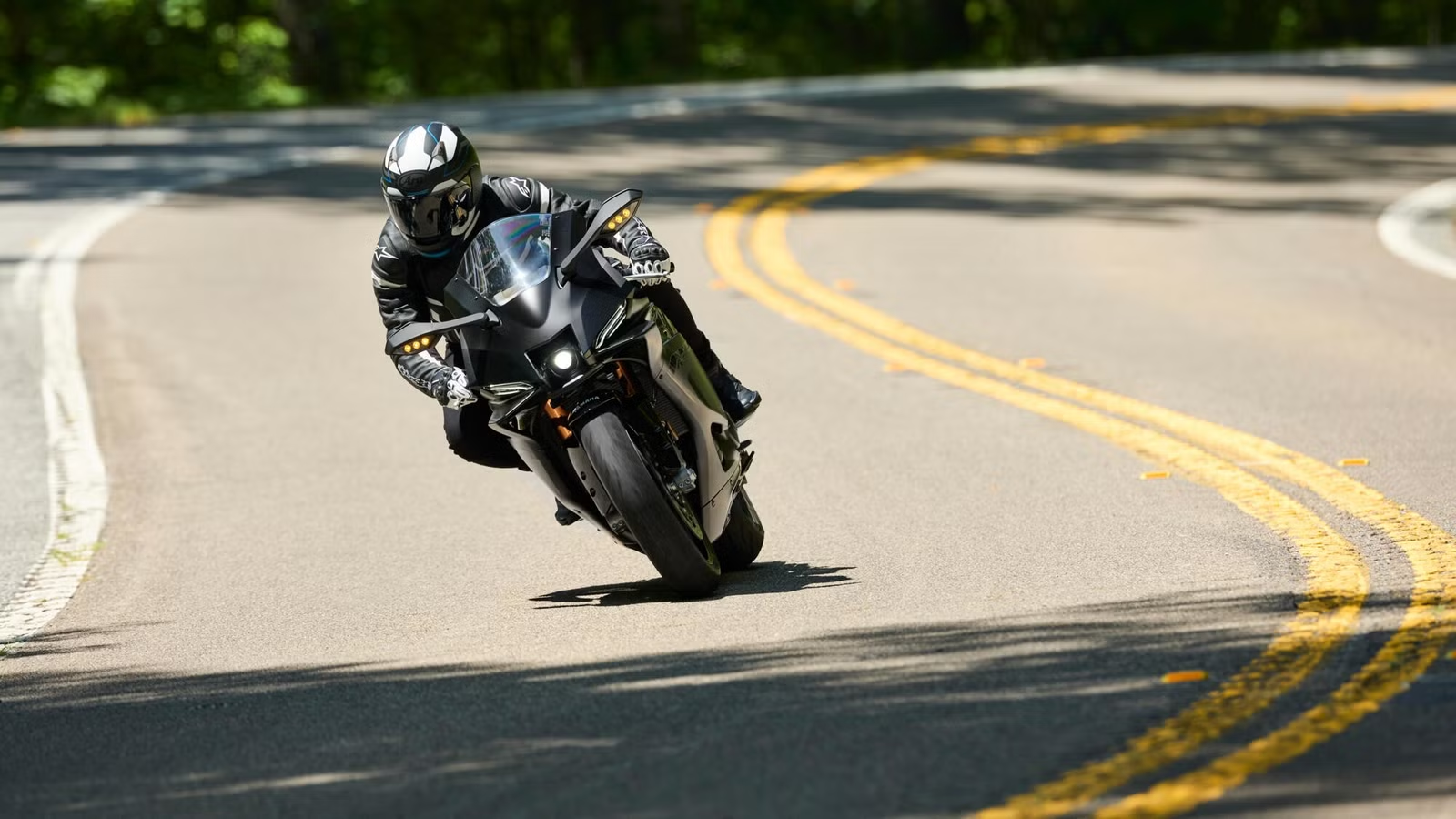
The latest YZF-R9 carries Yamaha’s modern middleweight supersport formula into 2027, largely unchanged from previous model years. It pairs the familiar 890cc CP3 triple with a dedicated aluminum chassis and a level of track-focused hardware that looks ambitious for its price. And you get the contemporary interpretation of Yamaha’s aggressive styling, with winglets et al., that holds its own against any European counterpart.
CP3 Engine’s Versatility Shines On Track And Off It

At the R9’s center is the 890cc CP3 inline-triple with R9-specific ECU calibration and gearing. Pushing 117 horsepower at 10,000 rpm, and accompanied by 69 pound-feet of torque at 7,000 rpm, it’s well within the sights of the Panigale V2 figures despite the completely different engine architectures. More importantly, the R9’s CP3 was never designed around a narrow high-rpm operating window. Its strong midrange means that the rider doesn’t have to repeatedly chase the final few thousand revs to find strong performance. Yamaha also fits its third-generation bidirectional quickshifter, ride-by-wire throttle, assist-and-slipper clutch, and cruise control to complete the road-use versatility.
Yamaha Hasn’t Skimped On The Chassis Hardware

Mind you, this isn’t an MT-09 wearing fairings. Yamaha developed a dedicated supersport chassis around the engine rather than simply repackaging the naked bike. The R9’s gravity-cast Deltabox frame is Yamaha’s lightest aluminum supersport frame to date. Its rigidity has been specifically increased for the braking and cornering loads generated by track riding. And it’s supported by quality components as well. A 43mm KYB inverted fork and KYB rear shock are fully adjustable units, including high- and low-speed compression damping.

Braking equipment follows with Brembo Stylema monobloc calipers gripping twin 320mm discs through stainless-steel lines and a Brembo radial master cylinder. Wet weight is 430 pounds with a full 3.7-gallon tank, while the wheelbase measures 55.9 inches. Yes, the R9 is less knife-edged than the old R6, but also considerably easier to ride quickly off the racetrack as much as on it.
The R9 Makes Superbike-Level Electronics And Aero Accessible

Price becomes particularly difficult to explain once electronics enter the equation. The latest six-axis IMU-based tech is undoubtedly pricey, but smart packaging of the features it unlocks is what the Japanese have become increasingly good at. Unlike the R6, the R9 boasts of an IMU feeding lean-sensitive traction control and brakes, while Yamaha also provides features like slide control, wheelie control, engine-brake management, back-slip regulation, launch control, multiple power-delivery settings, and configurable Yamaha Ride Control modes.

The five-inch TFT adds dedicated street and track layouts, smartphone connectivity, navigation support through Garmin StreetCross, and access to the substantial electronic menu. Yamaha also built telemetry capability into the R9’s track-focused ecosystem. This is considerably distanced from the old Japanese value proposition of offering a strong engine while leaving the expensive electronic toys to European alternatives, further bridging the gap to the Ducatis and Aprilias.

Then there are the winglets. On a smaller bike, winglets are overkill, but on the R9, they aren’t decorative appendages just so the brochure can mention the magic word – MotoGP. Yamaha claims they reduce front-wheel lift under acceleration, while the complete bodywork makes the R9 the most aerodynamically efficient production Yamaha it has developed, and that’s saying something for a brand that has dominated multiple seasons of MotoGP and WSBK.
The Pricey Panigale V2 Shows Just How Much The YZF-R9 Gives You For The Money

Between the aerodynamics, brakes, suspension, IMU, and electronic rider aids, the R9’s $12,499 price starts looking more like Yamaha aggressively exploiting economies of scale of the CP3 platform. And a quick comparison with what the Panigale V2 offers shows just how far the R9’s value stretches. Ducati’s 890cc V-twin produces 120 horsepower and 69 pound-feet, putting it almost level with the Yamaha. Its aluminum monocoque chassis also helps keep mass down, with Ducati quoting 395 pounds wet without fuel, which factored in also puts the R9 in the ballpark.

The standard Panigale V2 brings fully adjustable suspension, Brembo M50 calipers, cornering ABS, traction control, wheelie control, engine-brake control, and Ducati Quick Shift. That leaves the $16,995 standard V2 costing $4,496 more than the R9 for broadly similar output and a comparable level of chassis and electronic sophistication. Ducati might boast of more exotic engineering and the appeal of a V-twin superbike, but Yamaha simply delivers everything that the Ducati does at a much more approachable price, and that’s its USP.
Source: Yamaha

Related posts
Latest Post


No Comments