
This Chevy-Powered Racecar Was Built From Scratch To Destroy The Shelby Cobra
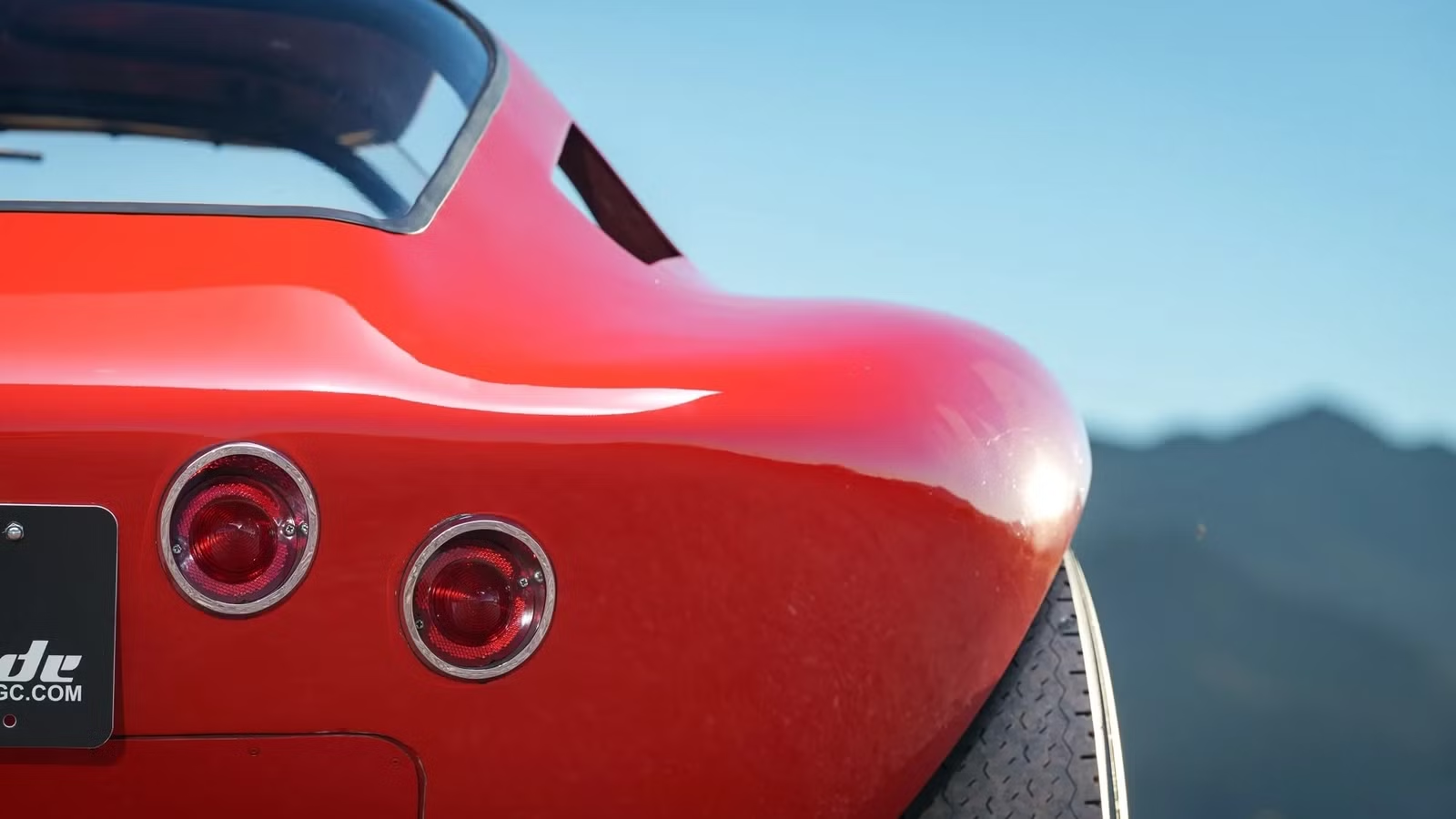
Sometimes automakers build cars specifically for racing rather than for public sale. But for brands like Chevrolet and Ford, winning motorsports was, and still is, a great way to get more buyers in the door. Proving that your car was the best made a massive difference, and Chevy was tired of losing to the Shelby Cobra. So, it bent the rules to build a brand-new model with the specific purpose of finally defeating Ford’s Shelby Cobra.
Chevy Was Determined To Crush The Shelby Cobra

In the early 1960s, the Shelby Cobra was an unstoppable force in the Sports Car Club of America (SCCA) racing series. It easily defeated Chevy Corvette models and European imports like the Ferrari 250 GTO, Porsche 904 GTS, and Jaguar E-Type. The Shelby Cobra was humiliating the Corvette in stock races, which General Motors didn’t like at all. In fact, the Shelby Cobra became known as the “Corvette Killer”.
But it had a significant power-to-weight advantage by weighing 1,000 pounds less than the Corvette, making it too easy to outrun Chevy’s flagship racer. However, General Motors implemented an official ban on factory-backed motorsports and performance development in January 1963. Factory-supported racing teams and engineering assistance were prohibited.

General Motors leaders feared that promoting high-performance power and street racing would lead to regulatory and political backlash. The company was also being threatened with antitrust lawsuits as it controlled 50% of the automotive market. Corvette Chief Engineer Zora Arkus-Duntov took matters into his own hands by secretly building the lightweight Corvette Grand Sport in an attempt to leave the Cobra in the dust.

Models were being built with the intention of selling 125 models to private buyers to get around the racing ban. But once General Motors found out after only five cars were made, they canceled the entire project and ordered the Grand Sport models to be destroyed. This forced passionate racing engineers to get more creative.
The 1963 Bill Thomas Cheetah Was Built To Race

After the Corvette Grand Sport was canceled, the head of General Motors’ Performance Product Group secretly got together with Bill Thomas to launch the project “Cobra Killer.” Bill Thomas Motors was set up as an independent shop, providing distance from General Motors corporate.
While the Shelby Cobra was based on a European roadster, the Cheetah GT was built from scratch. It featured a lightweight fiberglass body built on a steel tube-frame chassis for a weight advantage. This car weighs in at about 1,500 to 1,650 pounds, while the 1963 Shelby Cobra weighs roughly 2,100 to 2,315 pounds.
You’ll find that the 327 cubic-i

nch (5.4-liter) small-block V8 engine under the hood was often stroked to 377 cubic inches. Stock configurations deliver 360 hp and 350 lb-ft of torque, while aggressive tunes churn out about 500 to 520 hp and 513 lb-ft of torque. The Cheetah GT can accelerate from 0 to 60 mph in about 3.5 seconds and complete a quarter mile in roughly 10.5 seconds at around 135 mph, with a top speed of 215 mph.
Meanwhile, the 1963 Shelby Cobra got the 289 cubic-inch (4.7-liter) small-block V8 engine. It produces 271 hp and 312 lb-ft of torque in standard form. Racing turns increase its power to about 380 to 400 hp. The Cobra accelerates from 0 to 60 mph in nearly 5.5 seconds, with a 13.8-second quarter-mile time at about 112 mph and a top speed of 138 mph.
The Cheetah GT’s Racing Prestige Didn’t Last Long

The Cheetah GT was introduced in 1963 but didn’t race until 1964, and its career ended by 1966. But during its run, the racer completed its mission of outrunning the Shelby Cobra on paper. Unfortunately, it failed to meet homologation requirements of having 100 production models built to compete directly against the Cobra in the GT class.
Because the car utilized Corvette parts like NASCAR-spec drum brakes, adapted rear suspension assemblies, differentials, coil-over shocks, leaf springs, steering spindles, and Muncie four-speed manual transmissions, it was positioned as a dominant racing force.

But the Bill Thomas Cheetah faced a few problems. For example, it was caught by General Motors in 1965, and Chevy’s secret funding was immediately pulled. Plus, homologation racing requirements were increased from 100 production models to 1,000. On top of that, a fire destroyed Bill Thomas’s shop in Anaheim, California, on September 9, 1965. Production ended as automotive parts, tooling, and incomplete cars were lost.
While some historians agree that the Chevrolet Cheetah would have left the Shelby Cobra in the dust, it also may have had significant problems to correct first. For example, the lightweight frame lacked the structural rigidity needed for aggressive racing; the frame flexed during rapid cornering, and because the engine was placed so far back, the exhaust landed dangerously close to the driver’s legs, leading to extreme heat.
Collectors Don’t Throw Shelby Cobra Money At Cheetah GT Models.

Coming across a surviving Cheetah GT model is extremely rare. Historians estimate that only between 11 and 25 completed models were ever made. Unfortunately, official production records were lost in the devastating shop fire. But the car still holds significant value even though it’s affordable compared to the Shelby Cobra.
An original Bill Thomas Cheetah or Cheetah GT typically sells for $500,000 to over $800,000. Extremely rare early models will command higher premiums. For example, General Motors President John F. Gordon’s Cheetah #002 prototype sold for $2 million. Replicas tend to sell for between $30,000 and $40,000.
1964 Shelby Cobra models in average condition fetch between $825,000 and $980,000. Examples in pristine condition cross the auction block for roughly $1,200,000 to over $2,900,000. An ultra-rare Daytona Coupe model that raced in the 24 Hours of Le Mans sold for $42,900,000, and replicas go for around $40,000 to $90,000.
Source: Hagerty, Robb Report

Related posts


Latest Post


No Comments