
The Retro Luxury Sedan That Puts Modern Sports Cars To Shame
The early 2000s marked a golden era of German luxury car automotive engineering. This age was defined by an escalating horsepower war and understated elegance, while also incorporating noteworthy technological advancements. Unlike modern high-performance vehicles that rely heavily on aggressive aerodynamic designs and an abundance of digital interfaces, European tuning culture in the early 2000s focused on stealth and speed, with a hint of flamboyant character.

Specialist tuners and boutique manufacturers took understated executive cruisers and transformed them into high-speed long-distance machines capable of dominating Germany’s unrestricted Autobahns. One ultra-rare flagship luxury sedan from this period stands as the ultimate expression of that philosophy, offering hand-built exclusivity and refined V-12 power that embarrasses modern sports cars.
What Makes The Alpina Brand So Iconic
Burkard Bovensiepen founded Alpina in 1965 in Buchloe, Germany. The business began by developing dual carburetors for passenger vehicles. Recognizing the precise engineering of these components, manufacturers granted full factory warranties to cars equipped with Alpina parts, establishing an early foundation of technical expertise.

Throughout the decades, Alpina secured major achievements in both motorsport and road-car development. The company won numerous European Touring Car Championships during the 1970s. In 1983, the German Federal Ministry of Transport officially accredited Alpina as an independent automotive manufacturer rather than an aftermarket tuner.

Alpina maintains a legendary, decades-long relationship with BMW. Operating as a bespoke partner, Alpina integrats its hand-assembly and engine modification processes directly into BMW assembly lines, creating high-performance variants focused on high-torque output, effortless long-distance touring, and handcrafted luxury interiors.
The BMW Group fully acquired the brand rights to Alpina. Operating as an ultra-luxury sub-brand under full BMW ownership, the marque bridges the gap between high-performance production vehicles and flagship luxury commissions. Ongoing projects focus on integrating bespoke detailing, advanced electrification, and high-end personalization directly into future platform architectures.
Why The E38 Is One Of The Best 7 Series Models To Exist

Introduced in 1994, the third-generation E38 BMW 7 Series represents a high point in executive luxury sedan design and represents a stark contrast to the 2026 BMW 7 Series. Its key design elements include a low profile, clean horizontal body lines, perfectly balanced proportions, and wide kidney grilles integrated seamlessly into a sleek front fascia. The BMW community holds the E38 in high regard as the peak of classic BMW design, offering an ideal blend of mechanical ingenuity, sophisticated analog controls, and timeless styling before the brand introduced Chris Bangle’s controversial design shifts and complex digital interfaces.
Driven by engaging chassis dynamics, precise hydraulic steering, and smooth powertrain engineering, it balances driver engagement with long-distance comfort. Furthermore, its place as a pioneering technology showcase featuring early satellite navigation and advanced curtain airbag systems solidifies its status as one of the most iconic flagships in automotive history.
Alpina Brought Supercar Performance To The Luxury Car Segment

The 2000 Alpina BMW B12 6.0 represents the absolute peak of the E38 chassis, existing as a low-volume, hand-assembled flagship that pushed the full-size luxury sedan into supercar territory. The bespoke marque applied significant alterations to the drivetrain, suspension, and visual aesthetic. The intent was for it to offer autobahn-dominating high-speed stability without compromising the refined ride quality that defines luxury cruisers.
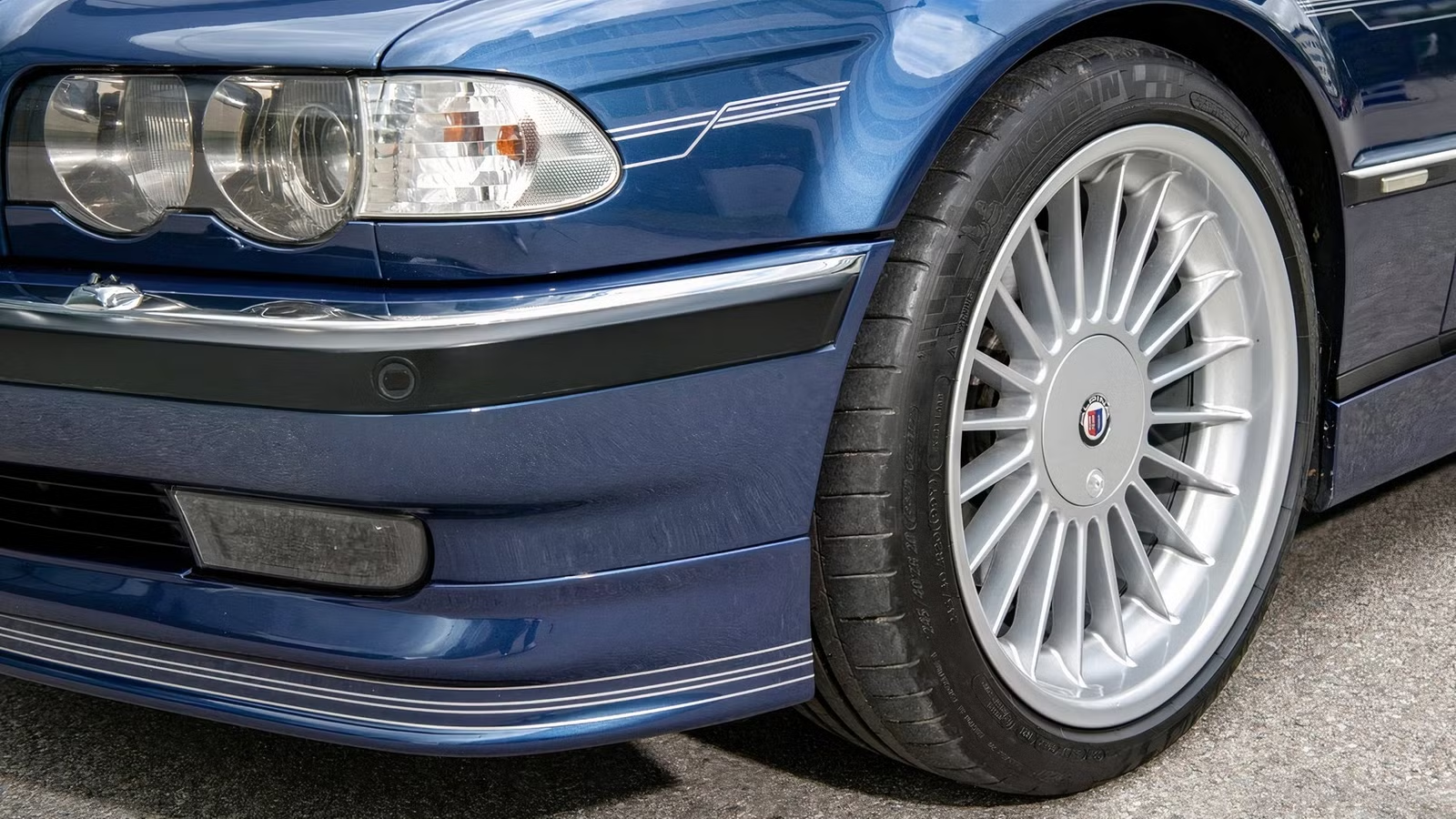
It stands as an underrated legend in the early 2000s performance luxury segment due to its exceptional rarity, understated aesthetic, and engineering depth. The B12 package adds distinctive 20-inch multi-spoke wheels, signature pinstriping, and a subtle front lip. The combination of an analog mechanical feel, handcrafted interior luxury, and massive V-12 performance makes the B12 6.0 one of the most sought-after halo vehicles from the turn of the century.
Pure V-12 Performance Pushing 430 Horsepower

The BMW M73 engine consists of a naturally aspirated 60-degree V-12 design, employing an aluminum-alloy cylinder block with Alusil-coated bore surfaces to eliminate separate cylinder liners and reduce total weight. It features a single overhead camshaft per cylinder bank driving two valves per cylinder, single-row timing chains, and roller rocker arms to minimize mechanical friction. In factory specification, the 5.4-liter variant produces 322 horsepower at 5,000 RPM and 361 pound-feet of torque at 3,900 RPM, paired exclusively with a ZF 5HP30 five-speed automatic transmission.
To create the high-performance iteration for the B12 6.0, Alpina increases engine displacement to 6.0 liters by expanding both cylinder bore and stroke. Alpina equips the block with lightweight forged Mahle pistons, altered camshaft profiles, high-flow cylinder heads, modified intake manifolds, and a bespoke stainless steel exhaust system with high-flow catalytic converters. These mechanical modifications elevate power output to 430 hp and 443 lb-ft of torque, managed through an optimized transmission calibrated for rapid shift response and high torque limits.
The standard BMW 750iL accelerates from 0 to 60 MPH in a claimed 6.4 seconds and reaches an electronically governed top speed limit of 155 MPH. With Alpina’s modifications applied, the 0 to 60 MPH time drops to under 5.8 seconds. The removal of the factory electronic governor allows the sedan to reach an unrestricted top speed of 181 MPH.
No Compromising On Luxury In The Cabin

The 2000 Alpina BMW B12 6.0 features an interior designed to combine high-speed grand touring comfort with bespoke detailing. Alpina craftsmen based at the company’s Buchloe facility re-upholstered the factory E38 cabin using high-grade Lavalina leather, which covers the seats, door panels, and center console. Standard comfort and convenience features include 16-way multi-contour heated front seats with memory settings, double-glazed insulating side glass to suppress cabin noise, a heated steering wheel, and dual-zone automatic climate control.

Long-wheelbase variants add extended rear legroom, power rear sunshades, and heated rear seats. Entertainment and technology systems include a dashboard-integrated GPS navigation unit, an integrated car phone system, and a premium Hi-Fi sound setup featuring a trunk-mounted six-CD changer.
Alpina introduces specific visual and functional modifications that distinguish the B12 6.0 cabin from the standard BMW 7 Series. The driver interacts with a custom blue-faced instrument cluster that replaces the standard black BMW dials, featuring red needles and a speedometer scale extended to 330 km/h to account for its higher top speed.

Alpina replaces the factory steering wheel with a bespoke leather unit fitted with Switch-Tronic shift buttons integrated into the rear of the wheel rim for manual gear selection. Additional trim changes include hand-finished Myrtle wood veneer inserts, signature blue and green contrast stitching on leather surfaces, dedicated door sill entry plates, and a silver-plated or wooden center-console plaque displaying the individual production build number.
Revisions To The Plush But Poised Suspension

The standard BMW E38 7 Series utilizes a double-pivot MacPherson strut front suspension paired with a multi-link integral-V rear axle system. Constructed largely from aluminum components to minimize unsprung weight, this configuration balances highway isolation with precise directional control.
Standard models incorporate hydraulic double-acting shock absorbers, coil springs, anti-roll bars, and a recirculating-ball steering box with speed-sensitive Servotronic power assistance. Top-spec variants feature Electronic Damper Control to dynamically adjust damping stiffness, along with a self-leveling rear pneumatic suspension system to maintain ride height under varying payload conditions.
To accommodate the increased power and higher top-speed capabilities of the B12 6.0, Alpina re-engineered the suspension system in collaboration with Eibach and Bilstein. Alpina fits custom-tuned coil springs that lower the ride height and the center of gravity, while reducing high-speed aerodynamic lift.

The setup incorporates bespoke gas-pressurized Bilstein shock absorbers calibrated with firmer compression and rebound valving, stiffer anti-roll bars, and reinforced control arm bushings. These modifications sharpen turn-in response and control body roll without introducing harshness.
Alpina completes the chassis overhaul by fitting signature 20-inch Classic multi-spoke alloy wheels wrapped in low-profile Michelin performance tires, replacing the smaller factory 16-inch or 18-inch wheels. The enlarged wheel diameter accommodates upgraded performance braking components, featuring larger ventilated rotors and high-friction pad compounds to deliver fade-resistant stopping power suited for sustained high-speed driving.
Limited Exclusivity And Good Used Values

The factory baseline original MSRP for a stock North American BMW 750iL starts at approximately $92,100 when new around the late 1990s and 2000 model year. Based on Bring a Trailer’s sales history, used standard E38 750iL models fetch between $15,000 and $25,000 on average depending on mileage and condition, while well-preserved, low-mileage examples consistently reach around $30,000 to $40,000 in enthusiast market auctions.
Alpina produced a total of 321 units across two engine variants. This includes 227 units of the early 5.7-liter B12 produced between 1995 and 1998, and just 94 units of the 6.0-liter B12. When new, the flagship B12 6.0 commanded a base price of 220,000 Deutsche Marks, which would have been just over $114,000. Adjusted for inflation, this figure would be worth an astonishing $277,800 today.
In today’s pre-owned market, E38 Alpina B12 models trade with average values hovering near $50,000 to $60,000, while exceptionally preserved, low-mileage B12 6.0 examples command prices from $80,000 to $120,000 among private collectors and specialized international auctions.

Available Models
BMW
- Founded
-
1916
- Founder
-
Karl Rapp
- Headquarters
-
Munich, Germany
- Owned By
-
Publicly Traded
- Current CEO
-
Oliver Zipse
Sources: Alpina, BMW, BMWBlog, Bring a Trailer, and Classic.com.

Related posts


Latest Post


No Comments