
Plymouth’s Full-Size Muscle Car Was Rarer Than A Hemi ’Cuda
Few muscle cars carry the kind of mythological weight that the Hemi ‘Cuda does — and for good reason. For a brief, glorious window in 1970 and ’71, Plymouth’s third-generation Barracuda could be ordered with the legendary 426 Hemi under its hood, instantly cementing its place in the muscle car pantheon. Rated at 425 horsepower (SAE gross) and 490 pound-feet of torque, the big-block V8 was a genuine monster, capable of launching the ‘Cuda from zero to 60 mph in just over five seconds. But raw power was only part of the story.
The Stuff Of Mopar Fans’ Wildest Dreams

Its cult-classic status is reinforced by staggering rarity. Hemi-powered Barracudas are extraordinarily hard to find: only 652 hardtops and 14 convertibles were built for model-year 1970, while the 1971 run is believed to account for just 114–119 examples. If you do track one down, expect to pay supercar money — millions for the ultra-rare convertibles, and anywhere from $300,000 to $900,000 or more for the hardtops. To put that in perspective, a manual 1971 convertible restored to perfection sold for a staggering $3.5 million at Mecum Seattle in 2014, and another changed hands at $3.3 million not long after. The Hemi ‘Cuda is, by any measure, in a league of its own when it comes to collectability.
Blurring The Line Between Luxury And Muscle

But what if we told you there’s an even rarer Plymouth muscle car that everyone seems to have forgotten about? It’s arguably just as interesting as the ‘Cuda in many regards, yet it was a short-lived oddball experiment that arrived at the very tail end of American muscle’s golden era.

By 1970, the segment had reached a point where manufacturers were willing to try almost anything. Plymouth began wondering what might happen if it dropped a healthy dose of big-block Mopar performance goodness into a full-size luxury coupe — creating a true sleeper that would surprise with its capabilities rather than telegraph its intentions at a glance.
Meet The Quintessential Mopar Unicorn

You’d think Plymouth didn’t need another performance model, given that its lineup already included the Road Runner and GTX alongside the legendary ‘Cuda. Still, the idea of taking a full-size car built on Chrysler’s C-body platform and transforming it into a genuine performance weapon proved too tempting to resist.
That’s how the Sport Fury GT 440-6 came to be, and its existence continues to baffle gearheads to this day. Sure, the Fury nameplate had been associated with performance before, but that reputation had faded by the late 1960s. Plymouth had shifted its muscle car focus to the B-body platform shared by the Road Runner and GTX, which made the C-body Sport Fury GT an unexpected arrival for 1970.
440-6 Specifications
|
Engine |
440 Six-Barrel V8 |
|
Capacity |
440 Cubic Inches |
|
Horsepower |
390 HP (Gross) |
|
Torque |
490 LB-FT (Gross) |
|
0-60 MPH |
6.6 Seconds |
|
Quarter-Mile |
14.7 Seconds |
That numerical “440-6” designation refers to the hardware under the hood: a 440-cubic-inch Six-Barrel V8 known as the Six Pack in Dodge terminology. It came equipped with triple Holley two-barrel carburetors and a healthy 390 hp, along with a massive torque output peaking at 490 lb-ft — matching the 426 Hemi stroke for stroke. That meant the Fury GT 440-6 was capable of serious acceleration despite tipping the scales at over 4,000 pounds. According to Mopar Connection Magazine, the GT Six-Barrel could sprint from zero to 60 mph in 6.6 seconds and cover the quarter mile in 14.7 seconds.
A Wolf In Sheep’s Clothing

Beyond the Six-Barrel engine, the A52 package fitted to the Sport Fury GT brought a suite of meaningful chassis upgrades: 11-inch heavy-duty drum brakes, a front sway bar, stiffer suspension, and 15-inch Rallye wheels measuring six inches wide. Dual exhausts, a high-flow intake manifold, a heavy-duty driveshaft, and a beefed-up rear axle rounded out the package.
All of these additions transformed the luxury-oriented Fury into a fully fledged muscle car — one dressed in a tuxedo rather than a tank top. As compelling as it sounds on paper, buyers weren’t quite sure what to make of it, and few chose the GT over Plymouth’s more focused performance models.
Those who wanted muscle looked to the Road Runner or ‘Cuda, while the full-size luxury coupe crowd had little interest in a Six-Barrel setup. The timing only compounded the problem. Entering the muscle car segment in 1970 was like arriving at a party an hour before last call — the scene was already winding down fast. Rising insurance premiums on big-block cars and tightening emissions regulations were squeezing compression ratios and strangling performance across the board. Plymouth’s full-size bruiser was, in many ways, doomed from the start. Very few copies left the assembly line in this configuration, making it one of the rarest Mopar unicorns in existence.
Redefining What “Rare” Actually Means

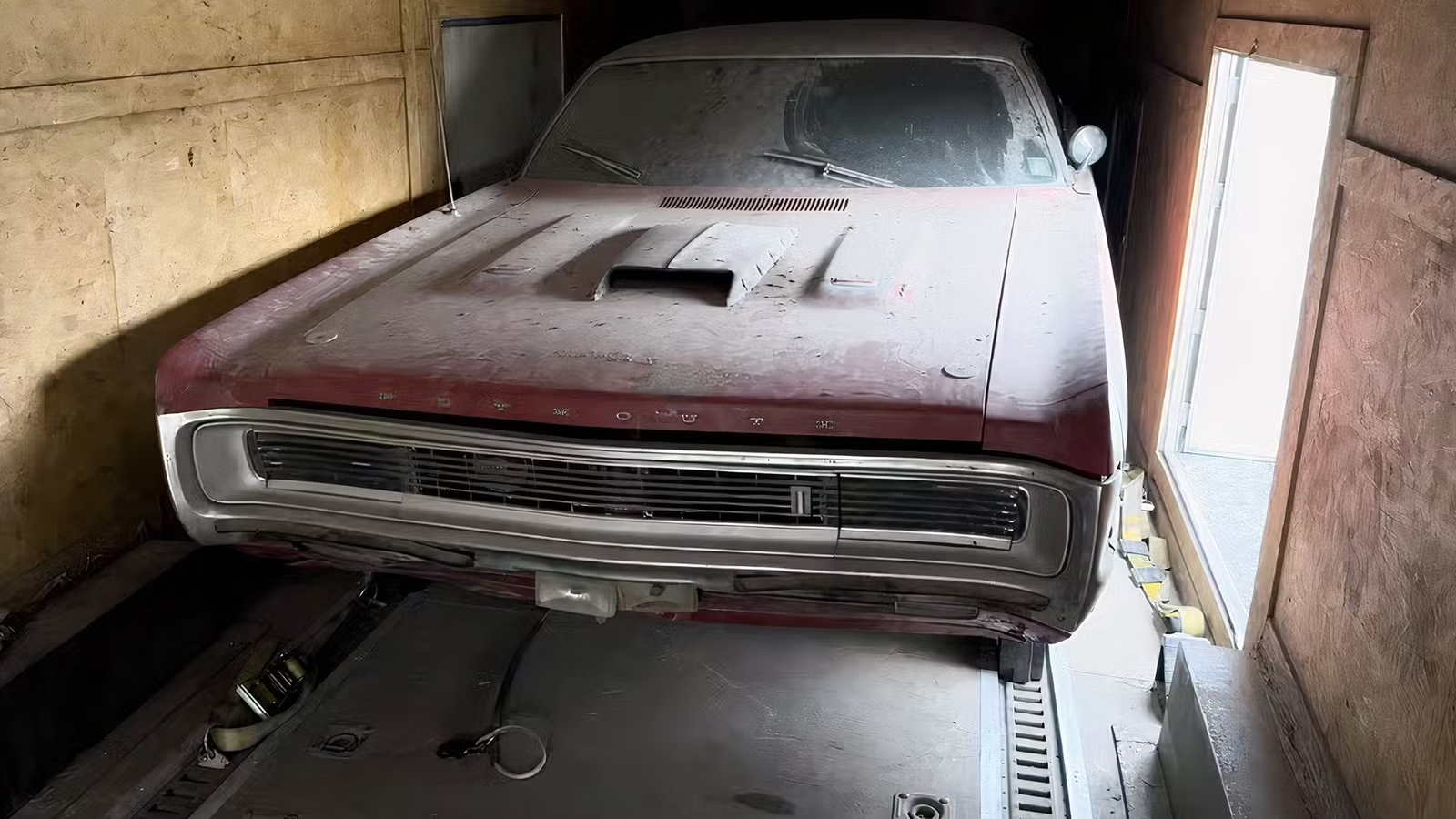
Only 66 units were ever produced, and how many have survived to the present day remains unclear — making them nearly impossible to come by. Even the Hemi ‘Cuda, with its production numbers in the hundreds, seems almost plentiful by comparison. One can only imagine what a GT 440-6 might command at auction. These cars are so scarce that documented sale records are essentially nonexistent, which is what made a fairly recent barn find send Mopar enthusiasts into a frenzy. A Sport Fury Six-Barrel was rescued in 2025 after sitting neglected for well over four decades.
It’s seen better days, for sure, but Tom Hergert and his team at Rocket Restorations in Olympia, Washington are bringing it back to its former glory. The finished result is sure to be a genuine treat for anyone with even a passing interest in old-school American muscle.
Road Runners, ‘Cudas, and the prestigious GTX are all undeniably cool, yet the Plymouth Sport Fury GT 440-6 occupies a category of its own in terms of scarcity and collector appeal. The day one of these specimens hits the auction block will be fascinating — and the final hammer price even more so.
Sources: Mopar Connection Magazine, Mac’s Motor City Garage,

Related posts

Latest Post


No Comments