
The Pontiac Muscle Car That Took Things Too Far
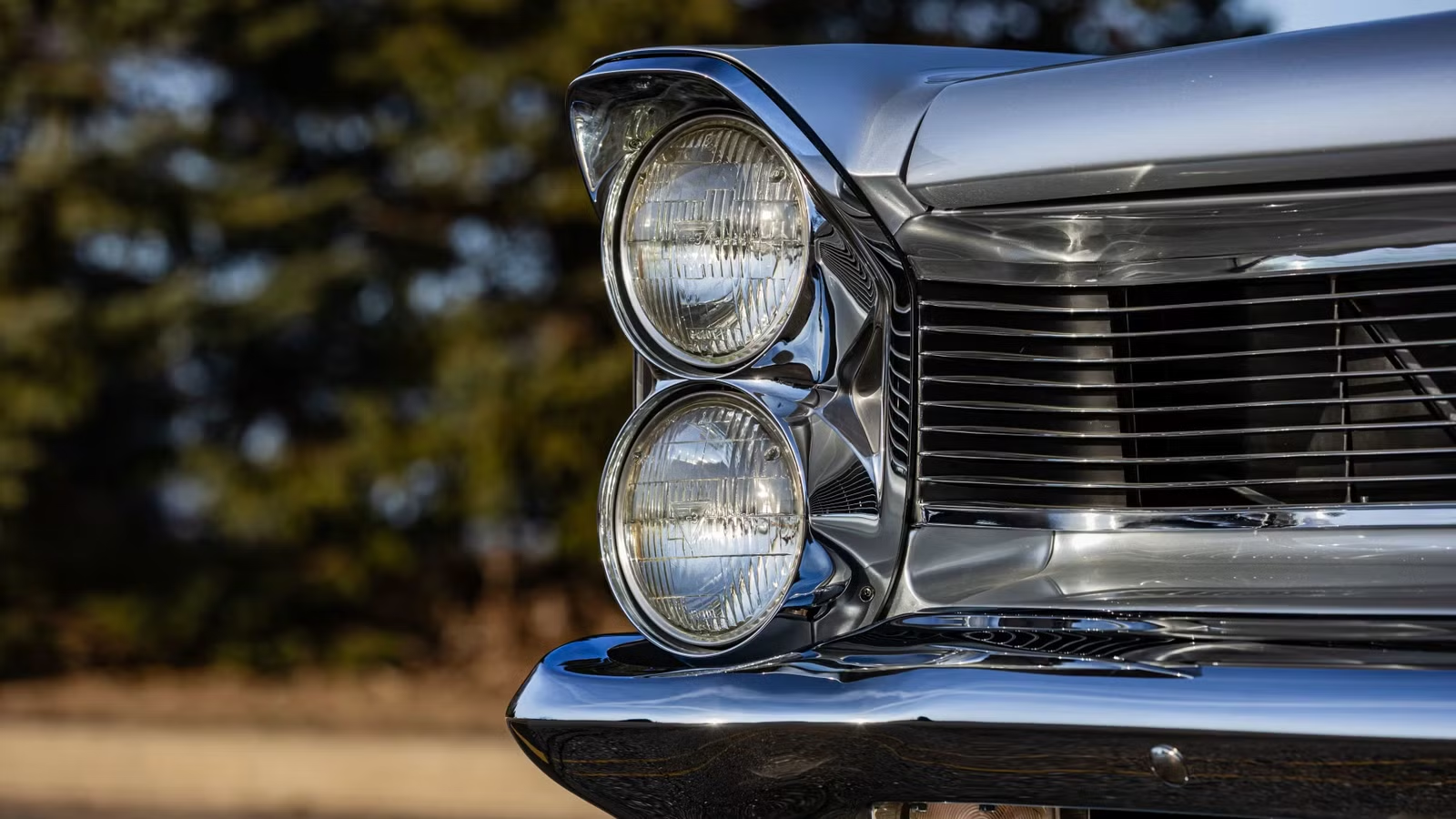
The early 1960s rewarded automakers for going big. More power, less weight, and faster quarter-mile times sold cars, and every brand in Detroit knew it. But one automaker pushed the formula so far that its own corporate parent stepped in to stop it.

The result was a factory-built machine that was deliberately weakened in the name of speed, too fragile for the street, and dead within weeks by executive order. Yet without this car, the muscle car era might never have happened at all. To understand how one Pontiac went too far, you first need to understand the war it was built to win.
The Super Stock Arms Race Was Pushing Detroit To Extremes
By the early 1960s, drag racing had become Detroit’s favorite battleground. Ford, Chrysler, and General Motors were all building special models strictly for the strip, packing them with big, race-tuned V8 engines and exotic lightweight body components. The target was America’s exploding youth market, and the strategy was simple: win on Sunday, sell on Monday.

For Pontiac, the strategy was working better than anyone could have hoped. Racing success transformed the brand’s image and helped push it to No. 3 in total US sales by 1962, behind only Chevrolet and Ford. Its position on the track was directly tied to its position in the showroom.
But as the 1962 drag season wound down, that position was under threat. Ford, Chrysler, and Chevrolet were closing the gap in the Super Stock ranks with bigger engines and a growing supply of weight-saving aluminum parts. Pontiac’s grip on the class it once dominated was slipping, and everyone in the division knew it.
Pontiac needed a drastic answer for 1963. What its engineers came up with went further than anything its rivals had attempted, and further than General Motors was willing to accept.
Pontiac’s Rare Muscle Car That Beat Ferraris On The Track And Then Vanished
It was the fastest muscle car of its era, but it disappeared just as quickly as it appeared.
The “Swiss Cheese” Catalina Had 120 Holes Drilled Into Its Frame

That answer was the 1963 Pontiac Catalina 421 Super Duty, a full-size car put on the most extreme diet Detroit had ever seen. Pontiac’s engineers started with the chassis itself, cutting the top section away from the boxed frame rails to leave a U-shaped channel. Then they drilled approximately 120 holes into the rails, removing as much metal as possible while keeping just enough structure to hold the car together.
Sources vary on the exact count, with some putting the number closer to 130. Either way, the perforated frame earned the car its famous nickname. Journalist Roger Huntington took one look at the drilled-out Pontiacs in the May 1963 issue of Hot Rod and called them the “Swiss Cheese” cars, and the name stuck for good.

The frame was only the beginning. Pontiac swapped in aluminum for the front fenders, hood, inner fender wells, radiator core support, bumpers, and bumper brackets; even the exhaust manifolds, bellhousing, and rear axle center section were cast in aluminum. The front sway bar was deleted, and every ounce of non-essential equipment, soundproofing, and body sealer was stripped out.
All told, the Swiss Cheese Catalina weighed roughly 400 pounds less than a stock Catalina. But the diet came at a cost that showed up before the cars even left the factory. The drilled frames were so flimsy that workers had to brace them with heavy timbers on the assembly line, just to keep them from folding or twisting before the bodies went on.
The 421 Super Duty Made Far More Than Its 410 HP Rating

|
Engine |
Transmission |
Power |
Torque |
|
6.9-liter 421 Super Duty V8 |
Borg-Warner 3-speed manual |
405 hp |
425 lb-ft |
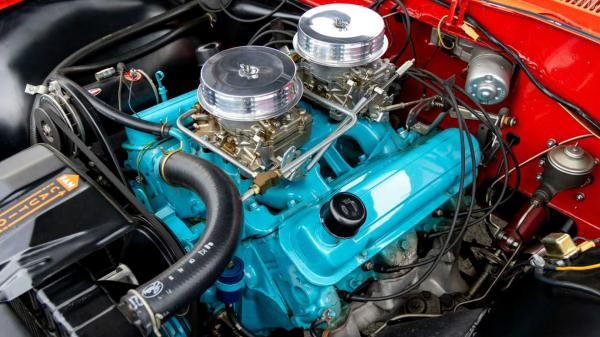
The engine matched the ambition of the chassis. The 6.9-liter 421 Super Duty V8 was built with 13.0:1 Mickey Thompson pistons, a #10 McKellar camshaft, lightweight valves in reworked cylinder heads, and a heavy-duty rotating assembly. Feeding it all were twin Carter AFB four-barrel carburetors sitting on a special aluminum intake manifold.
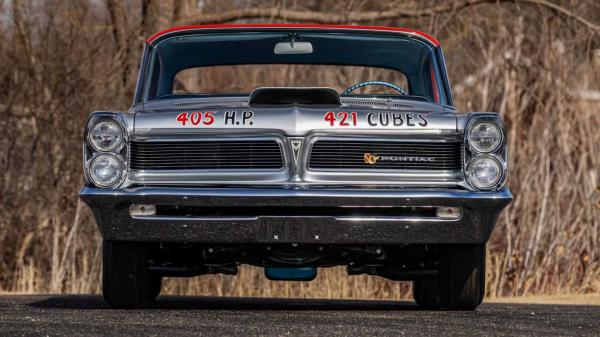
On paper, Pontiac rated the engine at just 405 horsepower. In reality, the 421 Super Duty was widely understood to make closer to 500 hp when properly tuned. Pontiac told the NHRA 405 hp, but the strip said otherwise, and that gap was very much by design in an era when sandbagging the rating helped a car’s racing classification.

Weighing in at 3,308 pounds, the Swiss Cheese Catalina ran 12-second quarter-miles at speeds around 120 mph, and the Packer Pontiac car set an NHRA C/Stock record of 12.27 seconds at 114.64 mph that stood for years.
There was one more trick hiding in the build sheet. To qualify for stock racing classes, the cars had to roll down the regular production line, so all 14 left the factory with ordinary two-barrel 6.4-liter 389 V8s under their hoods. The real Super Duty engines were installed afterward by Pontiac Engineering, before the cars ever shipped.
The Rarest Engine Ever In A Pontiac Muscle Car
Fewer than 200 of these V8 engines ever powered Pontiac muscle cars in the early ’60s, making them rare and extremely desirable.
General Motors Killed Its Fastest Car By Executive Order

Here is the detail that separates the Swiss Cheese Catalina from every other muscle car of its day: you could not buy one. These were all-out race cars, never designed for street use, and Pontiac gave them away to key drag racing teams rather than selling them to the public. Even the racers who received them learned the hard way that the diet had gone too far. The lightweight frame needed frequent patching and reinforcement, especially around the rear suspension, where the drilled rails struggled under launch forces. The aluminum exhaust manifolds could only handle short bursts of heat before they began to fail, making this a car built to survive roughly a quarter-mile at a time.
Then the company itself pulled the plug. On January 24, 1963, Pontiac issued an internal bulletin announcing the immediate discontinuation of its Super Duty 389 and 421 engines, following an edict from GM chairman Frederic Donner ordering every division to withdraw from racing at once.
The reason had little to do with the car itself. Ford and Chrysler had already walked away from the industry’s 1957 anti-racing agreement in mid-1962, but GM controlled roughly half the US market and feared the Justice Department might move to break the company up. GM killed its fastest car because the company was too dominant, not because anyone in Washington had complained about it.
The shutdown was total. Just 88 Super Duty V8s made it out the door for 1963, and only 14 Swiss Cheese Catalinas were built before the ban came down. Pontiac engineer Mac McKellar later recalled that the order from above was blunt: all development and support stopped immediately, and anyone caught violating the policy would be fired without question.
This Rare ’60s Pontiac Muscle Car Was Harder To Find Than A COPO Camaro
This pre-GTO Pontiac packed a 421-cubic-inch Super Duty V8 and ran 11.7-second quarters, influencing the muscle car revolution that followed.
Pontiac’s Banned Race Car Accidentally Created The GTO

The ban should have been a disaster for Pontiac. The division had built its entire image on racing, and losing the track meant losing the thing that made young buyers care about the brand. Instead, it forced the idea that changed everything.
Ad man Jim Wangers sent a memo to engineer John DeLorean arguing that if Pontiac could no longer race, it needed to take racing off the track and put it on the street. The result was the 1964 GTO, a midsize car with a big V8 aimed squarely at the buyers Pontiac could no longer reach through the strip. The initial run of 5,000 cars sold out by Thanksgiving 1963, and sales hit 32,450 by the end of the model year.
The car that started it all became a blue-chip collectible. Only nine of the 14 Swiss Cheese Catalinas are believed to survive, and at Mecum’s Indy 2025 auction, one sold for $742,500 including the buyer’s premium, making it the most expensive Pontiac Catalina ever auctioned. A second example, built for racing legend Mickey Thompson, brought $473,000 at the same sale.
The Swiss Cheese Catalina went too far, and Pontiac paid for it. But the lesson it taught — that excess belonged on the street, in a car people could actually buy — launched the muscle car era itself.
Sources: Mecum, Macs Motor City Garage

Related posts


Latest Post


No Comments