The Japanese Sports Car That Balances Thrills And Trust
8 minutes reading
Saturday, 15 Aug 2026 15:00 0 52 autotech
Japan makes reliable cars, but Japan is also known for making thrilling sports cars. Combine these two, and you’ve got a vehicle that’s both emotional and pragmatic. Reliability isn’t necessarily an exciting topic, but it’s not something to be taken for granted if you’ve ever owned a temperamental vehicle.
Today, we’re going to explore a Japanese sports car that balances thrills while also being a trustworthy companion. This is a passionate sports car that’s simple to maintain and own, and will also last a very long time. The best part is that this Japanese sports car is also one of the most affordable sports cars on sale in the United States.
1990 Honda Civic Si side profile viewBring a Trailer
When Japan’s automotive industry began to flourish, its vehicles were compact, reliable, and fuel-efficient. Japanese cars didn’t become popular in the post-war United States, where size and power mattered most in almost any vehicle class.
A Beautiful Toyota And A Fair Lady
Low-angle front 3/4 shot of 1967 Toyota 2000GT in red parkedBring A Trailer
Japan started sending its cars to the United States in the late 1950s, with Toyota and Nissan (the latter being branded as Datsun) being the first brands to arrive. Initial sales of the Japanese vehicles were lackluster, especially since they lacked the size and power that American cars had at the time.
But it would be the Toyota Corona in the 1960s when the Japanese brands would start making a name for themselves. This vehicle, along with the Toyota Stout, was one of the most durable and reliable cars at the time, and this is when the Japanese brands started to make a name for themselves for quality and longevity.
High-angle shot of 1971 Datsun 240Z interior showing cockpitBring A Trailer
It was also in the 1960s when Japanese cars started to be recognized for their engineering ingenuity and desirability when Toyota released the 2000GT. Only a handful of left-hand drive (LHD) models arrived in the United States, but it was enough to create a stir among car enthusiasts.
Eventually, Nissan released the Fairlady Z, which was called the Datsun 240Z for the United States. The grandfather of today’s Nissan Z further gave the impression that Japan knows how to play ball when it comes to sports cars—even if its inline-six isn’t necessarily the big V-8 that Americans were looking for at the time.
The Oil Crisis Catalyst
Side shot of a 1976 Honda AccordHonda
By 1973, the United States was facing an oil crisis. It was during this time that fuel efficiency finally became a necessity for every new car moving forward. When American automakers started to adapt to ever-stricter fuel efficiency requirements set by Corporate Average Fuel Economy (CAFE) standards in 1975, their vehicles failed to keep up with the superior fuel efficiency, performance, and reliability of smaller Japanese engines.
This was the so-called American “malaise era”, because this was the time when the “Big Three” American automakers didn’t know how to create fuel-efficient engines that would match the refinement, reliability, and performance of what the Japanese were already making.
rear 3/4 view of a white 1972 Honda CVCC Civic with black stripes at a car meetilikewaffles11 / flickr
Take, for example, Honda’s CVCC or Compound Vortex Controlled Combustion. This patented Honda engine technology removed the need for its vehicles to be fitted with a catalytic converter during the oil crisis. As a result, its most powerful version is a 1.8-liter four-cylinder that produces 100 horsepower, which outmuscles the 2.3-liter 88-horsepower four-cylinder of the Ford Mustang II.
The Japanese would soon learn about fuel injection and variable valve timing, and this led to even more powerful four-cylinder engines whose power density from such a compact package would already outperform a heavier V-8.
Why The MX-5 Miata Is The Most Reliable Sports Car You Can Buy
Three 2024 Mazda MX-5 Miatas Parked Next To Each OtherMazda
The automotive community has cheekily made the Miata name into an acronym that stands for “Miata Is Always The Answer.” Building on Japan’s strength in making compact and reliable sports cars, the Mazda MX-5 Miata focuses on mechanical simplicity and lightness. Indeed, the Miata is a trusted answer.
How The MX-5 Miata’s Mechanical Simplicity Translates To 16+ Years Of Ownership
Light Gray2024 Mazda MX-5 Miata On The Move With Roof DownMazda
I’ve said this many times in my articles, and today, this couldn’t be more true. The simpler the car, the more reliable it is, and that’s exactly what the MX-5 Miata has always been. Thanks to its focus on lightness, the MX-5 only needs a simple yet effective and efficient four-cylinder engine. Its 2.0-liter Skyactiv-G four-cylinder produces a modest 181 horsepower and 151 pound-feet of torque, which is more than enough for a car that merely weighs 2,341 to 2,439 pounds, depending on the spec.
With few electronics and complications, the MX-5 Miata is as mechanically simple as any car could get. This is why it frequently ranks as among the most reliable new cars in America. iSeeCars determines that the MX-5 Miata has an average lifespan of 16.8 years or 116,008 miles, and a 4.1 percent chance of reaching 200,000 miles. This makes it the publication’s most reliable sports car.
The MX-5’s Secret: You Don’t Need 400 Horsepower To Feel Alive
Close Up Of 2024 Mazda MX-5 Miata Steering WheelMazda
Now, the Mazda MX-5 Miata isn’t known for speed, but I think most of us can agree that it isn’t a slow car, either. Due to its sheer lightness, the suspension doesn’t need to be overly firm, which also pays dividends to its ride quality. Being light and compact, it is easy to maneuver. In other cars, particularly German cars, their sheer stability and quietness make them too relaxed to drive at high speeds. Meanwhile, 75 MPH in a Mazda MX-5 Miata does feel like you’re going at that speed. As a result, there’s no need to drive a car at terrifying speeds just for the fun to start.
That’s also the case with its handling. The MX-5 being a light car with just the right tire width and suspension geometry means that you also don’t need to drive it at high cornering speeds just for you to feel what it is capable of. It also has a slight degree of body roll by design, which is used as a means of letting you know how the car is behaving during a corner. It’s like a ballet dance partner, where the steering and chassis are the MX-5 Miata’s means of communicating how it flows through a corner.
The 2026 MX-5 Miata Lineup: Which Version Matches How You Want To Drive?
The Mazda MX-5 Miata remains one of America’s most affordable sports cars. Prices start at $30,430, and here’s what you’ll be getting, depending on your budget.
The Soft Top Miata: Three Trim Levels That Let You Choose Your Level Of Obsession
Rear 3/4 high-angle shot of 2025 Mazda MX-5 MiataMazda
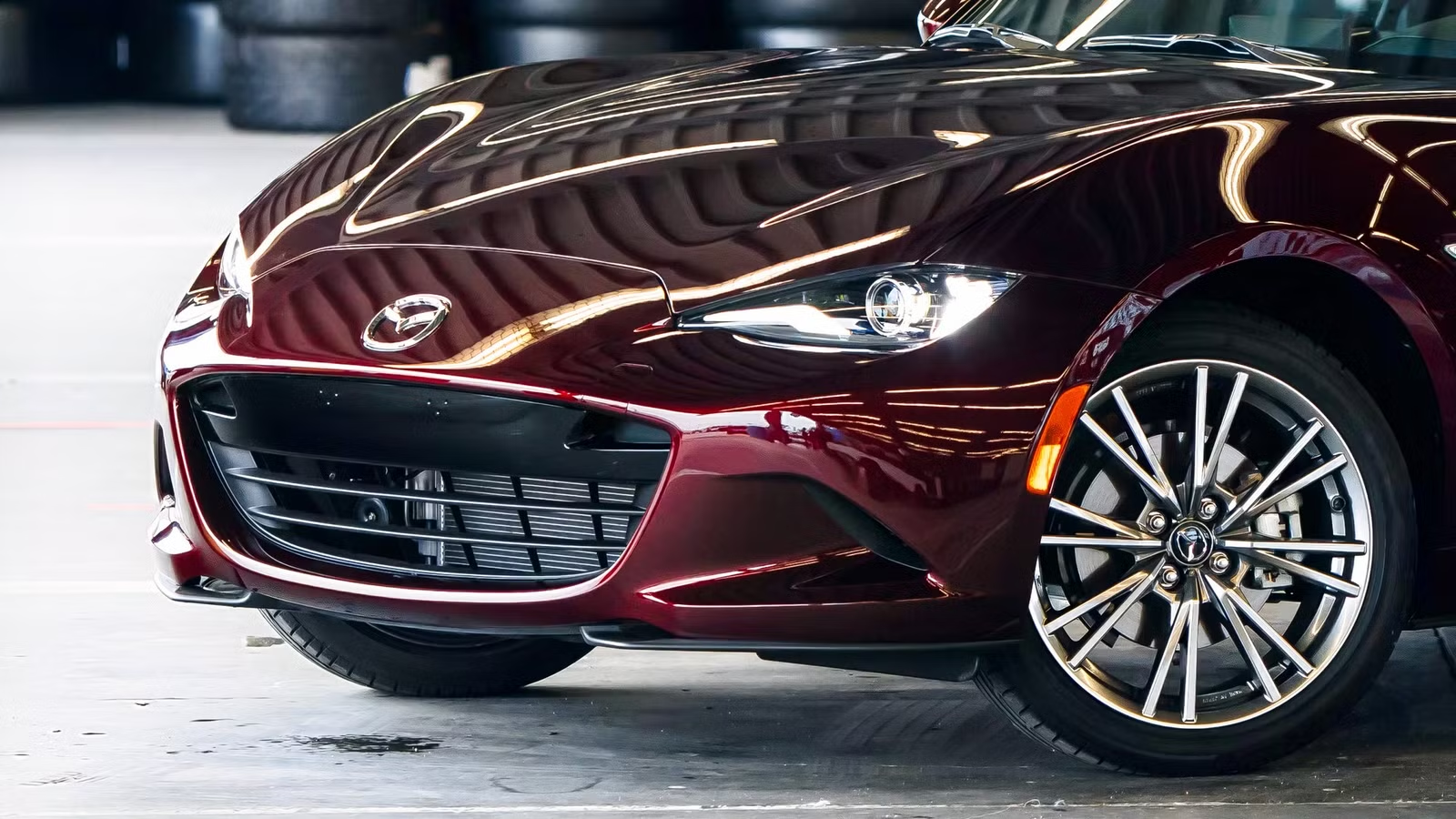
The MX-5 Miata received a mid-cycle facelift in 2024, giving it revised front and rear bumpers, new LED headlights with integrated LED daytime running lights, new LED taillights, and a fresh set of alloy wheel and paint choices. Kicking off the MX-5 Miata range is the base Sport, which gets 16-inch wheels, a sole manual transmission option (the proper transmission for a Miata, in my opinion), the full Mazda i-Activsense advanced safety suite (except for Mazda Radar Cruise Control), the second-generation Mazda Connect infotainment with wired Apple CarPlay and Android Auto, as well as a six-speaker audio system.
Stepping up to the Club adds a black rear spoiler and front chin, 17-inch black alloy wheels, heated front seats, wireless Apple CarPlay and Android Auto, a nine-speaker Bose sound system, Bilstein shocks, the new Asymmetric Limited-Slip Differential (Asymmetric LSD), and the new DSC Track for additional play within the limits of using DSC.
A close-up shot of the manual transmission in a 2024 Mazda MX5 MiataMazda
Finally, the range-topping Grand Touring benefits from adaptive LED headlights, rain-sensing wipers, body-colored mirrors with heating and auto-dimming, a two-tone finish for the 17-inch wheels, and a choice of leather or Nappa Leather upholstery. An automatic transmission becomes available in this variant, which adds Mazda Radar Cruise Control, but deletes Asymmetric LSD and DSC Track.
The MX-5 RF: A Folding Metal Roof That Adds Refinement Without Ruining The Formula
Front 3/4 shot of 2026 Mazda MX-5 Miata RF in white parkedIan Wright | CarBuzz | Valnet
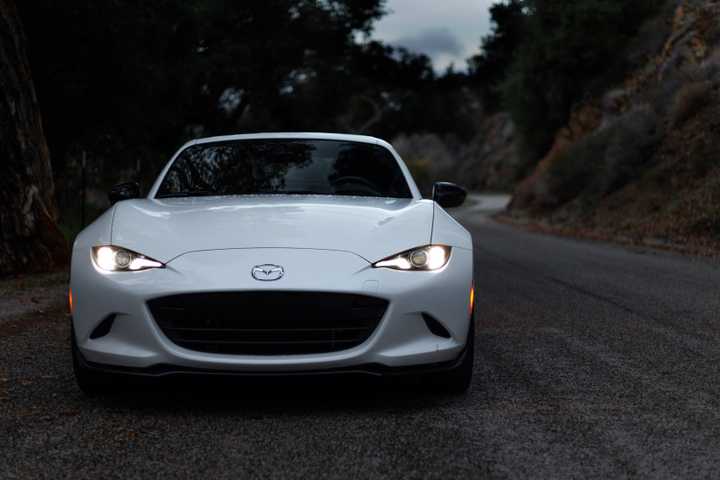
For those who like the fastback design of the RF, the MX-5 Miata RF is the version for you. Though the folding metal roof adds weight, the weight penalty is only a little over 110 pounds. For some, the added refinement of a folding metal roof is worth the weight penalty. To reflect this orientation, the MX-5 Miata RF range kicks off with the Grand Touring already, which mirrors the features of the Soft Top Grand Touring.
Lastly, the RF Club variant serves as the pinnacle of the entire MX-5 Miata range, and for this one, you can only get it with a manual transmission. Like the RF Grand Touring with a manual, you get Bilstein dampers in the RF Club, but also BBS forged wheels and heated Recaro sports seats with Alcántara upholstery.










No Comments