
The Forgotten Wide-Body Jeep That Predicted Today’s Factory Hot-Rod SUVs
Buyers in showrooms today are handing Ford and Land Rover more than $80,000 for factory wide-track performance SUVs, and Jeep’s own 2026 Wrangler Moab 392 stickers at $79,995, matching the Ford Bronco Raptor to the dollar.

Meanwhile, Jeep markets its heritage harder than any brand in the business. Here is the twist: the formula everyone is paying for — wide axles, flared fenders, a big V8, and full-time four-wheel drive — was invented five decades ago as a sub-$400 option box on a striped two-door from the disco era. Jeep built it first, and then Jeep quietly erased it.
The Wide-Body Performance SUV Wasn’t Born In The 2020s
Walk through the current crop of factory hot-rod SUVs and the recipe is remarkably consistent. Manufacturers widen the track, bolt on boxy fender flares, install a torque-rich V8 or something that behaves like one, and pair the package with permanent four-wheel drive and showroom-ready attitude.

That recipe now commands serious money. The 2025 Jeep Wrangler Rubicon 392 Final Edition carried a starting price of $99,995, while the 2026 Wrangler Moab 392 arrived at $79,995, a figure that lines up exactly with the Bronco Raptor’s MSRP. Land Rover’s Defender occupies the same financial territory once the configurator gets involved.

Automakers present the wide-body treatment as a modern innovation, and they price it accordingly. The flared wheel arches, the widened stance, and the extra rubber are positioned as advanced engineering worth a five-figure walk from the standard model.
The inconvenient history is that one American brand offered this identical formula fifty years ago for $349. It came straight from the factory, to outrun nearly everything else with a transfer case, and the company that built it has spent the decades since behaving as if it never existed.
The 1976 Jeep Cherokee Chief Invented The Wide-Body SUV For $349

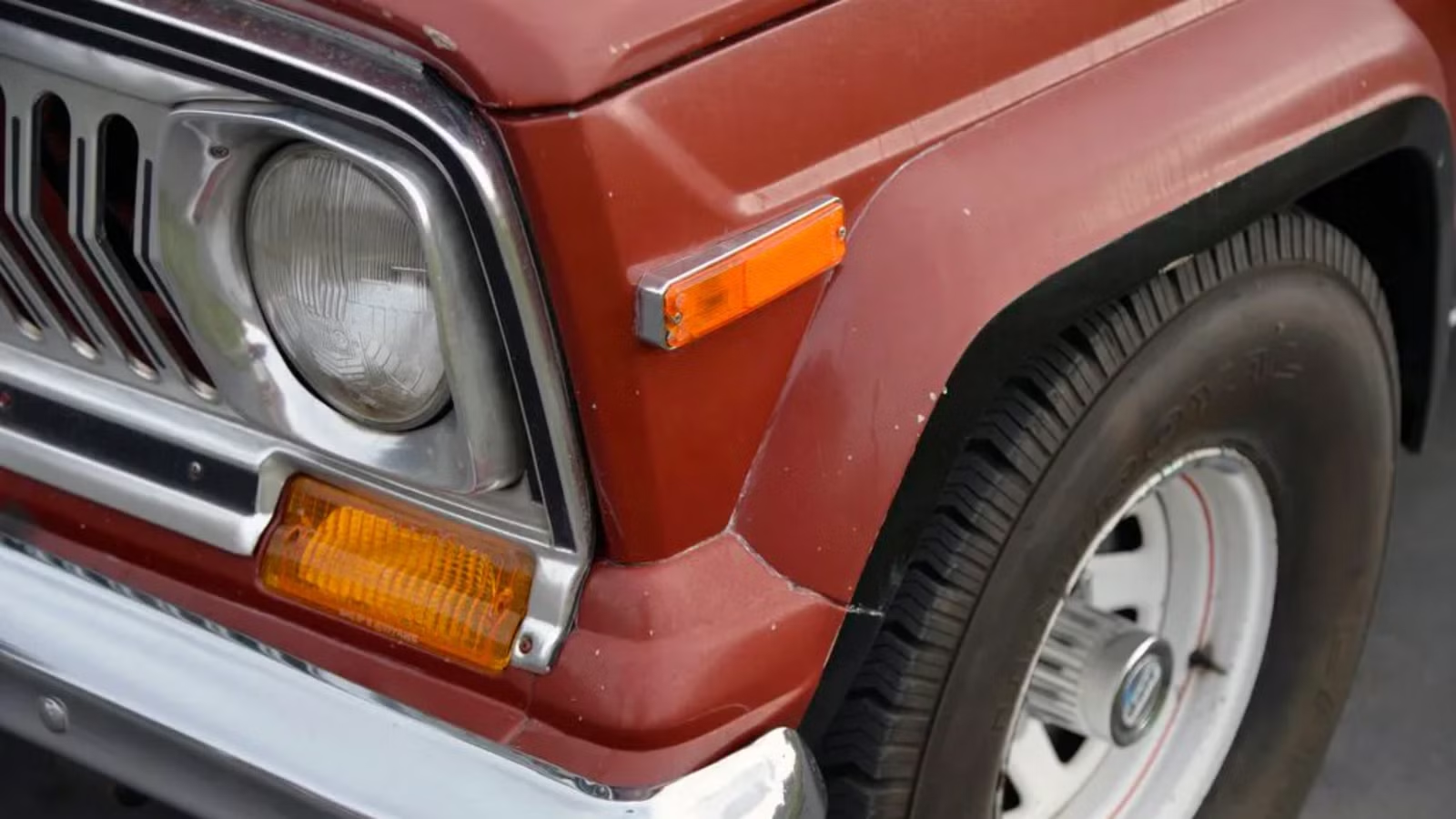
That $349 option box belonged to the Jeep Cherokee Chief. Jeep added the Chief package to the SJ Cherokee line in 1975 as an early 1976 model, bringing distinct trim, larger fenders, and wide-track axles that made room for larger tires.
The look was clever parts-bin engineering rather than a clean-sheet design. Jeep borrowed front fenders and rear flares from its J-truck line and paired them with wider axles, giving the two-door Cherokee a muscular silhouette that nothing else in the lineup could match.

The equipment list read like a modern special edition drawn up decades early. The Wide-Track option included exterior stripes, larger wheels, axles roughly three inches wider, enlarged front and rear wheel cutouts, Dana 44 axles at both ends, and an upgraded interior, all for $349 over the standard “S” model.
The numbers behind the stance were genuinely significant. Wide-track Chiefs measured roughly 65 inches of front tread against about 59.4 inches for standard Cherokees and Wagoneers, according to period documentation compiled by the International Full Size Jeep Association, making the Chief the widest-tracked full-size Jeep ever built and wider even than the heavy-duty J20 pickup.
Jeep kept the treatment exclusive to the two-door body, and four-door Cherokees never received wide-track axles. That exclusivity fit the mission, because the Cherokee courted younger, more adventurous buyers while the Wagoneer was pitched as the grown-up’s wagon. Squint at the spec sheet and the template becomes familiar. A widened stance, borrowed truck fenders, and available big-cube power is precisely the formula Jeep would rediscover decades later with the Grand Cherokee Trackhawk and the Wrangler Rubicon 392.
The AMC 401 And Quadra-Trac Turned The Chief Into A 100-MPH 4×4

The Chief’s engine ladder started sensibly and ended somewhere ridiculous. Buyers could choose a 4.2-liter inline-six, a 5.9-liter V8 with either a two-barrel or four-barrel carburetor, or the range-topping 6.6-liter AMC 401.
Period test numbers put the era in perspective. Motor Trend’s instrumented test of an inline-six automatic Cherokee Chief recorded a 0-60 mph run of 18.4 seconds and a quarter-mile of 21.2 seconds, which was entirely normal for a mainstream 4×4 of the mid-1970s.

The 401 was rated at up to 215 hp in early-spec form. The big AMC V8 carried a forged crankshaft, forged connecting rods, and the high-nickel block shared across the AMC V8 family, and with 3.07:1 highway gearing a 401-equipped Chief would run past 100 mph and outpace anything else in its class.
The supporting hardware was equally serious. A T-18 four-speed manual came standard, while buyers could option General Motors’ Turbo-Hydramatic TH400, a three-speed automatic more commonly found behind three-quarter-ton and one-ton trucks than family-friendly 4x4s.
The second half of the formula sat underneath the floor. Jeep’s chain-driven Quadra-Trac system delivered full-time four-wheel drive with an available 2.57:1 low range, meaning the Chief offered constant all-weather traction years before permanent 4WD became an industry talking point.

The window for the full-fat combination was brief. AMC discontinued the 401 at the end of 1978, so a wide-track Chief with the biggest engine and Quadra-Trac represents only about three model years of production, which goes a long way toward explaining their scarcity today.
The value equation is the part that stings the most in hindsight. The entire wide-track package cost $349 in period, while the stance alone is now baked into window stickers running from $80,000 to $100,000.
Restomod Builders Now Charge Six Figures For What Jeep Sold For $349

Finding a clean Chief today takes patience and money. Rust, hard trail use, and modest production numbers thinned the herd for decades, and the survivors now trade at figures that would have seemed absurd even five years ago. The market has rendered its verdict clearly. Classic.com records the highest SJ Cherokee sale at $315,000 for a 1979 Cherokee Chief in June 2026, which is genuine new-Defender and Grand Wagoneer money for a truck Jeep once sold as a $349 upgrade.
The restomod industry has gone further and built dedicated infrastructure around the Chief. Texas-based Vigilante, through its JeepHeritage parts arm, sells a fully boxed rolling chassis engineered specifically for 1976-1983 wide-track Cherokees, complete with Fox coilover suspension, an adjustable 4-link setup, Dana axles, and 6-piston Baer brakes, and it accepts the factory body with no cutting or fabrication.

Those chassis exist to handle serious output. Vigilante offers 6.2-liter Hellcat crate engines producing 707 hp, or Redeye versions making 810 hp, backed by Currie-built Dana 44 and Dana 60 axles, modern transfer cases, and braking hardware the original truck could never have dreamed of.
The validation runs deeper than horsepower. Vigilante began its chassis program with complete 3D scans of a 1980 Cherokee Chief body, which means these builders are constructing by hand, at six-figure prices, exactly what a factory Trackhawk-style Chief revival would be.
Jeep Revived Every Nameplate Except The One That Started It All

Jeep’s own history pages celebrate the wide-track era in loving detail, yet the Chief nameplate has never returned to a showroom. Even in period, follow-up packages like the 1979 Golden Eagle simply reskinned the Chief formula with new graphics rather than advancing it.
The competitive stakes make that absence harder to explain. Ford sold 109,921 Broncos through the third quarter of 2025 against 128,054 Wranglers, and the gap has been closing rapidly as Ford discounts the Raptor into direct contention with Jeep’s own V8 offerings.

A revived Chief would not require inventing anything, because the nameplate, the silhouette, and the wide-track playbook are already sitting in Jeep’s archives.
Ford and Land Rover did not invent the wide-body performance SUV, because Jeep wrote the recipe in 1975, priced it at $349, and then spent five decades pretending otherwise. Every Moab 392 and Bronco Raptor sitting on a dealer lot today is, in effect, a Cherokee Chief tribute act performing with a six-figure cover charge.
Sources: Jeep, Motortrend, Classic, International Full Size Jeep Association

Related posts
Latest Post


No Comments