
The Subaru Pickup That Bolted Plastic Chairs In Its Bed To Dodge A 25% Tariff
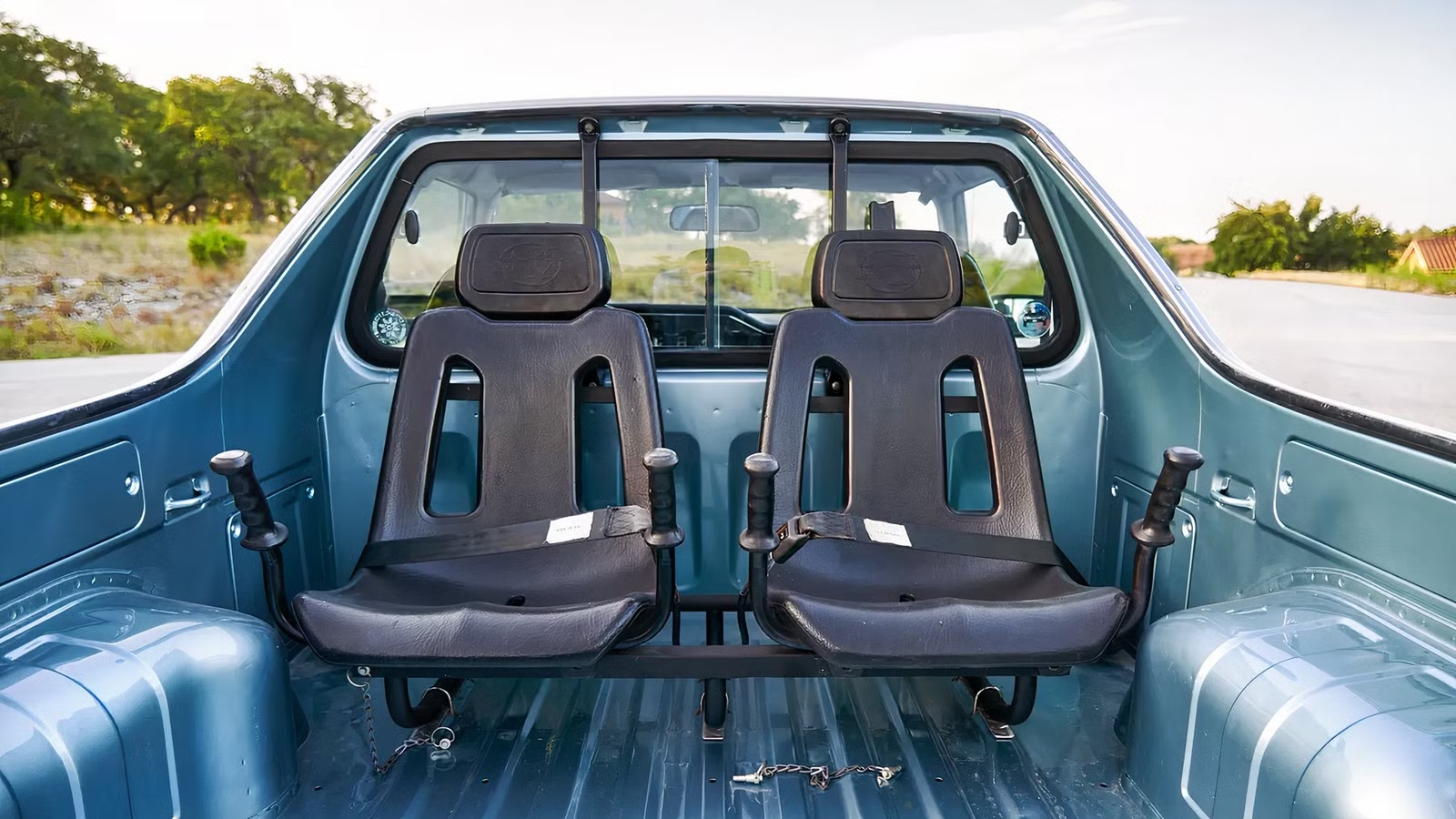
The concept of having two people strapped into factory-fitted, rear-facing lawn chairs in the back of a pickup cargo bed seems absurd today. However, in the late 1970s, this was Subaru calculated legal hack to circumvent the 25% “Chicken Tax” that was introduced in 1964 on imported light trucks.

As one of the auto industry’s most bizarre regulatory workarounds, this allowed Subaru to enter the rapidly growing compact pickup segment in the US with an unusual unibody load-hauler that was completely different from anything else on the market. By simply bolting on two open-air rear seats, it was officially classified as a passenger vehicle, and therefore only subject to a 2.5% import tariff – a tenth of the duty applied to other fully built-up light pickup trucks. It was a bold plan that worked.
The Chicken Tax
America’s so-called “Chicken Tax” was an import tariff that originated in the 1960s due to a trade dispute with Europe, which had introduced levies on poultry to protect its local farmers from rapidly growing US exports. The US retaliated with a 25% tax on a variety of imported goods, which included trucks as its auto industry came under increasing threat from imported vehicles.

European manufacturers had already established a growing presence in the US, but the 1960s and 1970s saw the Japanese manufacturers gaining a significant foothold. They offered consumers smaller, less expensive, more fuel-efficient, and often better-built and more reliable alternatives to the large gas-guzzlers that dominated the product offerings from America’s Big Three auto giants: Chrysler, Ford, and General Motors.

These factors were forced to the forefront of car-buying decisions during the first global oil crisis in 1973, and then again during the second one that hit in late 1978. Increasing pressure created by US emissions and fuel economy regulations spurred on further demand for Japanese cars, while the US automakers proved consistently slow in responding to the rapidly evolving automotive climate.
There are so many similarities to today’s ICE/EV battle, the tit-for-tat tariff wars, and the exponential growth of China as an automotive manufacturing powerhouse, it’s uncanny. However, the Chinese brands haven’t yet had any direct sales impact on the US market due to prohibitive trade policies, perceived connected vehicle security concerns, and a 100% import tariff on Chinese-made EVs.
Creative Workarounds

The Volkswagen Type 2 was among the first vehicles to be heavily affected by the 25% tariffs that came into effect in 1964, having been sold in the US since 1952. The tax applied to the single cab, double cab and panel van models, but not the Transporter passenger versions.
The 25% tariff ultimately drove VW out of the pickup market in the early 1970s, but the Japanese manufacturers soon filled that gap over the ensuing years with the Datsun 620, Toyota Hilux, Mazda B-Series (and its Ford Courier twin, built by Mazda), and the Isuzu-built Chevrolet LUV. All these pickups relied on a body-on-frame construction, and would have been slapped with the same additional import tax had the manufacturers not found a clever loophole.

The US Customs tariff schedule explicitly treated a cab chassis without its cargo box as a “truck chassis,” which only carried a 4% duty, while a complete light truck attracted the full 25% penalty. Accordingly, the vehicles were simply shipped to the US without the cargo bed, which was either imported separately or manufactured locally before being fitted.
Eventually, the workaround was eliminated for all light pickup trucks in August 1980, forcing the imported brands to prioritize setting up or expanding US production.
Subaru Needed A Different Solution

Subaru was eager to get a slice of the US pickup market. Without a body-on-frame pickup in its portfolio, it developed the functionally accurate yet ridiculously named “Bi-Drive Recreational All-Terrain Transporter” (shortened to BRAT) as a compact pickup based on the Subaru Leone/L-series passenger car that had been sold in the US since 1972. Despite its family car underpinnings, the BRAT was classified as a pickup, and therefore subject to the Chicken Tax that would have made it prohibitively expensive.
It used a unibody construction, which meant the cargo bed was integrated into the overall bodywork of the vehicle, and couldn’t be removed as its rivals had done as a cheeky “cheat code”. Therefore, Subaru’s engineers found an innovative and completely legal solution that required nothing more than bolting two plastic rear-facing jump seats to the open cargo bed, complete with safety belts and grab handles.

Although this offered very little safety for the exposed rear-seat occupants, the NHTSA had no option but to concede that these were legitimate designated seating positions. The quirky BRAT was thus classified as a passenger vehicle, attracting a 2.5% tariff instead of 25%, despite it undeniably being a pickup.
When the cab-chassis loophole was closed for the other Japanese manufacturers in 1980, Subaru held the unique advantage of retaining the low tariffs due to its passenger car classification. The market soon moved on, though, leaving the BRAT trailing on the sales charts after an initial spike.
Early Commercial Success Soon Faded

The Subaru BRAT was launched in the US in 1978, powered by a 1.6-liter flat-four engine producing a mere 67 horsepower and 81 lb-ft of torque. With a starting price of $4,209 at the time, it was more expensive than the Chevy LUV, Hilux, and B-Series, but undercut the Datsun 620 by nearly $200.
However, it had unique features that none of its rivals could offer: selectable part-time four-wheel drive with low range as standard; car-like driving characteristics; and yes, that unusual and legitimate four-passenger capability. This was matched to a load capacity of around 1,000 pounds, which wasn’t far off its competitors, which ranged from 1,100 to 1,400 lb in standard wheelbase forms.

Later BRAT models received an upgraded 1.8-liter flat-four engine, which was available in 73–82 hp naturally aspirated form, or with a turbocharger that produced between 95 hp and 111 hp in the final iterations. A four-speed manual was standard along with an optional three-speed automatic, except on the turbo models, which were only offered with the automatic.
Approximately 100,000 units were sold in the US from 1978 through to 1987, when imports ended. This included a 1981 facelift and, ironically, the deletion of the rear jump seats for the final two model years.

Although it enjoyed strong sales of around 23,000 units in 1978 and 1979, the BRAT’s niche status and novelty soon wore off as the other Japanese manufacturers offered greater capability with the addition of 4×4 variants, heftier load capacities and more powerful engines. By 1980, sales dropped to 12,000 units and then averaged between 4,000 and a peak of 6,900 vehicles over its remaining lifespan, ending on 1,274 sales in 1987. It continued to be exported to Europe, Australia and New Zealand until 1994 (badged variously as the Brumpy, MV and 1800 Pickup in other markets), but was never sold in Japan despite being built there.
A Small But Enthusiastic Following

As with many unusual and interesting cars, the BRAT has shifted from what was once just a practical and affordable compact pickup with an unusual side story, to a vehicle that has become quite collectible and sought-after by Subaru enthusiasts. It also appeals to buyers that are drawn to novel cars that are out of the ordinary – and the BRAT certainly ticks those boxes.

Its popularity will have been greatly enhanced through the wild antics of Travis Pastrana and the team from Hoonigan. They transformed a 1978 BRAT into the unhinged Brataroo 9500 Turbo, which has 10 times the original car’s power, for its latest Gymkhana video in Australia that went live in late 2025. It includes two daring passengers strapped into the unconventional rear seats for the epic downtown Sydney Harbor drift sequences.
Prices for the BRAT are unexpectedly strong for what was ostensibly a relatively cheap work truck that didn’t sell in huge numbers, and that in most cases would have been used and abused rather than preserved. There’s no real indication of how many remain on US roads today, but they rarely come up for sale or auction. The most recent transactions on Bring a Trailer were $16,500 for an original one-owner 1982 1.8-liter GL manual with 54,000 miles, and a later 1986 model with 83,000 miles for $16,951. The entry point for a high-mileage example is around $7,500, while an immaculate or restored car is likely to fetch close to $20,000 or more – if you can find one.

This rarity, along with the offbeat character and charm, certainly contribute to its appeal. The inevitable interest and value enhancement generated through the Gymkhana 2025 starring role is hard to quantify, but it has certainly thrust this eccentric rule-breaking pickup back into the enthusiast mainstream.
Sources: Subaru, Volkswagen, Bring a Trailer, Classic.com

Related posts


Latest Post


No Comments