
The Muscle Car Configuration So Insane Almost Nobody Ordered It
Muscle car fans love to debate the rarest configuration ever built. And yes, there was once a one-year-only 450-horsepower beast. And yes, as few as 20 hit the streets. But the truth is that it wasn’t rare because it was forgotten. It was rare because it was a configuration so absurd that no one ordered it. It all begs the question: why did the automaker offer it in the first place?
The Rarest Muscle Car Configurations Were Rare For A Reason

There are a few high-performance muscle car configurations, built in ultra-low numbers, that stand out throughout automotive history. Most were purpose-built tools for a specific job. And that job was almost always drag racing.
The most iconic example might be Pontiac’s 1963 “ Swiss Cheese” 421 Catalina. GM fitted them with a 421 cubic-inch V8 conservatively rated at 405 hp and aluminum front fenders, fender wells, hood, radiator support, and bumpers. But if you think they were lightweight sports cars, think again. Other weight-cutting measures included a manual transmission with just three gears, deleting the front sway bar, deleting all sound insulation, and drilling holes in the frame. That’s right, the engineers drilled 130 holes in the metal of the frame to make the drag racer lighter. You couldn’t even buy a “Swiss Cheese” Catalina. Pontiac assembled 14 and gave them away to prominent drag racing teams for publicity.
Another classic example is when Mopar built its Super Stock 1967 Dodge Coronet (W023)/Plymouth Belvedere II (R023). To qualify for competition, these needed to be “stock” cars, so Chrysler Corporation shut down an assembly line on a Sunday to build 55 of each model. They obviously had the 426 Hemi V8, but it was tuned up with modified intakes. Mopar also tossed short Hooker headers and a Prestolite transistorized ignition setup in the trunk for buyers to install later. To save weight up front, the big car’s suspension components were swapped with the lightweight running gear from a compact “A-body” Mopar, such as a Dart. Just 11 of the Coronet W023s were ordered with the slower manual transmission, making it one of the rarest Mopar configurations ever.


Over on the Blue Oval side, the 1964 Thunderbolt was a complete Frankenstein car. Ford dropped the NASCAR-homologation 427 “high rise” V8 with its 4-barrel Holley carb into a racing version of the tiny Fairlane. Engineers swapped the doors, hoods, fenders, and bumpers out for fiberglass components, the side and rear windows out for plexiglass, and deleted every creature comfort. They even yanked the passenger-side windshield wiper to save a few ounces. The resulting “Thunderbolt” was once clocked running the 1/4 mile in 11.61 seconds at 124 mph. Ford assembled 49 4-speed cars and 51 automatics.
But there was one 450-hp car offered by Chevrolet that might have been built in even lower numbers than any of the above drag racers. Even in a world of special editions with holes in their frames and windshield wiper deletes, it made no sense.
Chevrolet’s LS6 Chevelle Was An Endangered Species When It Debuted

Chevrolet might be responsible for putting the final exclamation point on the muscle car chapter of automotive history. In 1970, it debuted a 454 “LS6” V8. The absurd 11.25:1 engine with its four-barrel Holley 780-cfm carb had a factory rating of 450 hp at 5,600 rpm and 500 lb-ft at 3,600 rpm.
The 7.4-liter V8 was a drag racing monster, barely suitable for street use. Buyers could pair it with the Muncie M22 4-speed stick shift or a Turbo Hydra-Matic 400. Buyers could also order it in either the Chevelle or the El Camino, for a muscle truck truly too wild for its era. But that was far from the most bizarre configuration available.

When MotorTrend took the 1970 Chevelle LS6 out for a road test, it admitted the car was meant for much more than drag racing teams to buy and modify. In fact, it listed several components it recommended owners swap out during a full transmission and rear-end teardown after a few thousand miles—or a few passes at the drag strip. This thing had so much low-end torque, MotorTrend recommended filling your left rear tire to 30 psi but leaving the right at 28 psi. But stock, it handily ran 13.44 seconds in the 1/4 mile.
The reviewers found that at a standstill, anything more than a light touch of the throttle sent the wheels spinning. Their maximum effective launch rpm was just 900: idle speed. In fact, they achieved their fastest 1/4-mile run by getting the engine as hot as possible just to reduce low-end torque and launch at a higher rpm. Yeah, the LS6 Chevelle simply had too much torque.
Reviewers Wrote Eulogies For The 1970 454

MotorTrend’s 1970 road test read more like a eulogy than a review. “Even though buyers might still be available after 1971, strict legislation concerning emission outputs, coupled with ascending insurance rates, will render this car—or this type of car—worthless.”
It predicted that California’s transition away from leaded gasoline and tightening emissions regulations would soon spread nationwide, threatening the future of high-compression engines like the LS6. Insurance rates for a car with the LS6’s horsepower were on track to be a full third of the car’s value within a few years. MotorTrend concluded, “We savored every moment of this car, for the memory may have to last a long time.”
The journalists were right. Early 1971 GM literature showed the LS6 V8 was technically available in the Chevelle. But no LS6 Chevelles were assembled; the LS6 returned for 1971 as a Corvette-only option, with just 188 buyers selecting the high-compression big-block before it disappeared. The short lifespan of the LS6 Chevelle makes its rarest configuration even rarer.
The Convertible LS6 Chevelle Was A Configuration So Insane That No One Wanted It

GM produced approximately 4,663 LS6 engines across the 1970 Chevelle/El Camino and 1971 Corvette. The third-rarest configuration was an LS6-powered El Camino, with around 500 built. The second rarest was the 1971 Corvette LS6, with just 188 built. But far and away, the rarest configuration was the 1970 LS6-powered Chevelle convertible. GM never published official numbers, but experts agree there may have been as few as 20 assembled. And for good reason.
The MotorTrend review gives you some idea how much torque the LS6 Chevelle made (too much). Now imagine stripping off the metal roof panel. The resulting car would be floppier than a rubber Gumby doll forgotten on the pavement on a 98-degree summer day.

Launches and cornering would be a challenge—to say the least. MotorTrend swapped the stock shock absorbers out for Hurst/Gabriels with 1 3/16th-inch pistons, saying they “made handling better.” But a convertible might require even more love.
Finally, the convertible version was actually heavier than the hardtop Chevelle. That meant it was a nonstarter for drag racers who needed all the advantage they could get. There were also obvious safety concerns about hitting 100 mph in a ragtop with no rollover protection. But some folks did order the LS6 convertible.
Chevrolet Sold A Handful Of LS6 Chevelle Convertibles

Chevrolet did not keep records of specific Chevelle configuration sales numbers. LS6 V8 engine production numbers come from the New York plant where that V8 was assembled. This is how we know that GM sold 4,475 LS6-powered A-bodies of various configurations in 1970. But historians do have some estimates of how many were convertibles.
According Chevelle expert Dan Carr estimates the likeliest production number at 95 LS6 convertibles. Appraiser Colin Comer’s number is a bit lower: 17 to 50. Back in 2018, Hemmings admitted there might have been “less than 20” built. Hot Rod magazine puts the number anywhere between 20 and 70. When Mecum listed an automatic LS6 convertible, it announced that this was one of just 18 with the automatic transmission still in existence, but didn’t offer further evidence. The number of surviving four-speed cars could be even lower.

At the end of the day, buyers ordered more than zero LS6 Chevelle convertibles. But the actual number was close to none. Of the 4,475 LS6 engines built, fewer than 2% ended up in Chevelle convertibles.
The LS6 Chevelle Convertible Is A Bizarre Chapter of Detroit’s History

So who ordered an LS6 Chevelle convertible? Like everything else about these cars, we don’t have a ton of information on these vehicles’ original buyers. The following information is gathered from Mecum auction listings.
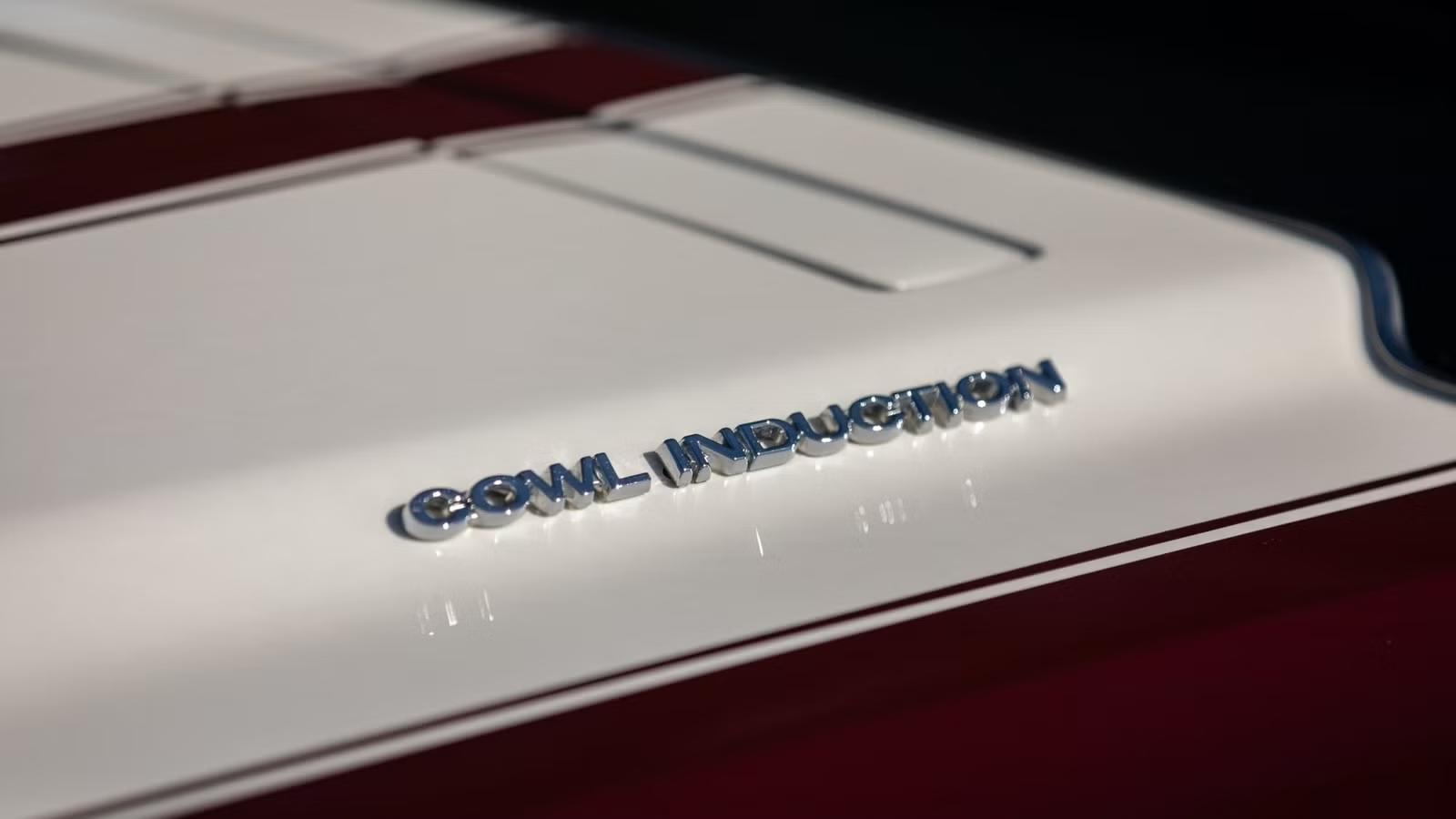
VIN 136670B134303 had the first two owners put 44,000 miles on the clock but was “never modified for racing.” Meanwhile, two buyers (VIN 136670B142595 and 136670B161703) insisted on the powerful LS6, but deleted the “D88” stripe option and cowl induction hood scoop. The result was lightning-quick sleepers. Bob Fuller of Iowa went in the opposite direction: he added a custom “450 H/P” callout to the rear bumper of his black automatic LS6 convertible. It was actually one of two LS6 Chevelles Mr. Fuller owned, and he didn’t reach for the ragtop’s keys often, driving it just 10,222 miles in 50 years.
A major clue is VIN 136670L159017. It was actually ordered by General Motors. It was optioned with every possible extra, finished in light blue with a light blue interior and white stripe, and then shipped to Colorado. It was delivered to Chuck Ruwart Chevrolet in Denver, to be specific. It became the company car for GM’s “Zone Representative” out there. Cruising around the Rockies in this thing must have been a nice job perk for someone. Perhaps GM knew the LS6 convertible was impractical, but the marketing department could think of no better billboard for the 454 than a carefree droptop that could go like a bat out of hell.

Here are the details of all the cars I could dig up. VIN 136670B161703 (finished in turquoise with a manual) and according to Mecum it sold for $308,000. VIN 136670L195340 (black automatic, unrestored) also sold at Mecum for $330,000. VIN 136670B175145 (a red automatic) sold via Mecum for $396,000. VIN 136670L159017 (a light blue automatic) sold by Mecum for $434,500. Then VIN 136670B155423 (a white manual) broke the Chevelle record when it sold at a Mecum auction for $660,000. VIN 136670B188926 (a dark red manual) sold at Mecum for $770,000. VIN 136670B138594 (a forest green manual) sold in Scottsdale via Barrett-Jackson for an undisclosed sum. Finally, enthusiast Dan Carr restored a light-green-over-red example with an undisclosed VIN that is definitely not for sale.
Sources: General Motors, LS6 Registry, Hemmings, Hot Rod, MotorTrend, Mecum, and Barrett-Jackson

Related posts
Latest Post


No Comments