
Suzuki’s Motorcycle-Powered Supercar Concept Explained
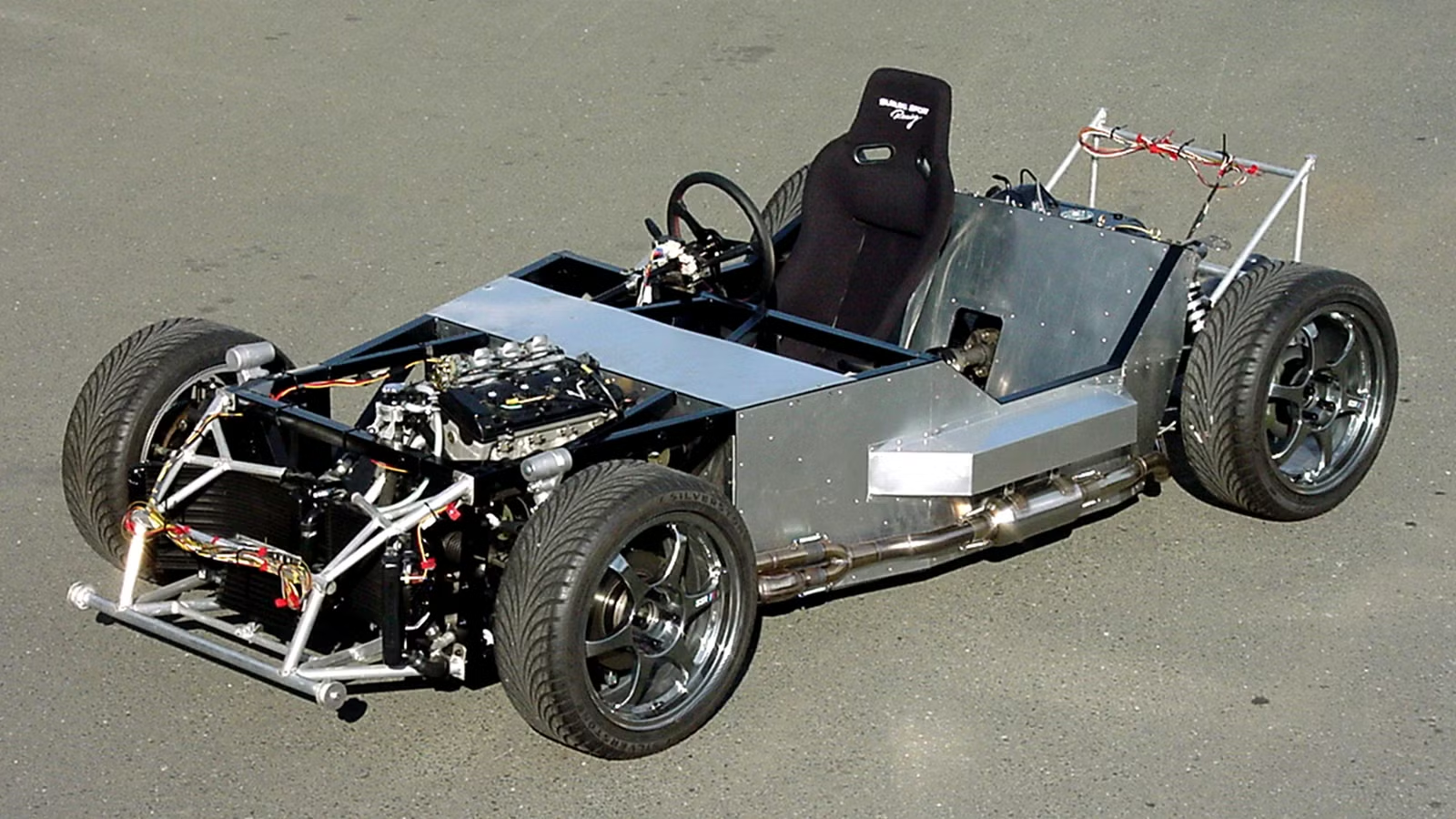
Modern lightweight performance cars like the Ariel Atom, KTM X-Bow and BAC Mono have proven that exhilarating driving experiences do not always require enormous power outputs. By combining minimal weight, compact dimensions and high-revving engines, these machines deliver a level of engagement that rivals far more powerful sports cars.

However, more than two decades ago, one forgotten Japanese concept explored this same philosophy by pairing a superbike engine with an ultra-light sports car. Despite its innovative engineering and remarkable performance potential, it never reached production and has since faded from enthusiast conversations.
The Forgotten Suzuki Supercar Powered By A Motorcycle Engine
Long before lightweight, minimalist sports cars became a recognized niche, Suzuki explored the idea of combining superbike technology with a dedicated performance machine. During the late 1990s and early 2000s, manufacturers were increasingly experimenting with radical concept cars that challenged traditional ideas of performance, design and engineering.

Suzuki’s ambitious project followed this trend by creating an ultra-light sports car built around motorcycle-derived technology rather than a conventional automotive engine. Despite its advanced thinking, impressive engineering and unique approach to performance, the project never progressed beyond the concept stage. Today, it remains one of Suzuki’s most overlooked and interesting creations, remembered by only a small group of enthusiasts who appreciate what the Japanese manufacturer attempted to achieve.
Meet The Suzuki Hayabusa Sport Concept

Unveiled in 2002, the Suzuki Hayabusa Sport Concept was one of the most unusual performance projects to emerge from the Japanese manufacturer. Displayed at the 2002 Tokyo Auto Salon, the concept demonstrated Suzuki’s ambition to transfer the extreme performance characteristics of its flagship superbike into an ultra-lightweight sports car.
Rather than using a traditional automotive engine, Suzuki fitted the concept with the original Hayabusa’s 1.3-liter, four-cylinder motorcycle engine in a front-mid-engine layout, creating a machine focused on minimal weight, agility and driver involvement. With its tiny footprint, race-inspired construction and motorcycle-derived powertrain, the Hayabusa Sport Concept represented a bold alternative vision for future performance cars. Although it never entered production (like its previous motorcycle-engined concept), its innovative approach continues to attract enthusiasts who appreciate its ahead-of-its-time engineering philosophy.
Suzuki Borrowed One Of The World’s Fastest Motorcycle Engines

At the heart of the Suzuki Hayabusa Sport Concept was the same 1.3-liter inline four-cylinder engine that powered the legendary GSX1300R Hayabusa superbike. In its original application, the high-revving unit produced around 173 horsepower at 9,000 rpm and 102 lb-ft at 7,000 rpm, giving the lightweight concept an exceptional power-to-weight ratio. The engine was paired with a six-speed sequential transmission, allowing rapid gear changes more familiar to racing motorcycles than conventional road cars.
Suzuki chose this powertrain because it offered impressive performance in a compact and lightweight package, perfectly matching the concept’s minimalist philosophy. However, the motorcycle engine also brought compromises, including limited low-speed torque, a narrow powerband and a less conventional driving experience compared with a traditional sports car engine.
Just 1,212 Pounds Made Every Horsepower Count

The Suzuki Hayabusa Sport Concept’s greatest performance advantage came from its incredibly low mass. Weighing just 1,212 pounds (550 kilograms), the lightweight machine achieved a power-to-weight ratio comparable with many dedicated sports cars despite using a relatively small motorcycle engine.
With 173 hp available, the concept theoretically offered supercar levels of acceleration, with estimates suggesting a 0–62 mph sprint in the region of four seconds. However, outright speed was never the primary objective. Suzuki focused on agility, sharp responses and maximum driver involvement, with the low weight benefiting braking performance, cornering ability and overall control. The result was a car designed to deliver an intense, mechanical driving experience where every input from the driver mattered.
It Offered Mid-Engine Engineering Inspired By Race Cars

Beyond its motorcycle engine, the Suzuki Hayabusa Sport Concept featured a layout designed around pure driving involvement. Its front-mid-engine configuration placed the powertrain mainly behind the front axle, while rear-wheel drive ensured a more traditional sports car character.
The lightweight chassis was engineered around compact packaging and ideal weight distribution, allowing Suzuki to maximize traction, balance and cornering ability. The suspension system was designed with performance driving in mind, helping the concept deliver sharp responses and race car-like agility.
By combining a small footprint, centralized mass and minimalist construction, Suzuki created a machine focused less on outright power and more on the connection between driver, chassis and road. Its engineering philosophy closely reflected the principles used by modern lightweight track-focused sports cars.
Minimalist Styling That Still Looks Modern Today

The Suzuki Hayabusa Sport Concept’s design followed the same lightweight philosophy as its engineering, prioritizing function over unnecessary decoration. Its compact proportions, low stance and minimalist cockpit gave it the appearance of a purpose-built track machine rather than a conventional road car.
The bodywork featured clean surfaces and integrated aerodynamic elements that highlighted the concept’s performance-focused character. Instead of relying on excessive styling details, Suzuki allowed the structure and engineering to become part of the visual appeal. More than two decades later, the concept still looks surprisingly contemporary because its design follows principles now common among lightweight performance cars: simplicity, minimal mass and an uncompromising focus on the driving experience.
Why Suzuki Never Built It This Concept

Despite its advanced engineering, the Suzuki Hayabusa Sport Concept was never intended to become a mainstream production model. Turning a radical prototype into a road-going sports car would have required significant investment in development, safety testing, emissions compliance and manufacturing processes.
More importantly, motorcycle-engined cars remained a highly specialized market with limited appeal beyond dedicated enthusiasts. For Suzuki, the business case for producing a lightweight performance car with such a narrow audience was difficult to justify, especially as the company focused on its core motorcycle, compact car and mass-market vehicle businesses. The concept successfully demonstrated what was technically possible, but the costs and limited commercial potential ultimately outweighed the benefits. As a result, Suzuki’s ambitious experiment remained a fascinating one-off rather than a production reality.
History Eventually Proved Suzuki Was Right

Although the Suzuki Hayabusa Sport Concept never reached production, the lightweight performance philosophy behind it would later become increasingly popular. Cars such as the Ariel Atom, KTM X-Bow, BAC Mono and Radical models proved that extreme performance could be achieved through minimal weight, compact dimensions and driver-focused engineering rather than simply chasing more horsepower. It is also fair to say that Caterham laid that foundation many years earlier.
Today, the concept deserves greater recognition as a bold and innovative experiment that combined motorcycle and automotive engineering in a unique way. As a one-off creation with no production successor, it remains an exceptional concept and continues to fascinate enthusiasts. Ultimately, it stands as one of Suzuki’s greatest performance “what if?” cars.
Sources: Suzuki Sport Racing, Global Suzuki

Related posts





Latest Post


No Comments