
The Motorcycle That Makes Buying Another Bike Hard To Justify
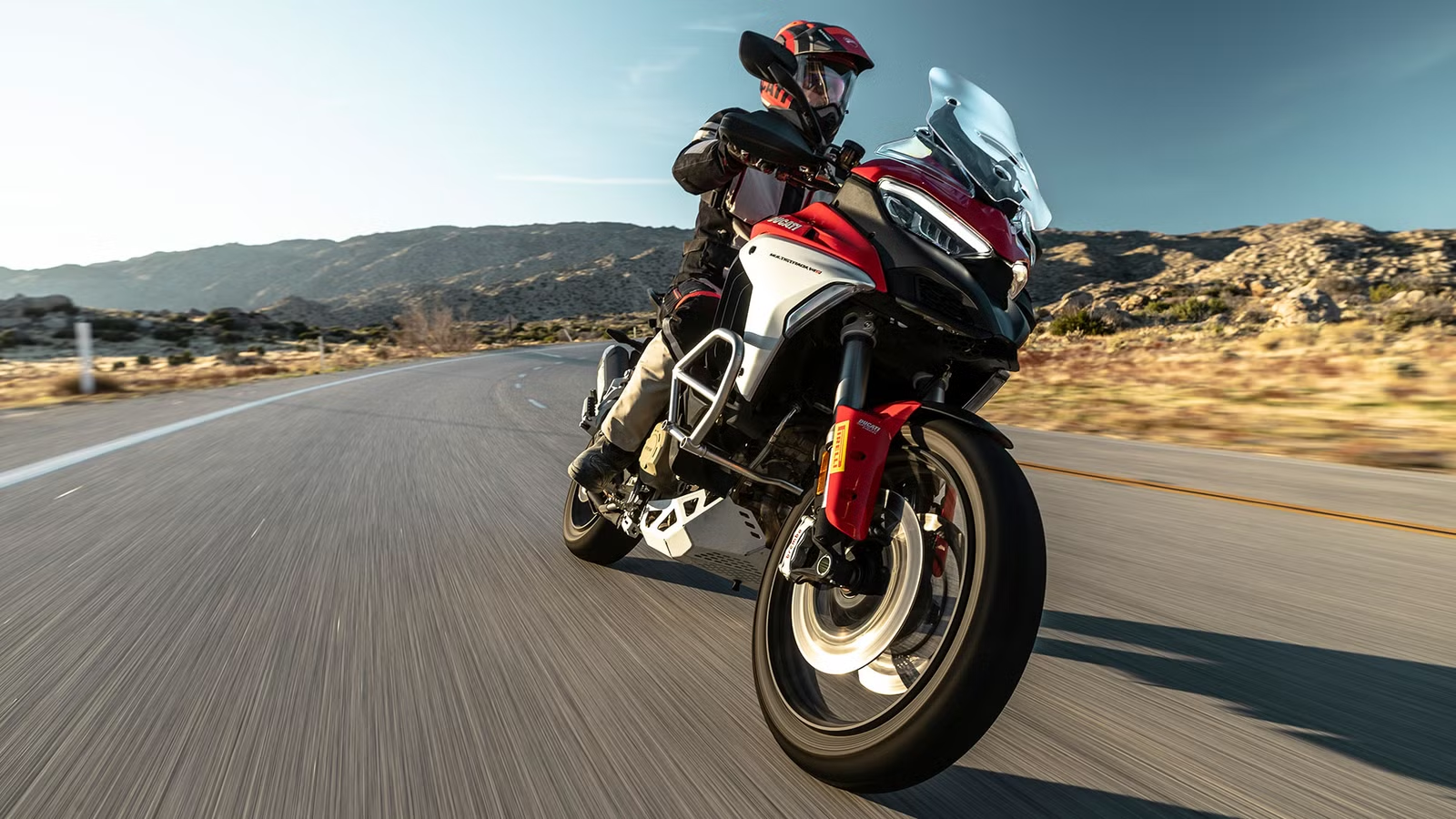
Getting your first motorcycle is a rather spectacular occasion. Every ride feels like an excuse to go somewhere, every unfamiliar road becomes an opportunity to explore, and with more time in the saddle, you start discovering what your motorcycle does particularly well and where it falls short. Then you ride a friend’s motorcycle, spend more time immersed in the culture of being on two wheels, take a longer trip, and begin to see just how differently other bikes can approach the same roads. Before long, that is how one motorcycle becomes two, then three, and the idea of building a multi-bike garage starts to seem less excessive and more inevitable. But ever since the inception of a certain kind of motorcycle, the question of whether you really need more than one bike has become a little harder to answer.
Why Adventure Motorcycles Are The Ultimate All-Rounders Today

Sure, adventure motorcycles are relative newcomers to the world of two wheels, but they have quickly become some of the most versatile motorcycles around. A Kawasaki Ninja ZX-6R is built to devour corners, a Honda Gold Wing is made to rack up serious miles in comfort, and something like a Kawasaki KLX230 is happiest picking its way through mud, rocks, and whatever lies beyond the road.
These motorcycles are specialists, while an adventure bike takes the opposite approach, borrowing enough from each world to handle almost all of them. Even within the category, there are different flavors, with some leaning toward pavement, others toward dirt, and flagship models combining performance, comfort, technology, and touring ability in one package.
Flagship Examples Get You The Best Of Everything

A basic adventure motorcycle or dual-sport proves the concept, but the flagships take it much further. At $20,000 and up, they effectively ask how many compromises can be removed from one motorcycle. The answer is a lot: an engine that keeps pulling across the rev range, suspension that can sometimes do the thinking for you, proper touring comfort, and enough bells and whistles to make almost every ride easier. They can still handle dirt, too. The only real compromise is that dropping a 500-pound-plus flagship is going to be a lot more painful than dropping a lighter ADV.

The Multistrada Has Spent More Than 20 Years Perfecting The All-Rounder Formula

And when you’re talking about expensive, technically ambitious motorcycles, a team from Bologna, Italy, was bound to have its own take on the all-rounder. Ducati called it the Multistrada, which translates to “many roads,” and the first one arrived in 2003 as the Multistrada 1000 DS, a tall, unusual-looking motorcycle that mixed Ducati’s sporting character with the comfort and versatility needed to cover more than just a winding road.
The platform changed considerably from there. The Multistrada 1200 introduced Ducati’s idea of four motorcycles in one through its Riding Modes, while later versions added more sophisticated electronics, variable valve timing, and semi-active suspension. By the time the V4 arrived for 2021, the familiar V-twin had given way to the 1,158cc Granturismo V4.
Where The Multistrada V4 S Fits Into Ducati’s Adventure Lineup

The Multistrada family has taken on a few different flavors by 2026. The V2 and V2 S offer the smaller, lighter interpretation, while the V4 brings the 1,158cc Granturismo to the party. The V4 Rally adds more range and touring equipment, the Pikes Peak tilts the formula toward the road, and the V4 RS pushes it further toward performance. Then there is the V4 S, which brings together the V4’s performance, premium semi-active suspension, radar-assisted rider aids, touring equipment, and technology aimed at making a big adventure motorcycle easier to live with.
The V4 Granturismo Gives The Multistrada Performance To Match Its Versatility

At the heart of the Multistrada V4 S is Ducati’s 1,158cc Granturismo V4, producing 170 horsepower and 92 pound-feet of torque. It also represents a pretty major departure for Ducati, replacing the Multistrada’s V-twin and its Desmodromic valve system with a conventional spring-return setup.
On paper, that might sound like a step backward for a company so closely associated with Desmo, but the Granturismo makes a good argument otherwise: Ducati says the spring system puts less stress on the components and allows the valve-clearance interval to stretch to 37,000 miles. The 90-degree V4 also gets a counter-rotating crankshaft and Twin Pulse firing order.
The Chassis And Hardware Are Built To Put That Performance To Work

The V4 S puts that engine into an aluminum monocoque chassis, with a 19-inch front wheel, 17-inch rear, and Brembo four-piston front calipers. More importantly, it gets Ducati’s Skyhook DSS EVO semi-active suspension, which the standard V4 misses out on. Instead of asking the rider to manually adjust damping, the system continually changes it electronically as conditions and loads change. Its Bump Detection system can also spot a pothole or speed bump with a fork-mounted sensor and prepare the rear suspension before it gets there.
Premium Technology Makes The Ride Safer

At this price, the Multistrada V4 S was never going to show up with a basic electronics package. Alongside cornering ABS, traction and wheelie control, it gets engine-brake management, cornering lights, a quickshifter, and a 6.5-inch TFT with integrated navigation through Ducati Connect. Ducati’s Brake Light EVO can also flash the brake light during hard deceleration to warn traffic behind, while the V4 S’s radar package adds another layer of electronic assistance. The result is a motorcycle where a surprising amount of the work happens electronically, without the rider having to constantly interact with it.
Automatic Lowering Makes A Big ADV Easier To Manage

The Automatic Lowering Device takes one of the more awkward moments of riding a big ADV and lets the bike handle it itself. When the V4 S drops below six mph, the system reduces rear shock preload and can lower the motorcycle by up to about 1.1 inches. Once speed climbs past 31 mph, it returns the suspension to its preset riding height. That means the bike can sit noticeably lower when you’re coming to a stop or maneuvering at walking pace, before automatically returning to its normal stance once you’re moving again. The rider can also switch the system off when it isn’t wanted.
Radar-Assisted Riding Makes Long Trips Less Demanding

The radar system is easier to understand than the name makes it sound. One sensor looks ahead and another watches what is happening behind the bike. Adaptive Cruise Control uses the front radar to maintain a chosen gap from the vehicle ahead, while Forward Collision Warning can alert the rider when the bike detects a rapid approach. At the rear, Blind Spot Detection watches the areas the mirrors cannot always show clearly and warns when it detects a vehicle there or approaching quickly. Ducati says the ACC operates from roughly 19 to 99 mph, with four selectable following-distance settings.
The Multistrada V4 S Can Cover Almost Every Kind Of Ride

The V4 S doesn’t get all the extra equipment of the V4 Rally, but Ducati still gives it plenty to work with when the pavement ends. It has a 19-inch front wheel, 6.7 inches of front suspension travel, 7.1 inches at the rear, and a dedicated Enduro Riding Mode that cuts output to 114 horsepower, reduces traction control intervention, switches off wheelie control, and changes the ABS strategy for loose surfaces. On the road, the same motorcycle gets a 5.8-gallon tank, cruise control, integrated navigation, and suspension that can account for a passenger and luggage.
A Few Clever Touches Make Everyday Riding Easier

Some of the Multistrada’s cleverest features only become apparent when you’re using it as an everyday motorcycle. The Granturismo V4 can deactivate its rear cylinder bank when full power isn’t required and bring it back when more power is needed. Vehicle Hold Control can hold the brakes when you’re stopped on an incline, while Easy Lift opens the suspension hydraulics after startup, reducing the effort needed to lift the bike off its side stand. The seat can also be adjusted between 33.1 and 33.9 inches, with the optional Automatic Lowering Device covered earlier, giving the V4 S another way to manage its height.
The V4 S Is Expensive, But Its Rivals Aren’t Cheap Either

The Multistrada V4 S starts at $29,995 in the U.S., before the $1,295 destination charge, while Thrilling Black and Arctic White raise the MSRP to $30,395. Ducati also offers different equipment, wheel, color, and accessory configurations, while its Ducati Unica program takes customization much further for a very limited number of customers.
The BMW R 1300 GS starts at $20,395, although BMW’s own configured 2026 example reaches $28,090, while the $18,599 Honda Africa Twin Adventure Sports ES DCT brings electronic suspension, a 6.6-gallon tank, and Honda’s dual-clutch transmission for considerably less. KTM’s 1390 Super Adventure S EVO brings a large V-twin, semi-active suspension, front radar, and an automated manual transmission to the same broad flagship-adventure conversation.
Source: Ducati, BMW Motorrad, Honda Powersports, KTM

Related posts


Latest Post


No Comments