
The Dodge Wagon That Hid R/T Hardware Behind A Fleet Order Code
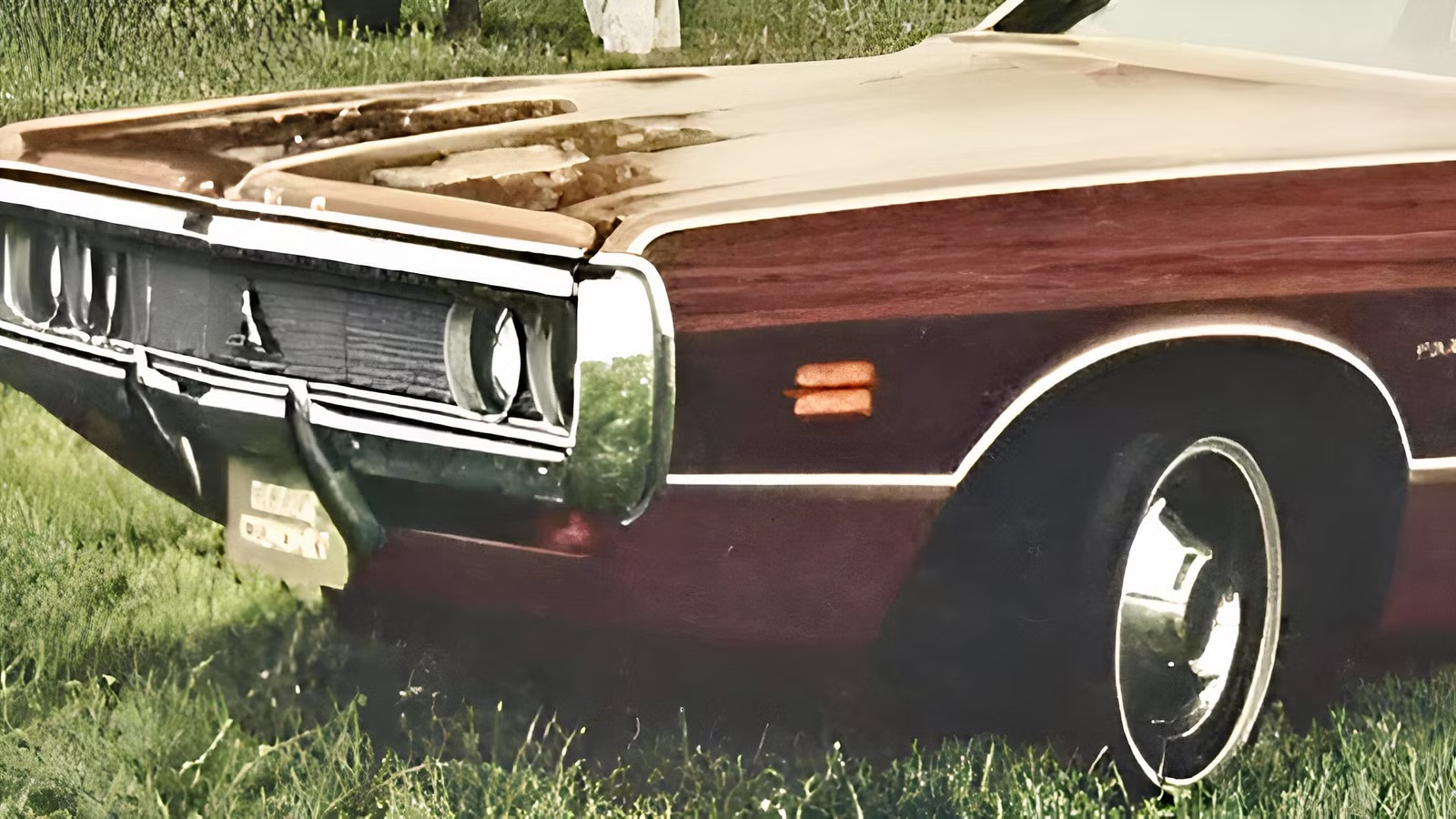
People love wagons, people miss wagons, and yet OEMs must have felt folks didn’t buy enough of them to keep them around. Considering that wagons are effectively taboo in 2026, you might be surprised to learn that during the first muscle car war, Detroit had a tendency to hide some of its best powertrains under the hoods of family-hauling wagons. Each of the Big 3 practiced this to one extent or another, but seldom did any of them do it as well as Dodge did. Back then, Dodge was perfectly happy packing heat in the same vehicle you did the grocery run in. Before minivans, that was just the way things were.
Dodge’s Big Family Wagon: A Great Hauler With a Big Secret

The Dodge lineup was practically oversaturated with talent back in the late 1960s. As unfathomable as it sounds today given how woeful its modern lineup is, Dodge was the beneficiary of a whole range of passenger car platforms that encompassed small runabouts, mid-size muscle cars, and full-size cruisers, all under one dealership roof. Using this method, Dodge managed to offer a little something to everyone, leveraging shared technologies between the platforms to keep production costs down.
Each platform had its place, and each represented a time when Dodge was at its all-time peak desirability. Still, if you wanted a Mopar muscle car, Dodge cultivated a core nucleus of sporty vehicles with gigantic engines around one platform in particular, the B-body. Introduced in 1962, the B-body was the backbone of Dodge’s lineup for nearly the entirety of the 1960s. As hilarious as it sounds, B-bodies were considered mid-size cars back in the day, which only went to prove what tanks on wheels the larger C-Body turned out to be. Over those years, icons like the Dodge Charger, Plymouth Satellite, GTX, and Road Runner called the B-body their native platform.
Still, one that routinely gets lost in the shuffle was the humble but mighty Coronet. Effectively, the Coronet was the slightly more reserved, family-focused counterpart to the burly Charger. Designed by Mopar legend Virgil Exner, the Coronet certainly resembled a Charger but was available in a range of body styles that separated it from its muscle coupe cousin. You could have a four-door sedan, a two-door coupe, a hardtop, a two-door convertible, and most importantly for our purposes, a four-door wagon with a cavernous rear hatch. In every way that mattered, the Coronet was a sales-volume titan that helped Dodge finance more ambitious vehicles like the Charger. It even came with the full suite of powertrains the rest of the Dodge lineup made use of.

The 440 Magnum V8: Overkill in the Best Way Possible

If you want proof that no one gave a second thought to fuel economy or good sense in the ’60s, look no further than Chrysler’s 440-cubic-inch, 7.2-liter Magnum V8. Hailing from the same RB family as the ubiquitous 413 V8 you’d find in the Dodge Polara and Plymouth Fury, it also shared DNA with the non-HEMI 426-cubic-inch Wedge motor that championed early Dodge Chargers and the D Series pickup truck. Introduced in 1965, the 440 Magnum motor was overkill personified.
Beneath the skin, its internals were built for two things: gobs of low-end torque and the ability to take punishment day in and day out. The crankshaft was made of forged steel, the connecting rods were far beefier than those of smaller RB motors, and the high-lift camshaft wouldn’t have looked out of place on a Lotus or a Jaguar, let alone a muscle car. The intake manifold was cast iron, not aluminum. Not ideal from a weight perspective, but surprisingly effective when durability is the priority. Atop the intake manifold, Dodge never bothered fitting a two-barrel carburetor in the name of “economy driving,” as GM did with its own 455-cubic-inch V8s.
Each 440 Magnum made use of either a four-barrel carburetor from Carter or Holley, or the iconic “Six-Pack” setup featuring three two-barrel carburetors sitting atop a specialized intake manifold. It allowed the 440 V8 to breathe like an engine half its size, meaning even the most mundane examples pumped out roughly 350 horsepower and a massive 480 lb-ft of torque. Of course, the use of gross horsepower figures, measured with open headers on a dyno stand, likely inflated those numbers somewhat. Still, what are the chances a Coronet wagon trim finds itself packing this absolute cannon of an engine? Well, if you’re Dodge in the ’60s or ‘70s, it’s all but inevitable.
The Coronet Crestwood Wagon: The Ultimate Wagon Stealth Fighter

Imagine pulling up to a red light in 1971 in your Mustang, Charger, or Gran Torino, fancying yourself the driver of the coolest, fastest car in the neighborhood. Only for a wood-grain-adorned, 440 Magnum-powered lump of American steel to pull up beside you, rev its engine, and pull away just as quickly from one stoplight to the next. That’s the exact scenario that assuredly happened at least once during the reign of the Dodge Coronet Crestwood Wagon. As the flagship trim for the Coronet Wagon lineup, the Crestwood was not only refined and stylish, but relatively fast and agile for what it was.
The seats were trimmed in a far plusher grade of vinyl, almost mimicking leather in feel. The exterior finish featured a faux wood-grain treatment, which, while dated by modern standards, was considered genuinely upscale in the 1960s. The dual-use tailgate either swung open like a door, or flipped down like the rear tailgate on a pickup truck, and the very same 440 Magnum V8 that made Mopar muscle cars household names at the time was available, alongside smaller engines like the 318 and the 400. By all accounts, it was as unlikely a combination of car, features, and engine as existed during the tail end of the first muscle car era. With an MSRP of $3,600 to $3,800 before options, or roughly $29,685 to $31,334 in today’s dollars, it was something of a bargain.
In its debut year, Dodge built somewhere in the area of 23,400 Coronet Wagons. Among those, fewer than a third — or as few as 6,800 units — were the range-topping Crestwood trim. The rest were less-glitzy mid-tier Custom Wagons or base models. From that run, it’s estimated that fewer than 100 Coronet Crestwood wagons came equipped with the 440 Magnum, making them among the rarest Dodge performance vehicles of all time, let alone of the 1970s. As an introductory treat for the then brand-new sixth-generation Coronet, the Crestwood wagon was a real show-stopper. Maybe not from a muscle car perspective, but certainly for middle-class American families who wanted to drive something flashy, while fulfilling all the needs of a family cruiser.
Rare, Sought-After, But Still Under the Radar

Given how rare a 440-powered Coronet Crestwood Wagon is, it’s not exactly common to see one roll past the auction block or show up online. Still, when one does show up, it reminds us just how fixated on other B-body muscle cars the broader collector community really is. Numbers-matching Chargers, for instance, are reliably six-figure collector’s items.
But a Coronet Wagon? That’s a different story entirely. A seller would be lucky to squeeze $30 or $40 grand out of one, even with a 440, numbers-matching with low miles. It might sound unfair, but it only means people in the know can get their hands on one for a non-astronomical amount of money. In the grand scheme of life, that’s never a bad thing.
Source: Classic.com, Dodge

Related posts


Latest Post



No Comments