
Jay Leno Just Drove A 112-Year-Old Supercar
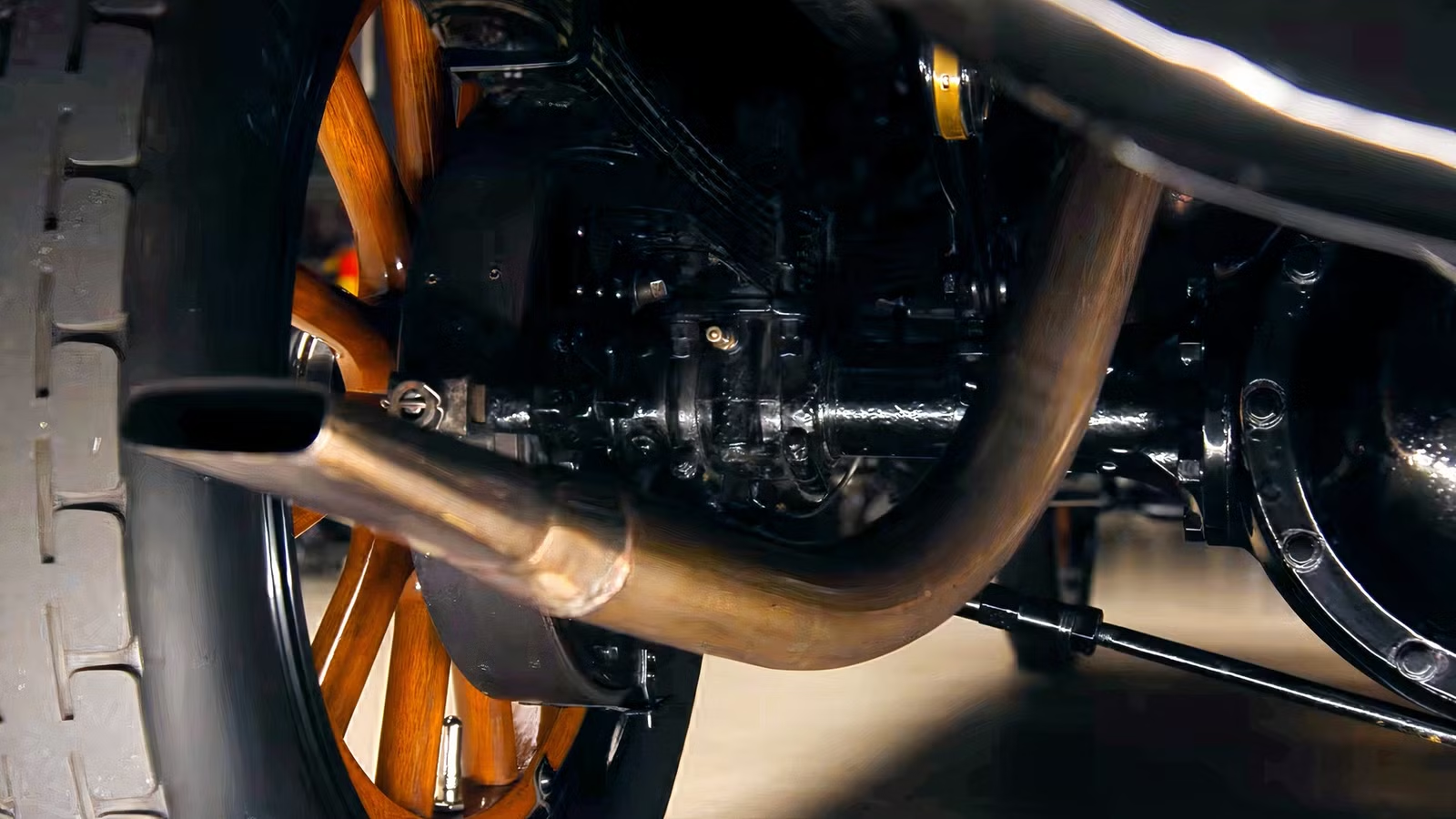
There is a point where horsepower stops telling the whole story. The 1914 Knox Little Six only produces a quoted 46 horsepower, which sounds laughable next to virtually anything rolling out of a modern showroom. Then you discover that its six-cylinder engine displaces a staggering 496 cubic inches, and suddenly that figure deserves a little more context.

Jay Leno recently got behind the wheel of one of these largely forgotten American monsters ahead of their time, courtesy of the Nethercutt Collection. Calling the Knox a supercar sounds like a stretch until you consider what performance meant in 1914. Leno pointed out that the engine is larger than a Chrysler 440 or even a 426 Hemi, while Cameron Richards of the Nethercutt Collection explained that this particular example can comfortably chug along at 70 mph. More than a century after it was built, it can still keep pace with modern traffic.
The really astonishing part, however, is rarity. Knox only produced 6 Little Sixes, according to Richards, and the Nethercutt Collection believes just two survive today. That makes Leno’s latest drive more than another outing in an unusual antique. It’s a look back at an era when America’s idea of building a faster car was wonderfully straightforward: make absolutely everything enormous.
A 496-Cubic-Inch Six-Cylinder Was America’s Idea Of A Supercar

The Little Six came from Springfield, Massachusetts, during a period when America’s automotive industry hadn’t yet consolidated around Detroit. Knox was one of the many manufacturers experimenting with what the automobile could become, and its answer was considerably more ambitious than the inexpensive transportation that would ultimately dominate the market. Under that massive hood sits a 496-cubic-inch six-cylinder with overhead valves and cylinders cast in pairs. Output was rated at just 46 horsepower, but Leno estimated that the engine could be producing well over 500 lb-ft of torque. That torque estimate is Leno’s, rather than a documented factory rating, but you don’t need a dyno sheet to understand what this engine was designed to do. During the drive, the Knox can pull away without throttle and comfortably accelerate toward 50 mph.

That would have been borderline absurd performance in 1914. Leno puts the car into historical perspective by pointing out that many Americans of the period had never experienced speeds beyond what a horse and carriage could manage. Richards describes the Knox as easily capable of 50 mph, while Leno suggests something like 60 or 70 mph would have represented almost unimaginable speed when much of the country’s road infrastructure wasn’t remotely prepared for it.
“These were the supercars of their day.” — Jay Leno
That’s what makes the modern definition of horsepower somewhat misleading here. The Little Six isn’t a high-revving performance engine trying to squeeze maximum output from every cubic inch. It’s an enormous, slow-turning workhorse designed to produce effortless low-end shove. As Leno puts it later in the drive, these were effectively the supercars of their day.
Knox Built Something The Market Wasn’t Ready For

If the Little Six was so impressive, why doesn’t Knox carry the same historical weight as Packard, Cadillac, or Duesenberg?
Price certainly didn’t help. The Little Six cost $4,350 when new, according to Richards. For perspective, the pair notes that a house could cost around $1,200 at the time, while Richards says the Knox carried roughly a $1,000 premium over an equivalent Packard. The problem wasn’t that Knox couldn’t engineer an impressive automobile. It had built an enormously expensive one without Packard’s established name recognition. Production numbers tell the rest of the story.
Richards says Knox built 383 automobiles in total during the relevant production run, but only six Little Sixes. The Little Six arrived during Knox’s final year of automobile production, with Richards explaining that demand simply wasn’t there for the massive six-cylinder machine the company believed Americans needed. In other words, Knox may have flown too close to the sun.

The engineering certainly wasn’t primitive. The Little Six used overhead valves during an era dominated by flathead engines, and Leno compares the sophistication of that configuration in period to something like a four-cam engine today. The pair also discusses Knox’s early experimentation with hydraulic rear brakes, years before four-wheel hydraulic systems became a major automotive development.
Unfortunately, being technically interesting doesn’t guarantee commercial success. Knox built a huge, expensive, remarkably capable automobile for a market that hadn’t quite figured out why it needed one.
This 112-Year-Old Car Still Runs With Modern Traffic
The Little Six featured in Leno’s video isn’t preserved as an untouchable concours piece, and that’s arguably what makes it so fascinating.
The Nethercutt Collection has modified the car specifically so it can continue being driven. Richards points out hidden rear disc brakes, a modern driveshaft, and an alternator among its upgrades. Turn signals and mirrors have also been added, while the original steering box remains untouched. Those changes mean its ability to cruise at modern speeds shouldn’t be confused with the capabilities of a completely original 1914 Little Six. But the engine is still the star.
Richards recalls riding in this very car at 70 mph on Interstate 5, while the collection has toured it extensively and even brought it to Pebble Beach specifically to participate in the tour rather than compete in the show. This isn’t a century-old automobile that spends its life sitting underneath museum lights. Once Leno gets behind the wheel, that usability becomes immediately obvious. The engine pulls easily toward 50 mph, the suspension absorbs rough pavement without excessive body shake, and the Knox can slow considerably while remaining in top gear before simply pulling away again. Leno even remarks that some antique touring cars become exhausting because the driver has to fight them constantly. Not this one. He says he could drive the Knox all day.
Today, only two Little Sixes are believed to remain. Yet one of them can still rumble into modern traffic, pull up behind a Tesla, and keep going. Forget the 46-horsepower rating. This was America’s supercar before America really knew what a supercar was.
Source: Jay Leno’s Garage

Related posts

Latest Post


No Comments