
Toyota’s Rugged Electric SUV Could Be The Closest Thing To An EV 4Runner
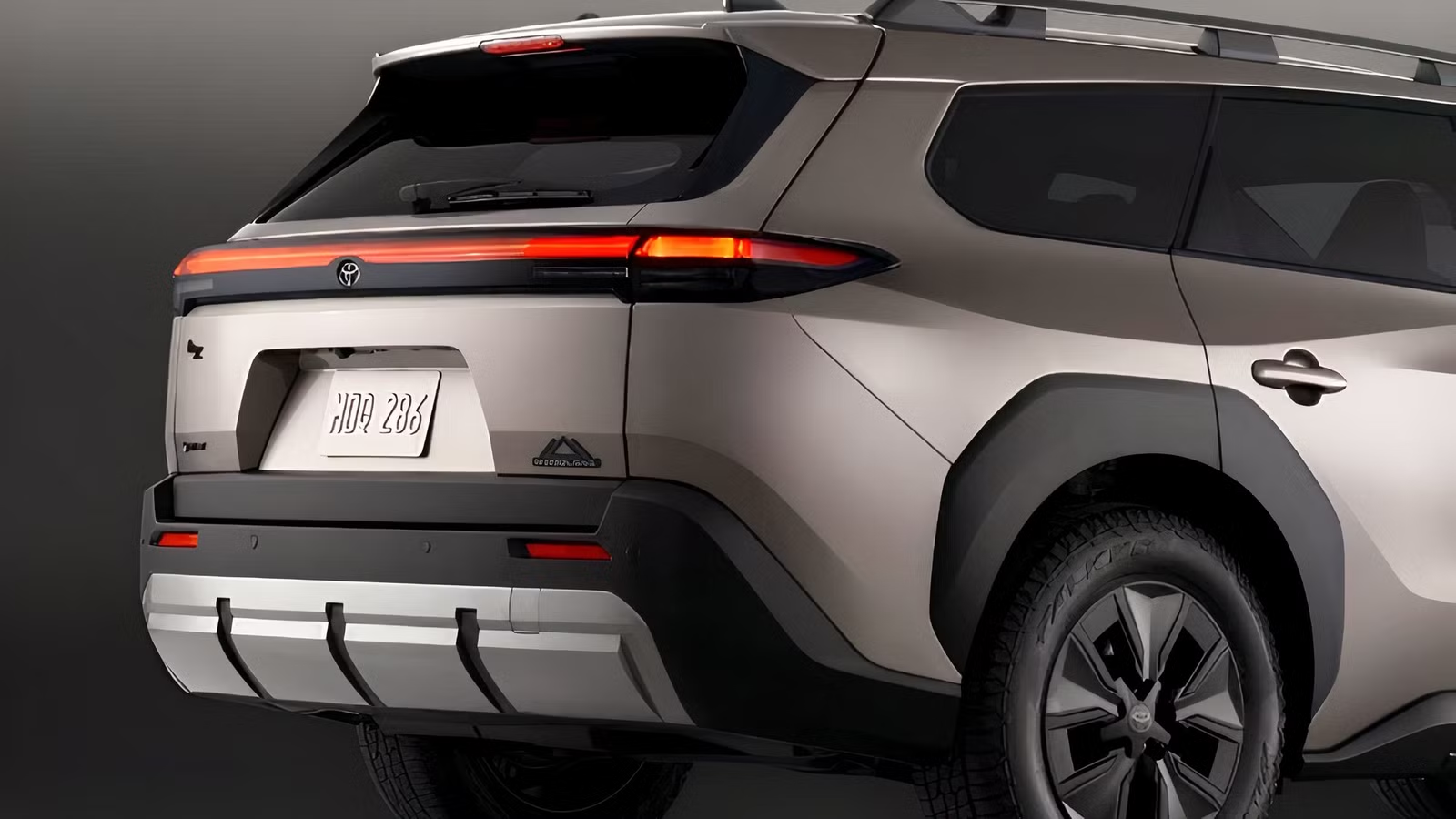
How often does an absolute dud of an automobile wind up pulling itself from the brink and turning into something even remotely desirable? Typically, when a vehicle gets to that point, it’s already well past any point of return. Well, at least in regards to one Toyota SUV, a somber prognosis turned out to be a bit premature. So much so that the company’s getting bold enough to add some style to the lineup, and considerably more capability to boot. It’s a fairytale story you seldom see in the automotive space, a true comeback story.
Toyota and EVs: Like Oil and Water, Until Recently

Toyota’s known the world over for observing what OEMs around the world are doing, throwing caution to the wind, and doing its own thing entirely. Such was how the company handled the emerging all-electric revolution when the California Air Resources Board called for design studies tasked with lowering the state’s overall vehicle emissions in the 1990s. Yes, Toyota did provide CARB with what it wanted, in EV RAV4 form, at that. But from then on, Toyota’s stance on strictly all-electric propulsion was tepid at best, and openly hostile at worst.
Toyota wouldn’t make an honest attempt at a production EV in America again until 2012, ironically with a RAV4 once again, and with none other than Tesla themselves helping integrate one of its single-motor powertrains into the chassis. That Gen-II RAV4 was as much a technological demonstrator as a production SUV, one that accelerated faster than its gas equivalent at the cost of reduced range. In the end, disputes between Tesla and Toyota soured the business relationship before it could mature properly. With as few as 2,600 examples produced between 2012 and 2014, the RAV4 EV was far more a compliance car than something Toyota went out of its way to build of its own volition.
From there, and until the very end of the decade, Toyota did everything in its power to put its green energy eggs in baskets other than pure battery electric power. The hydrogen fuel cell-powered Mirai sedan came from this period, as did the introduction of hybrid drivetrains across a wide range of Toyota’s North American rolling stock. In every way imaginable, Toyota was practically ideologically opposed to the idea of pure EVs. In the mind of its board of directors, battery EVs were too big, too heavy, too complicated, and most of all, way too expensive. Coming from the group that brought us the Prius, this should come as no big shock to anybody. Still, Toyota couldn’t be adversarial to EVs forever, and attitudes finally changed with the turn of the 2020s.

The bZ4X: A Real Dud, At Least at First

Toyota’s bZ (Beyond Zero) program is a testament to the fact that Toyota can indeed change its mind when it sees fit to do so. Conceived alongside Subaru through the early 2020s, the bZ initiative’s primary purpose serves to sell EVs specifically in the Chinese market, where battery electric propulsion isn’t just widely accepted, it’s the standard that most new cars in the region now see as normal. There, native brands like BYD, Geely, and NIO served as adversaries that could’ve pushed Toyota out of the local market entirely, and the bZ program was the brand’s final stand against a horde of domestic Chinese offerings.
Cars like the bZ3 compact sedan, the bZ5 crossover, the bZ7 full-size sedan, and the bZ3X SUV will likely never see the light of day outside China. Yet, Toyota made the bold decision to bring at least one machine from the bZ program across national borders to Europe and the United States. And so, Toyota entered the North American EV market for the first time in a decade when the bZ4X arrived in 2022. When it did, the reaction was, well, equivalent to a bunch of crickets. North American automotive journalists and influencers panned the bZ4X’s neutral styling, slow DC charging speeds, and pitiful 201-horsepower single-motor performance. It was to the point where trusted journalists and influencers like Doug DeMuro called the bZ4X and its Subaru Solterra counterpart “just plain bad” back in 2023.
In DeMuro’s mind, everything from the Mustang Mach-E to the Tesla Model Y was objectively better. In almost every respect, they surely were. Yet Toyota refused to throw in the towel, lowering the base price of its EV by thousands off the MSRP, expanding the range up to 314 miles, and clipping the last two digits off the car’s name to sound considerably less ridiculous. Did it fix most of the glaring issues Toyota’s only EV had? Not really, but with federal tax incentives active at the time, the newly-christened bZ started moving enough units to not be axed from the lineup altogether. Enough so, that Toyota felt comfortable putting some proverbial mustard into it.
The bZ Woodland Edition: An Electric 4Runner Alternative? Well, Kind Of

So then, what happens when Toyota gives the 2027 bZ the off-road treatment? Well, you get the 2027 Woodland. Coming to us with an upgraded 375-horsepower dual-motor e-AWD system, the bZ still isn’t the quickest EV out there. With instant low-end torque, it can still sprint to 60 in 4.4 seconds, and its Woodland Edition packs an upgraded X-MODE terrain suite and a 74.7 kWh battery pack, with a slight factory suspension lift that provides 8.4 inches of ground clearance. For some context, that’s roughly on par with the modern Subaru Outback or Forester, two heavy hitters in the off-road ICE SUV segment.
The above-mentioned X-Mode system doesn’t exactly replicate a low-range gearbox with locking differentials, but what it can do is modulate power delivery across all four wheels and provide targeted power vectoring to optimize traction on various off-road terrains. Optional all-terrain tires straight from the factory double down on the off-road capability, and an estimated 260 miles of battery range isn’t the worst figure we’ve ever seen. Coupled with low-speed grip control that mitigates wheel spin in low-traction environments, you really do get many of the same benefits as a well-sorted ICE 4×4. The bZ Woodland’s 3,500-pound tow rating means you can haul a small camper behind you, and with 74.3 cubic feet of cargo space with the rear seats stowed away, you can bring all your gear along for the ride.
Thanks to updated charging hardware, complete with an NACS port, you can charge from 10 percent to 80 percent in around 30 minutes under normal conditions. It mitigates some of the bZ’s lackluster range and ensures you can actually make it to the end of the trail without running out of juice. Elsewhere, a 14-inch center touchscreen and a cute little seven-inch digital gauge cluster keep with the theme of older bZ4Xs, but with a bit more functionality than before. With a base MSRP of $45,380 before fees, Toyota is positioning the bZ Woodland at only a few thousand bucks more than the equivalent 4Runner. Still, is it a one-to-one replacement? That’s a deeper question to answer.
A Decent Off-Roader: But No 4Runner

Okay, no more playing around. The bZ Woodland is the coolest EV Toyota’s ever marketed in the US, but clever parlor tricks run through a nifty terrain response computer can only get you so far compared to a real body-on-frame 4×4. Mechanical transfer cases, solid axles, locking differentials, none of them can be replicated with computer trickery or clever marketing.
With that said, seeing how far the bZ’s come since it was critically panned just a few years ago proves Toyota doesn’t just follow the status quo. If it doesn’t get things right the first time, you can count on it not to cut losses at the first sign of trouble. The bZ Woodland is living proof of that: very muddy, dirty proof.
Source: Toyota

Related posts


Latest Post


No Comments