
10 Short-Lived Muscle Cars That Became Rare Collectibles
Despite going dark in the late 1980s for a couple of decades, the Dodge Charger has been an enduring muscle car that is still going strong today. The Ford Mustang has been in constant production since its 1964½ debut and is arguably the most iconic car ever made. Many other Golden Age of American Muscle cars, like the Chevy Camaro and Pontiac Firebird, had long runs, and even something like the Plymouth Barracuda, which didn’t make it to modern times, still enjoyed a decade of dominance. For every lasting muscle car nameplate, however, there is a killer classic that only stuck around for a year or two.

Just because a street machine was a flash in the pan doesn’t mean it was no good, and in fact, some of the most formidable cars of the classic era were one-hit wonders. Sometimes they were homologation specials and others were promotional editions that had a shelf-life, but their limited production wasn’t because nobody wanted to buy them. The exact opposite was true, and these small-batch bruisers were in great demand from the beginning, as people recognized them as keepers. These short-lived classic muscle cars had that certain something—most likely a rare big-block—and because of their scarcity, became instant unicorns.
10
1971 Dodge Charger Super Bee
Units Produced: 5,054
The Coronet-based Dodge Super Bee was retired in 1971, but that awesome mechanized stinger lived on as the coolest trim of the third-gen Charger. There were actually Mexican Super Bees until 1980 as well as sporadic sightings in modern times, but the 1971 Charger Super Bee was one and done. Unlike many of the other cars on this list, the ’71 Super Bee wasn’t a special edition or an attempt to qualify for racing, but rather a regular production model that happened to have a modest run. With barely over 5,000 units built, it’s tempting to say nobody wanted these cars back then, but it’s simply not true as they were flying off the lots. It was Dodge that underestimated the demand, and that includes the Super Bees equipped with rare big-blocks, of which only 99 440 Six-Packs and 22 426 Hemis ever left the factory. There was never a time when enthusiasts didn’t know ’71 Super Bee Six Packs and Hemis were collectible, but the long-ignored lesser engines have been coming on strong lately with a base 383 selling at Mecum Indy 2025 for nearly $100,000.

9
1993 Ford Mustang SVT Cobra
Units Produced: 4,993

The Fox Body Mustang brought some much-needed style back to the iconic pony car, which spent much of the 1970s as a sad little Pinto clone. While the Fox Body was impressive from the start and the defining car of the entire 1980s, its former street presence was a little slower to return. This was the tail-end of the Malaise Era of detuned V8s, but by 1987 the legendary 5.0-liter V8 was making a decent 225 horsepower, marking a semi-return to performance. In 1993, Ford sent the Fox Body Mustang out with a bang by producing a special-edition SVT Cobra. With ten extra horsepower and performance upgrades aplenty, the Mustang SVT Cobra could go 0-60 in 5.9 seconds and had a 14.5-second quarter-mile ET, which was impressive for the era. Ford made fewer than 5,000 ’93 Mustang SVT Cobras, as well as 107 Cobra Rs, and the best proof that they were instant unicorns is found in the large number of no-to-low-mileage cars being auctioned off on sites like Bring a Trailer.
8
1970 Dodge Challenger T/A
Units Produced: 2,399

The Sports Car Club of America (SCCA) Trans Am Racing Series was enormously popular in the late ’60s and early ’70s, and all the major automakers were interested in participating. Chevy was first off the block with the 1967 Camaro Z/28 and then Ford followed suit with the Mustang Boss 302. Dodge wanted in and chose the new-for-1970 Challenger as its campaign hopeful with the T/A special edition. The SCCA had a 5.0-liter displacement limit for engines, so the ’70 Challenger T/A’s 290-hp 340 Six-Pack V8 that was sold to the public was destroked for competition to meet the requirements. The Challenger T/A wasn’t much of a Trans Am racer, so it was canceled after one year, but it was a remarkably cool street machine with distinctive hood scoops and aggressive side exhaust that was recognized as a collectible from the beginning. With only 2,399 T/As made, it has legit unicorn cred and is one of the few Mopar small-blocks that can rock the auction block, with pristine examples hitting the multi-hundreds of thousands, which is Hemi money.
7
1970 AMC Rebel Machine
Units Produced: 2,326

The weird thing about the 1970 AMC Rebel Machine is that they only made 2,326 of them, but it is by far the most memorable muscle car from the small automaker. Maybe it’s the aggressive styling of the Machine and its 340-hp 390 cubic-inch V8, but more than likely it’s that patriotic red, white, and blue paint scheme. A little known fact is that the ’70 Rebel Machine was also available in solid colors and possibly more than half ever sold weren’t of the American spirit variety. It is, however, the white body, blue hood, and red-striped Machines that people saw as potential collectibles, as apparently hardly anyone held on to a solid color version. Dozens of Team USA Rebel Machines have sold at auction, while we could only find one solid color listing, and it failed to hit the reserve. Part of being a unicorn car is having value, something most AMC muscle cars lack, but the Rebel Machine has hit over the $100,000 mark many times, so it’s officially an elusive mythical beast.
6
1969 Dodge Super Bee A12
Units Produced: 1,907

The Dodge Super Bee was available with the Hemi-esque 390-hp 440 Six-Pack V8 featuring a triple carburetor set-up until 1970, but the A12 package was only around for about half of 1969. Introduced mid-model year, the ’69 Super Bee A12 came with the aforementioned Six-Pack, plus a removable blackout fiberglass hood and a heavy-duty suspension. This was a car that was capable of quarter-mile ETs in the low 13s, and simply taking off the air cleaner had it running in the 12s. The 440 Six-Pack was a cheaper alternative to the 426 Hemi and could deliver similar, and sometimes better, performance. So 1,907 Super Bee A12s were snapped up by performance enthusiasts and held on to as significant Golden Age factory street machines. The Super Bee was introduced as an inexpensive, no-frills speedster, and even the ’69 A12’s elevated $3,540 window sticker was still less than a Hemi-equipped Mopar, but nowadays, they are commanding serious money, including one that sold for $264,00 in 2024.
5
1969-1970 Ford Mustang Boss 429
Units Produced: 1,358

In the late 1960s, Ford was looking to homologate their new 429 Cobra Jet V8, but they took a different approach than most automakers do. Instead of putting it in a special edition of the Torino, which was their NASCAR racer, they fitted some of those big-blocks into fastback Mustangs, which was one of the most impressive things the company had done since Henry Ford perfected assembly line production and brought the automobile to the masses. Due to the insane popularity of the Mustang and the miniscule production run, the Boss 429 was literally created as a unicorn car. Ford churned out 859 of these amazing pony cars in 1969 and another 499 in 1970 for a grand total of 1,358 cars, none of which ever appeared in a John Wick movie, as his claimed Boss 429 was really a Mach 1. People held on to these Mustang rarities, knowing that one day they’d be worth a fortune, and that was a sound bet as they regularly top a half-million dollars at auction.
4
1970-1972 Buick GSX
Units Produced: 846

GM infamously banned its divisions from equipping engines over 400 cubic in intermediate cars right before muscle cars became a craze, which essentially handed the streets over to Mopar for most of the Golden Age. In 1970, they rescinded this corporate policy and Buick responded by fitting a 455 V8 into the Gran Sport. They also created a special edition of the GS 455 known as the GSX, which stood for Grand Sport eXperimental. The car was meant to generate interest in the brand and foot traffic in the showrooms, so it was never intended to be a high-volume car, with just 846 units built between 1970 and 1972. This is another unicorn with a possible Holy Grail, as there were only 400 ’70 GSX Stage 1s with the underrated 360-hp and outrageous 510 lb-ft of torque version of the 455. This was the most formidable GM muscle car of the Golden Age with a 13.34-second quarter-mile that could outrun a ’70 Chevelle SS 454 LS6.
3
1970-1971 Plymouth Hemi ‘Cuda
Units Produced: 781

The stunning beauty of the third-gen Plymouth Barracuda and the extraordinary performance of the 425-hp 426 Hemi V8 were so compatible that their pairing inspired a dedicated nameplate with the Hemi ‘Cuda. For reasons that defy all logic and science, the Hemi was better under the hood of a ‘Cuda, delivering 13.1-second quarter-mile runs straight from the dealership, making it the quickest factory ride of the entire Golden Age. The Hemi ‘Cuda wasn’t a special edition, but it still ended up being extremely rare, with 666 evil fish in 1970 and just 115 in 1971. The ‘Cuda name would carry on until 1974, but the Hemi ‘Cuda only existed for two years as the 426 was discontinued after 1971. It was impossible to ignore this uncommon, remarkable-looking Mopar with track-ready performance, and it was prized immediately. The Hemi ‘Cuda isn’t just a unicorn, but also a Holy Grail with a 1-of-12 ’71 convertible selling for $3.8 million dollars at a Mecum auction, becoming the most valuable classic era muscle car.
2
1987 Buick GNX
Units Produced: 547

In the 1980s, Buick tried to recapture the performance reputation it earned with the GS 455 and GSX by making the Regal slightly more powerful. The T-Type, Grand National, and Turbo-T were all failed attempts to make the Regal a high-performance car, and when Buick finally got it right with the 1987 GNX, it discontinued the project. Regardless, for one glorious year, Buick had a Corvette killer with a notably underrated 276-hp 3.8-liter turbocharged V6 that could propel the Grand National eXperimental from 0-60 in 4.7 seconds and through a quarter-mile in 12.7 seconds. Buick only made 547 of these cars, with almost all being purchased by buyers who recognized their investment potential. There are scores of auction listings for ’87 GNX cars with next to no miles on the odometer, because they were purchased and held in anticipation of significant appreciation. As it turned out, that was a wise strategy as they are six-figure collectibles with almost a dozen cars selling above $200,000 at auction.
1
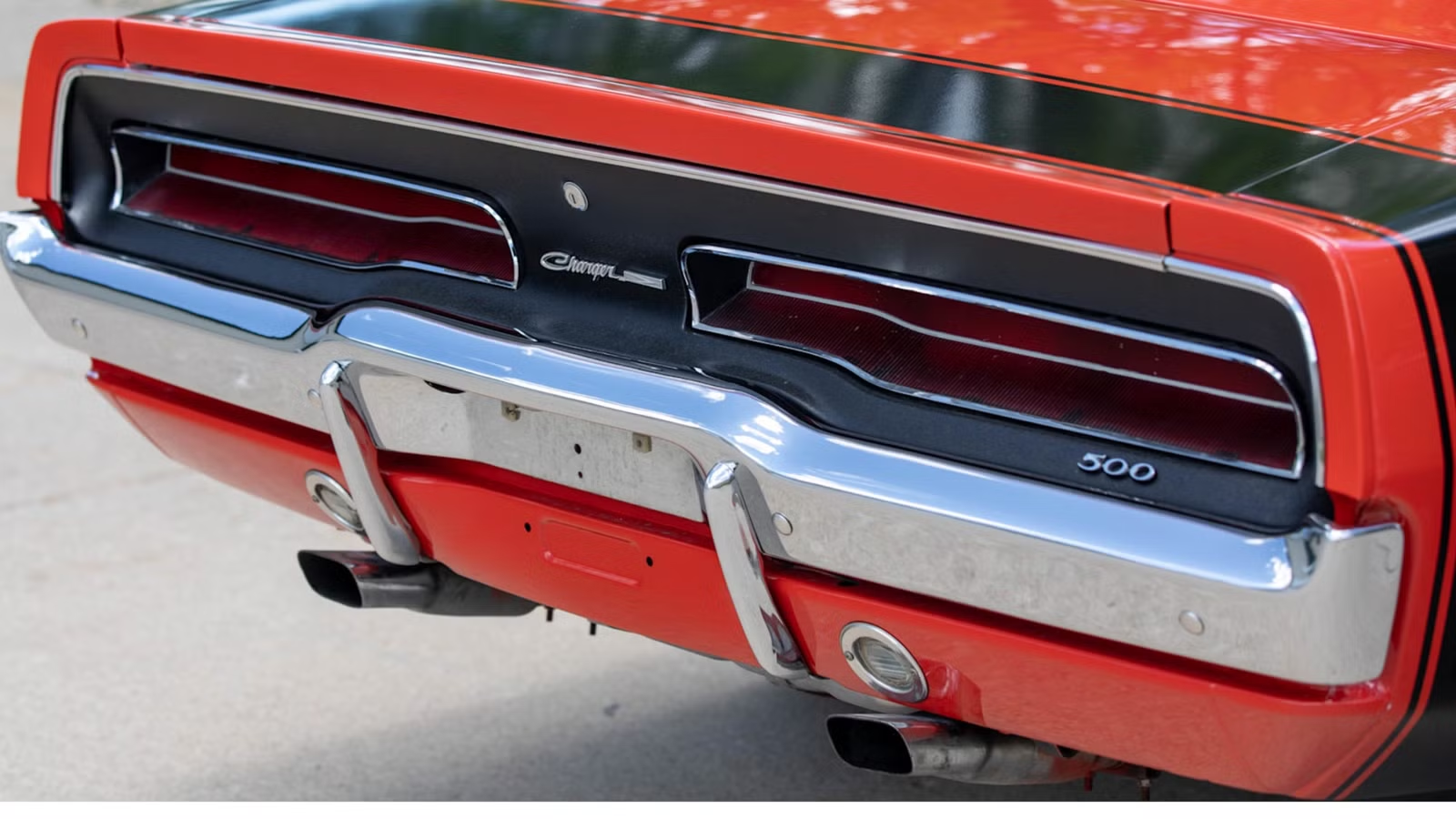
1969 Dodge Charger 500
Units Produced: 392

The Dodge Charger, especially when equipped with a Hemi, has always been a badass street machine but a surprisingly poor closed-circuit race car. The first-gen bodies created lift, which is actually scary at full-throttle, and the second-gen’s design created tremendous drag, making top speeds impossible. The 1969 Charger 500 was Dodge’s third attempt to build a NASCAR superstar by adding a flush-mounted grille and smoothing out the “flying buttress” recessed rear window. Dodge planned on making 500 of these cars to meet homologation requirements, but stopped at only 392 when it shifted focus to the ’69 Daytona aerocar, which would become a dominant NASCAR champion. Only 60 of these rare cars left the factory floor with a 426 Hemi under the hood. So Mopar aficionados knew they were something special. 18 of the 60 Charger 500 Hemis have been listed on Mecum in recent years, which shows how intuitive buyers were about its future value. Speaking of which, Charger 500 Hemis are multi-six-figure Mopars, with that Hemi Orange example pictured above achieving a $297,000 result at Mecum’s Spring Classic 2014.
Sources: Bring a Trailer, Mecum

Related posts


Latest Post



No Comments