The 2027 Chevy Bolt Is A Bargain EV—With One Big Problem
7 minutes reading
Tuesday, 29 Sep 2026 02:00 0 37 autotech
The 2027 Chevy Bolt costs $28,995 and can roll 262 miles between charges. Chevy is offering the car with either 2.9% interest on a loan over five years, or just .9% for 36 months. Considering the website Experian, says the average new-car loan rate is now 6.35% (and it’s 11.19% for used-car buyers), Chevy’s deals are pretty excellent. And given gas prices, you really should be at least considering switching to an EV. And, yep, the Bolt is a great option. It’s affordable, tight-handling, and a lot roomier and more practical than you might expect. Save for one flaw, this is a slam-dunk.
EVs, like gas cars around them, have become super-sized by default. The Bolt isn’t. It has the footprint of a Honda Civic hatchback (though its cabin is a tad roomier, actually), and even though it only boasts 210 horsepower, this EV barely weighs 3,800 pounds. That Honda is lighter, at 3,289, so it’s slightly quicker to 60 MPH, but the Bolt’s close — and it’s definitely faster from 50 to 70 MPH, positively leaping past pokier drivers.
A light blue Chevy Bolt driving through a city.Chevrolet
On a section of country road where I like to test handling, I came up behind a large SUV and blasted right around it, then carved through the next apex. The Bolt isn’t suspended like a sports car; the suspension is more daily-driver forgiving than that, and the steering is a little too numb with on-center feel. But the short overhangs and overall manageable size make this a lot more fun to drive than you’d expect—and it’s dead quiet on the highway.
Charging Via Tesla
2027 Chevy Bolt rear shotTopSpeed | Michael Frank
Because it has a NACS port (i.e., the standard used at Tesla Superchargers), it’s now easier to publicly charge the Bolt. Though if you’re planning to charge at home or at a public L1 or L2 charger, you’ll likely need an adapter to use a J1772 connector. If all that sounds like a foreign language, here’s the simple translation. Tesla cars have what’s called a NACS port. Think of this as a wall plug in your home. All carmakers are now following suit with NACS, so there’s a single standard for both plugs and charge cables. The trouble is that some L1 and L2 chargers haven’t switched over to NACS, hence the adapter needed from what’s called J1772 to NACS. However, you can charge the Bolt at Tesla Superchargers, and that — in theory — is great.
Decently Fast Charging
In theory, you can charge the Chevy at a rate of up to 150 kilowatts of juice. At a local Tesla charger, the car simply wouldn’t charge. The Tesla app wouldn’t pair with my phone, and the car kept reporting issues with the plug. There were several Teslas and a Rivian parked at the station, but no dice. At another Tesla Supercharger location, the process worked seamlessly, with a max charging speed of 111kW. The Bolt went from 26% charge to 80% in 20 minutes, which was quick enough.
Why Don’t Superchargers Have Longer Cables?
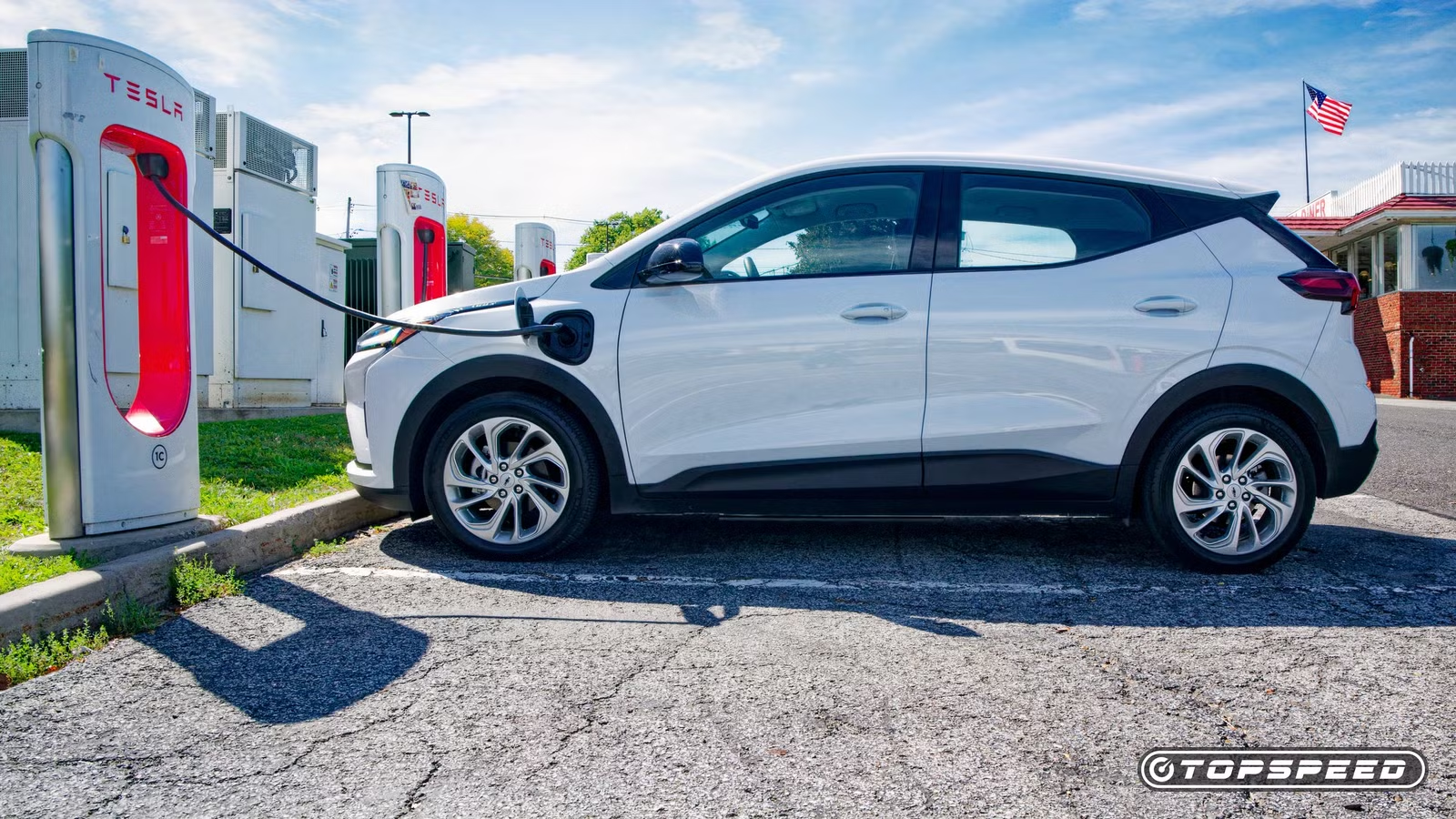
2027 Chevy BoltTopSpeed | Michael Frank
I zoomed in to show just how taut you have to pull the Tesla cable to plug the Bolt into a Supercharger. It works, but even with a port at the front of the car, making the Tesla cord reach is a challenge. Tesla does this because it wants to cut costs. A shorter cable costs less and uses less material. If you’re charging at home, the cables on home chargers are both longer and easier to use. Oh, and you won’t be paying the 53 cents per kilowatt I was tagged with by Tesla, since the national average for home rates is closer to 18 cents.
The Useful Bolt
The cabin of the Bolt is very well designed. Its 56 cubic feet of maximum cargo space doesn’t seem that capacious, but sheer boxiness makes the most of those numbers. For instance, there’s more knee room than in the second row of a Honda Civic or a Nissan Leaf, and the Bolt’s second row matches what the new Kia EV3 will offer. A large bin beneath the hatch floor stabilizes groceries or other small items, and the Bolt’s seats are plenty comfortable. If there’s a weakness, it’s that the infotainment display should be more upright. Its supine angle picks up way too much glare. However, that’s hardly the biggest flaw with the Chevy’s infotainment system.
No CarPlay Or Android Auto
2026 Chevy BoltTopSpeed | Michael Frank
When I reported on this issue back in 2025, I was, quite honestly, stunned that GM would try to play the same card as Rivian and Tesla, since they represent a tiny share of the market—and their buyers are often willing to make such sacrifices in the name of novelty. The Bolt isn’t novel. It’s a value play. The same applies to the Equinox EV. Yahoo Finance recently reported that nearly 80 percent of buyers say they won’t consider a car without Apple or Android phone projection, and after a week of fumbling with the Bolt’s infotainment system, I understand why.
Life Without CarPlay
2026 Chevy BoltTopSpeed | Michael Frank
As an alternative to CarPlay, the Bolt allows Google’s AI assistant, Gemini, to read and respond to texts (by enabling notifications when you pair your phone). But it’s far clunkier than CarPlay or Android Auto integration.
2026 Chevy BoltTopSpeed | Michael Frank
And speaking of native phone functions, this is where several flies land in your soup. Yes, the Bolt can run its own app suite — meaning, you can download apps directly to the car, and run them there, not off your phone. The issue is syncing. Spotify playing on your phone and then in the car won’t necessarily bookmark where you left off — for example, listening to a podcast on the car’s platform versus your phone’s platform. The same goes with other apps. This is frustrating. Your workaround might be just to use playback over Bluetooth. Which works. Until that stream ends and you want to play something else. But you can’t do that through your phone, because your apps won’t all populate in the Bolt’s infotainment menu.
What GM Has Done In Response
2026 Chevy BoltTopSpeed | Michael Frank
GM recently revealed its new infotainment screen for the 2027 Silverado and Sierra. It looks like that image above. But this merged system isn’t coming to the carmaker’s EVs(despite reports to the contrary). So GM is penalizing EV buyers for their powertrain selection, and that’s not good. Don’t forget that GM has rivals from Hyundai and Kia, in particular, that aren’t abandoning the EV space—or making buyers choose a gas car to get CarPlay or Android Auto.
TopSpeed’s Take
2027 Chevy BoltTopSpeed | Michael Frank
Here’s some simple math: The $28,995 Bolt is dirt cheap to own and to operate. At current gas prices, most EVs can cover the same distance as even the most fuel-efficient gas car for half the cost. (The simplest way to know this is to convert the gallons it takes to drive 100 miles in a gas car, multiply that by the price of those gallons, and compare that number to the kilowatts-per-dollar cost to go the same distance in your choice of EV.)
A hybrid will let you save gas, but a car like the Honda Civic Hybrid Sport CVT ($30,690) costs more. Considering alternative EVs? The Nissan Leaf, which has a slightly nicer interior, runs a steep $35,805. When the Kia EV3 arrives later this fall, it’ll run a more cost-competitive $31,385, which is still costlier than the Bolt.
So the Chevy is fun to drive, a bargain, useful, and pretty roomy and comfortable, too. And you can (usually) charge it anywhere you can charge a Tesla. Soon, when Ford’s Fathom and the Slate finally arrive, they’ll both be strong rivals to the Chevy. Which is good. But if you want a car and not a truck, the Bolt stands alone.


 110 autotech










No Comments