
Kia Sportage Hybrid vs. Hyundai Tucson Hybrid: Which One Wins?
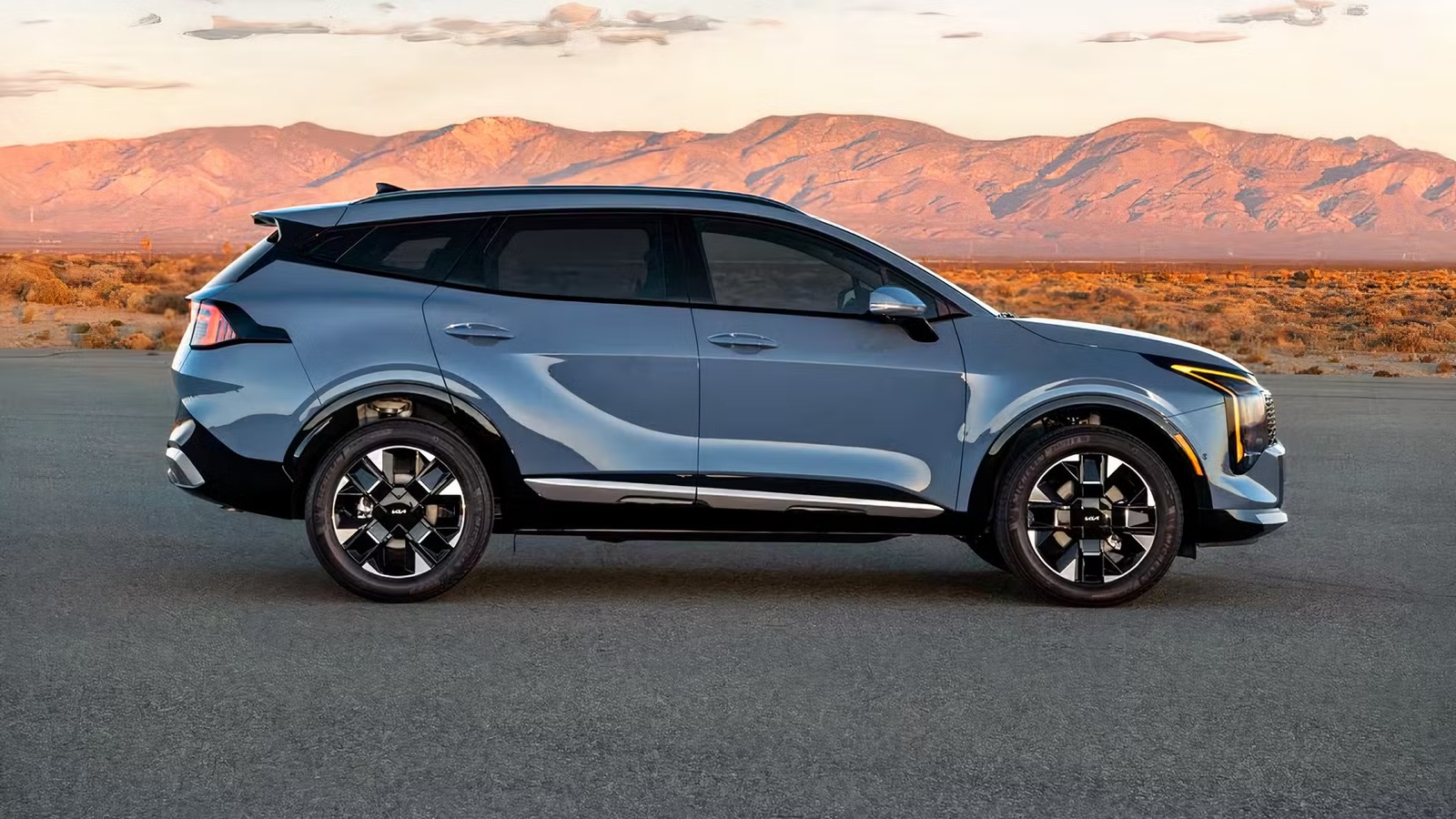
Walk onto a Kia lot and a Hyundai lot on the same afternoon and you could be forgiven for thinking someone is playing a prank. The Sportage Hybrid and Tucson Hybrid share an engine, a battery, a gearbox, and a warranty. Yet they are not twins. One offers a front-wheel-drive option that improves its fuel bill, while the other leans on sharper styling and a slightly stronger resale story. Here is how the regular hybrids compare.
Nearly Identical Powertrains, Different Strengths

Both SUVs use a 1.6-liter turbocharged hybrid setup with a six-speed automatic and a 1.49 kWh lithium-ion battery. Total system output is effectively a dead heat. That is 231 horsepower for the Tucson against 232 for the Sportage. Torque is listed at 271 pound-feet for both. If you were hoping a spec sheet would separate them, that’s certainly not the case here.
The real divergence is in how the power reaches the road. The Tucson Hybrid is sold with all-wheel drive only, while the Sportage comes in either front-wheel or all-wheel drive. That single choice matters more than any other difference between these two vehicles. Buyers in Phoenix, Miami, or San Diego who never see a snowflake can skip the extra driveline hardware on the Kia. Buyers in Denver or Buffalo, on the other hand, get AWD on either badge.

Then there is price, where the Kia opens a clear gap. Starting MSRP is $31,300 for the Tucson Hybrid and $30,490 for the Sportage Hybrid. That is only a small sticker difference on paper, but it widens once you compare like with like. The base Sportage LX with front-wheel drive undercuts the cheapest Tucson by more than $2,000 once destination charges are included. A Denver dealer comparison of the newer 2027 Sportage puts its starting price at $30,590, roughly $3,400 below a comparably positioned Tucson Hybrid.

Further up the ladder, the picture tightens. The mid-range Sportage trims are priced close to their Tucson counterparts. Consumer Reports lists a full range of $31,300 to $42,925 for the Tucson Hybrid and $30,490 to $40,590 for the Sportage Hybrid. So the Kia is cheaper at both ends of the range, but the gulf is widest at the bottom, where the front-drive Sportage LX has no Hyundai equivalent.
On the road, the shared hardware behaves as you would expect. Consumer Reports found that the Tucson Hybrid is significantly quicker and quieter than the gasoline model. It said the same of the Sportage, noting that the electric drive and turbo four-cylinder together make it quicker and quieter than the conventional version. Neither is a hot hatch in a raincoat. Both feel smooth and unhurried, with the electric motor filling in low-rpm gaps that would leave the non-hybrid versions breathless.

Given identical hardware, you would expect identical fuel economy. The EPA numbers say otherwise, though only in one configuration. The frugal Tucson Hybrid Blue is rated at 38 mpg in the city, highway and combined cycles, while other Tucson hybrids manage 36/37/36 mpg. The Sportage’s best case is a different animal: front-wheel-drive versions reach 40/42/41 mpg, dropping to 35/36/35 mpg with AWD.
Real-world testing muddies the picture further, in a useful way. Consumer Reports recorded 35 mpg overall for the Tucson Hybrid and 36 mpg overall for the Sportage Hybrid. A reviewer who tested both back to back agreed that neither is a class leader, noting that you should expect roughly 35 to 38 mpg, and that you have to drive carefully to reach those figures. If you are cross-shopping a Toyota RAV4 Hybrid or Honda CR-V Hybrid, that is a fair warning, as these Koreans are efficient, but they are not the efficiency champions of the segment.

With near-identical output, acceleration will be within a whisker, and the difference you feel will come from how each brand tunes throttle response and steering weight. The Tucson’s ride is firm yet steady, with responsive and secure handling. The Sportage has been described as having pleasant driving dynamics and a smooth ride. Essentially, the Hyundai leans slightly sportier, and the Kia leans slightly softer.
What about the plug-ins? They are a separate conversation and should not be confused with the numbers above. The Tucson plug-in hybrid offers 32 miles of electric range and 77 MPGe, falling to 35 mpg combined once the battery is depleted. The Sportage plug-in hybrid offers up to 34 miles of electric range. Plug-ins also cost more. They run about $5,000 above equivalent hybrids and are offered only on top trims. If you have a driveway charger and a short commute, they are worth a look. For everyone else, the regular hybrid is the sensible choice.
Cargo Space, Cabin Comfort, And Features Reveal Where Each Compact SUV Pulls Ahead

Space is where the two SUVs have the most room to disagree, largely because Hyundai publishes its cargo figures two ways. The headline numbers for the Tucson Hybrid are up to 41.2 cubic feet behind the rear seats and up to 80.0 cubic feet with them folded, while its SAE-measured figures are 38.7 and 74.5 cubic feet. Kia quotes one set for the Sportage Hybrid: 39.5 cubic feet behind the rear seats and 73.7 cubic feet with them folded. The Sportage figures are the like-for-like match for Hyundai’s SAE numbers, and on that basis the gap is just 0.8 cubic feet in each direction. The practical takeaway is that the Tucson likely has the edge when the seats are folded, and the Sportage matches or slightly beats it with the seats up. Neither hybrid gives up meaningful space to its battery, which Hyundai packages under the cabin, so you get essentially the same load area as the gasoline versions.
Passenger room is a tie in any way that matters. One reviewer noted plenty of room front and rear, with adults comfortable in either. A data-driven comparison rated the pair as comparable in both front and rear leg room. The Sportage adds a handy touch: a two-level cargo floor that can be lowered for large items or raised to sit flush with the folded rear seats. Both also include a space-saver spare tire under the cargo floor, which not every hybrid SUV offers. That is a real point in their favor if you take road trips, although a full-size spare would have been first prize.

Technology is where you might expect a winner, but the two are again evenly matched. Both offer dual 12.3-inch displays, and the Sportage brings standard wireless Android Auto and Apple CarPlay. At the top of each range, features are largely the same, apart from a few small differences in seat adjustment and a Harman Kardon sound system in the Hyundai versus a Bose unit in the Kia. If you care about audio, you will want to listen to both before you sign anything.

The genuine difference is in the controls. Consumer Reports notes that higher Tucson trims replace physical volume and temperature knobs with touch-sensitive controls and a push-button gear selector. The Sportage is not immune to criticism either, as one tester called its audio and climate controls persnickety. Both SUVs have therefore drifted toward touchscreens and haptic panels, but the Tucson has gone further. If you dislike hunting for a temperature slider while driving on the highway, spend extra time on that during a test drive.
Comfort is a matter of taste. The Tucson is described as having a nicely trimmed cabin that is relatively quiet. The Sportage gets credit for an upscale cabin with many standard and available features. Both statements are true, and neither vehicle will leave you feeling short-changed at the price.
Warranty And Reliability Data Show What Owners Can Expect Beyond The Showroom

On coverage, there is nothing to choose. Each brand offers a 5-year/60,000-mile basic warranty and a 10-year/100,000-mile powertrain warranty. That is among the strongest in the mainstream segment, and it applies to the hybrid system in both cases. If either brand were shorter on coverage, this section would write itself. Instead, it comes down to the cars themselves.
Predicted reliability is where the data gets interesting, with a caveat. Consumer Reports expects the 2026 Sportage Hybrid to have about average reliability compared with the average new car, based on 2023 to 2025 models. For the Tucson, the publication’s page for the wider model line says it expects better-than-average reliability. That page covers the Tucson range and not the hybrid specifically, so it is a hint and not a head-to-head result. Still, it is a mild mark in Hyundai’s favor.

Recalls tell a different story. The 2026 Tucson has been recalled twice by NHTSA, while the 2026 Sportage Hybrid has been recalled once. The Hyundai recalls include front-camera software that could cause the forward collision avoidance system to brake unexpectedly. Both brands also shared an issue with instrument panel display software, with Kia’s notice covering the 2026 Sportage, Sportage Hybrid and Sportage PHEV. Software recalls, whether fixed over the air or at a dealer, are a fact of modern car ownership. They are not a reason to walk away, but they are worth checking against your specific build date and VIN.

Crash safety and resale add two more data points. One analysis says the Sportage Hybrid earns higher NHTSA crash-test ratings than the Tucson Hybrid. Another finds that the Sportage Hybrid loses 49.8 percent of its value over five years, against 47.4 percent for the Tucson Hybrid. That 2.4-point gap is small, but on a $38,000 vehicle it translates into a few hundred dollars at trade-in time. It also partly offsets the Kia’s lower purchase price.
Where does that leave ownership? Roughly level, with the Sportage ahead on the day you buy and the Tucson slightly ahead on the day you sell. Both are backed by an excellent warranty, and neither shows red flags in the available reliability data. If you keep the car for a decade, as the warranty invites you to, the resale difference matters less than the monthly payment and the fuel bill.
The Better Overall Buy

Scoring the regular hybrids category by category, the Sportage wins on price, thanks to a lower starting point and a front-drive LX that the Tucson cannot match. Powertrain and performance are a tie, with the same engine, the same output, and a near-identical feel. Fuel economy goes to the Sportage if you choose front-wheel drive at 41 mpg combined, although the Tucson wins the AWD-only fight, with its Blue trim reaching 38 mpg. Cargo space is a tie with the Tucson slightly ahead when the seats are folded and the Sportage marginally ahead with them up. Passenger space and comfort are also a tie, with the Tucson riding slightly firmer and the Kia slightly softer. On features and controls, the hardware is level, though the Sportage gets a slight edge for its more conventional layout. Warranty coverage is identical, so that is another tie.

Reliability and safety go to the Sportage, narrowly, on fewer recalls and better NHTSA ratings, though Consumer Reports leans slightly the other way on predicted reliability for the Tucson line. Resale value is the Tucson’s category, by roughly 2.4 percentage points over five years. Tally it up and the Sportage takes more categories, but only just. The cars are so close that the decision should follow your priorities and not a scoreboard.

If you live somewhere warm and drive mostly in town, buy the Sportage Hybrid with front-wheel drive. It is the cheapest ticket into this powertrain; it is the most efficient version of it, and it comes with the same warranty as its Hyundai sibling. If you need AWD and care about resale, the Tucson Hybrid Blue is a strong contender, with 38 mpg combined and a better trade-in outlook. For everyone in between, the Sportage’s price advantage and marginally friendlier cabin controls make it the better overall buy. The winner, then, is the Kia Sportage Hybrid. Not by a landslide, but by a convincing margin where it counts: at the till and at the pump. If Hyundai can bring the Tucson’s price closer, or add a front-drive option, this comparison could look very different next year.
Sources: Kia U.S., Hyundai U.S., Consumer Reports & Kelley Blue Book

Related posts
Latest Post



No Comments