
Ford Escape Discontinued for 2027: What Owners Should Know
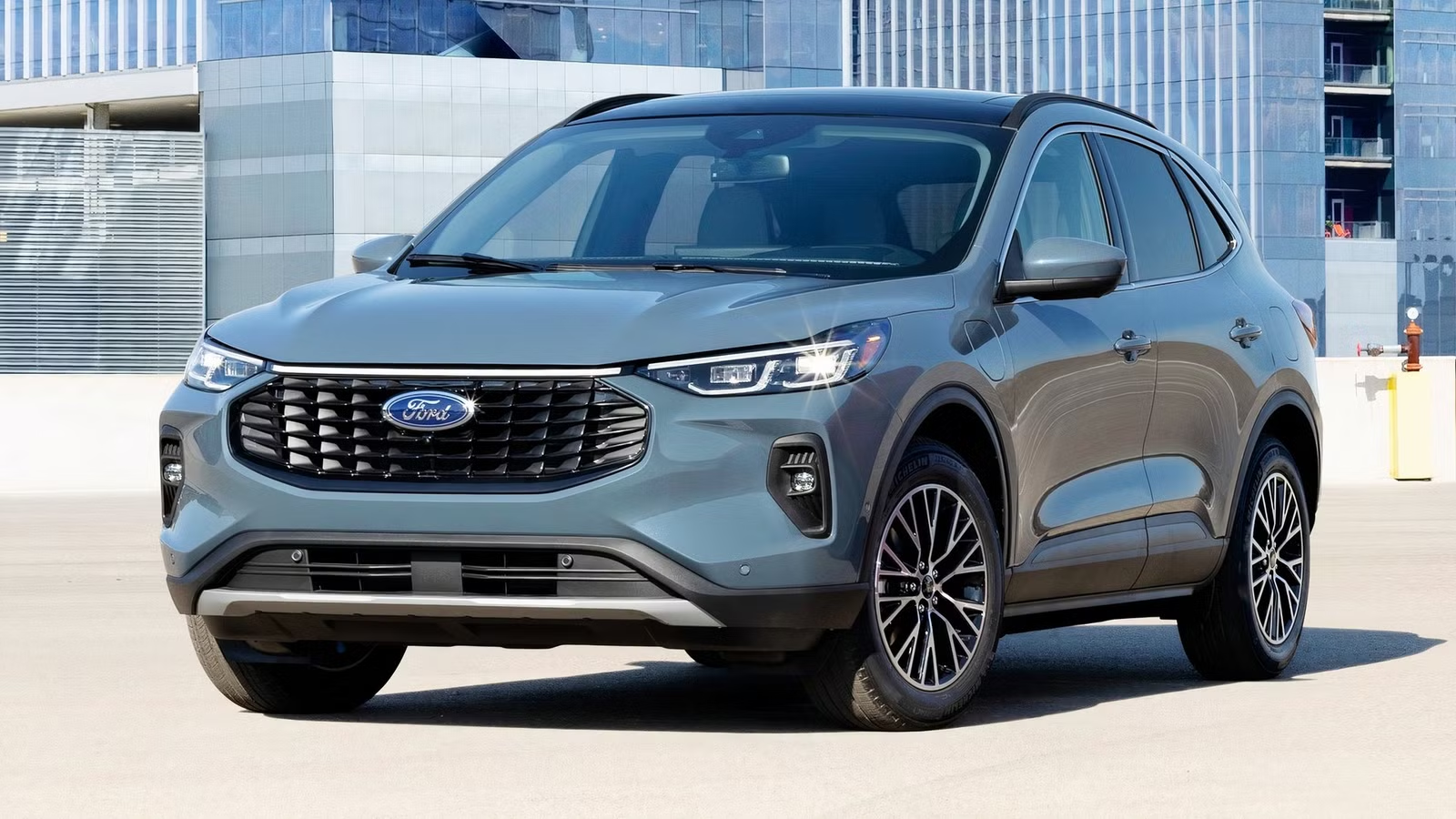
After 25 years and millions of units sold, the Ford Escape is done. Ford has officially confirmed the Escape will not return for 2027, ending one of the most recognizable nameplates in the compact crossover segment. The decision clears the way for Ford to retool its Louisville, Kentucky plant — the Escape’s longtime home — for a new lineup of affordable electric vehicles under the company’s Universal EV Production System, a $5 billion investment.

For current owners and anyone who had an Escape on their shopping list, the questions are practical: what happens to resale value, will parts and warranty support hold up, and what do you buy instead? Here’s what the discontinuation actually means.
Why Ford Is Pulling The Plug On The Escape
The Escape’s exit isn’t about poor sales or a product failure — it’s about factory priorities. Ford’s Louisville plant, which also builds the Lincoln Corsair on the same platform, is being converted to support EV production. The Corsair goes with it. Both models are casualties of Ford’s broader push to manufacture affordable EVs domestically, and the factory simply can’t do both jobs at once.

Production of the Escape wrapped before the end of calendar year 2025, though Ford built enough inventory to keep dealerships stocked well into 2026. Whether any of those units carry a 2026 model year designation remains unclear. What is clear is that no 2027 Escape is coming.
What Current Escape Owners Should Expect

Discontinuation doesn’t mean abandonment. Ford is legally required to support the Escape with parts and warranty service for years after production ends — federal regulations mandate at least a decade of parts availability for discontinued models. Owners with active factory warranties or extended service plans will see those honored as written.
Resale value is a more complicated picture. Compact crossovers hold their value reasonably well in general, and a nameplate with 25 years of mainstream recognition isn’t going to crater overnight. That said, the used-car market tends to soften around discontinued models once buyers realize there’s no new-car alternative to anchor pricing. Owners thinking about selling in the next year or two may want to move sooner rather than later, before the segment’s attention fully shifts to rivals.
One wrinkle worth knowing: stricter emissions regulations in California, New York, Vermont, Massachusetts, Oregon, and Washington mean Escapes built to current standards cannot be legally sold new in those states. If you’re in one of those markets, your options at dealerships may already be limited.
Will The Escape Name Come Back?

There’s a rumor circulating that the Escape nameplate could return at some point in the future — possibly attached to an EV or a redesigned model. Ford has not confirmed any successor, timeline, or product plan. Treat it as exactly what it is: an unconfirmed rumor. For now, the Escape is gone, and Ford has made no public commitment to reviving it.
Ford’s Only Compact Crossover Is Now The Bronco Sport

With the Escape gone, the Bronco Sport becomes Ford’s sole entry in the compact crossover segment. It’s a capable vehicle, but it’s a different one — designed around trail-ready hardware, higher ground clearance, and rugged capability rather than the Escape’s comfort-first, efficiency-focused formula. Bronco Sport offers available all-wheel drive and multiple drive modes, but it doesn’t carry over the Escape’s hybrid or plug-in hybrid powertrain options, which were a key draw for fuel-conscious buyers.
For shoppers who want what the Escape delivered — smooth ride, strong fuel economy, family-friendly cargo space — the Bronco Sport is a partial answer at best.
The Compact Crossovers That Fill The Gap

The good news for Escape loyalists is that the segment they loved is not going anywhere. Several rivals now own the space the Escape occupied, and most of them are strong.
The Honda CR-V and Toyota RAV4 are the segment benchmarks — both offer hybrid variants, generous cargo room, and long reliability track records. The RAV4 in particular has a plug-in hybrid version, the RAV4 Prime, that competes directly with what the Escape PHEV offered. The Mazda CX-5 skews slightly more premium, with a refined interior and available turbocharged engine that gives it a driver’s edge. The Hyundai Santa Fe was recently redesigned and now sits at the larger end of the compact segment, offering more interior space and a bold new look.
The Escape leaves behind a loyal owner base and a clear market need. The segment will absorb that demand — it just won’t be wearing a Blue Oval badge.
The Escape Is Part Of A Broader 2027 Discontinuation Wave

The Escape isn’t alone. Nearly a dozen SUVs are disappearing for 2027 across multiple brands. The Acura RDX is ending its run, though a hybrid successor is reportedly in development. The Tesla Model X — which helped define the luxury electric crossover category — is being discontinued so Tesla can repurpose its production capacity for humanoid robots. The Honda Prologue, which rode GM’s Ultium platform, is being killed after Honda cited a significant shift in EV demand. The Jaguar F-Pace, Land Rover Discovery Sport, BMW iX (US allocations), Volvo EX30 (US), and Volkswagen ID.4 (temporarily) round out the list. Polestar’s 3 and 4 are gone from the US entirely, blocked by federal rules on connected vehicles with Chinese manufacturing ties.
It’s a significant reshuffling of the SUV market heading into the back half of the decade — and the Escape’s exit, given its 25-year run, is the most historically significant departure of the group.

Related posts


Latest Post


No Comments