
The Kawasaki That Buried The Honda CB750’s Reign Overnight
Back when the Honda CB750 first came out in 1969, it proved to be an era-defining motorcycle. Coined the world’s first superbike, it transformed the motorcycle industry overnight. It was faster, more reliable, and most importantly, more affordable than anything comparable. Then, just three years later, Kawasaki released a motorcycle that made it feel almost irrelevant.
The Birth Of The UJM

The development of the CB750 did not go unnoticed. The other Japanese manufacturers paid close attention to what Honda was doing, and the moment it was greeted with critical acclaim, they were all quick to put something similar into full production. While Suzuki was still under the illusion that rotary motorcycles could be a “thing,” and Yamaha was initially content to simply offer middleweight alternatives, Kawasaki wanted the crown.
Their first prototype had the same 750cc displacement as the Honda, but Honda beat them to the punch, and we can only assume they knew they were beat right from the outset. Production was delayed a further three years before the bigger, better bike was finally put into full production. At the time of its release, it was by some margin the most powerful Universal Japanese Motorcycle (UJM) on the market.
The Kawasaki Z1 Became The “King Of Motorcycles”


With its more advanced 903cc inline-four, the Z1 had around 15 more horsepower than the Honda. Kawasaki had effectively brought a gun to a knife fight, and the buying public loved it! In a straight line, nothing could touch it. It had achieved its goal of becoming the “king” and this translated to sales success, but it was also far from perfect.
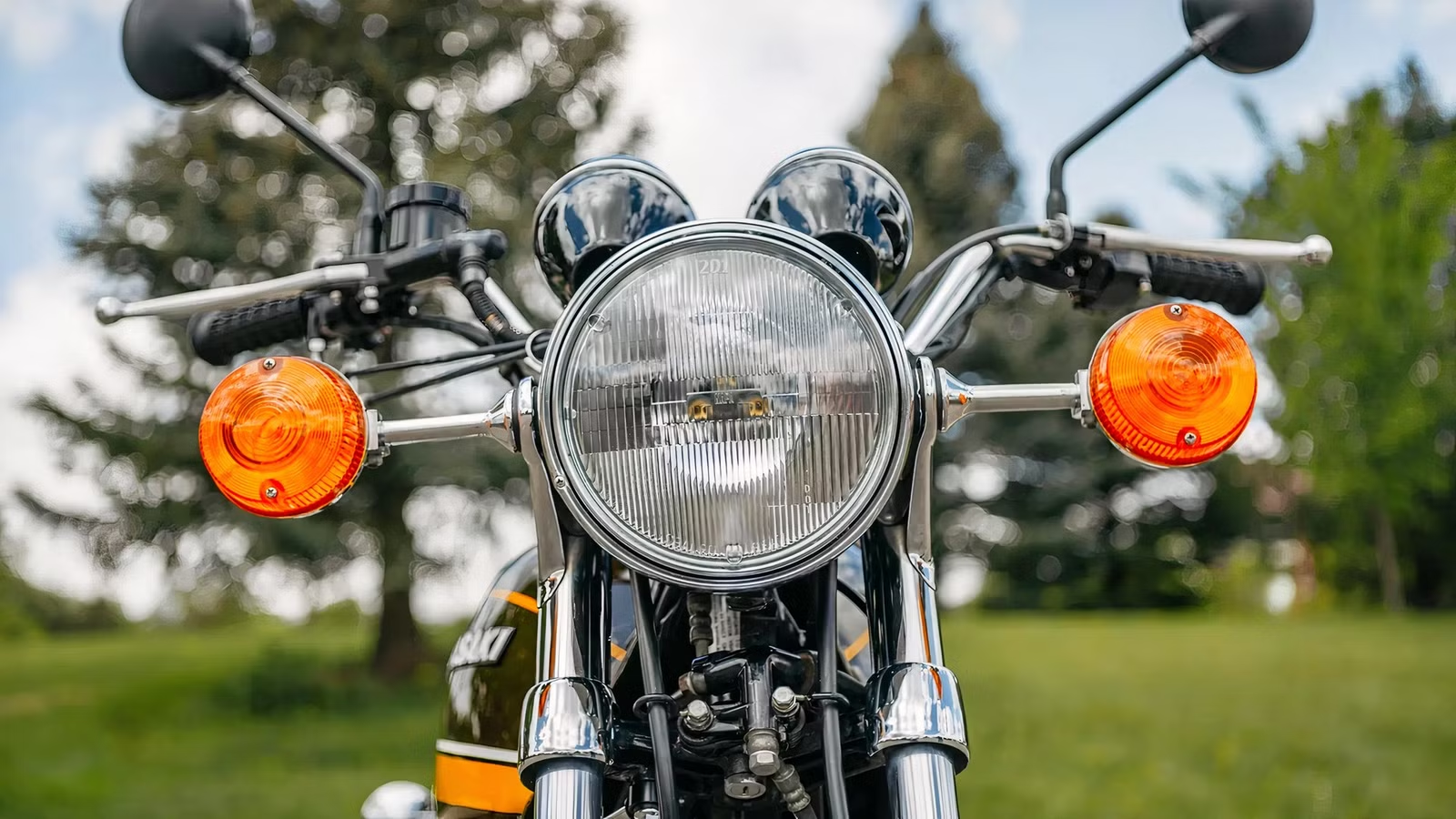
When these were launched in 1972 they were affordable, but prices are now on the rise as time takes its toll. You can find several bikes selling for between $5k and $8k, if you are willing to take on a bit of a project. Bikes in original or restored condition like the bike pictured ($20,000!) can sell for a lot more though.
The Z1 Had An Impressive DOHC Inline-Four
Power: 82 Horsepower

At the time of its release, the engine received widespread praise for how advanced it was. But, truthfully, that was only partially true. The Dual Overhead Camshaft (DOHC) arrangement was certainly advanced for the time, but by diving deeper into the engine you will discover proven technology that had been around since the 50s. Although its cam chains have long since proven their worth when compared to more “modern” cam belts, the specific roller bearings used to keep the crank in place are old tech. They made the bottom end difficult to manufacture, and have also proven to be less durable over time.
Powerful, Yet Flawed

As such, most of these bikes would have been overhauled at least a couple of times by now, unless the previous owners didn’t ride the thing, which is inarguably worse for the machine. By modern standards, 82 horsepower is not quite as much power as it once was, with several modern middleweight bikes making in excess of 100 horsepower these days, but none of those bikes have a chassis quite as crude as this.
“Wobbly” Handling Was A Hallmark Of The UJM Era

While straight line stability was never an issue thanks to the fact that the bike tipped the scales at almost 550 pounds, things would get interesting around corners. Japanese manufacturers paid little attention to chassis development throughout the 70s, because, quite frankly, that didn’t sell motorcycles. Performance did, and by the time this genuine high-performance motorcycle came out, it had around 30 more horsepower than its simple steel chassis was designed to handle.
Suffice to say the Z1 was not much of a canyon carver back when it was new. Today, it can actually be pretty dangerous in the wrong, untrained hands, or in the wrong condition. The vast majority of these bikes were thrashed from day one, and owners would make all sorts of wildly inappropriate modifications in an effort to “improve” the motorcycle. To get these bikes to handle, the chassis needed to be modified. If done by a trained professional, this is all good and well, but if the welding was done by somebody in their backyard, less so. Carefully going through one of these bikes is a safety-critical endeavor. Even if the rest of the bike was restored, a small clump of rust on the chassis is not going to be worth your time and effort fixing.
When Too Much Power Still Isn’t Enough, Strap On A Turbo
The Z1-R TC has to be one of the craziest motorcycles to ever get sold to the general public. As previously mentioned, the chassis already had to cope with around 30 more horsepower than it was designed for, and the addition of a turbocharger layered another 40 horsepower on top of that. This ill-conceived monstrosity was created to regain the “crown” Kawasaki had since lost by 1978.
Although this was not an official model, it was sold through Kawasaki dealers in the US, and it was by some margin the most powerful motorcycle money could buy back then. Naturally, just like the original, it offered unrivaled straight line performance, but a combination of that crude chassis and turbo-lag made it absolutely terrifying to ride fast. Even in a straight line!
What it did do was prove that there was some level of interest in turbocharged motorcycles. It inspired a string of full production models from all four of the Japanese manufacturers, all in the hope that it would be the next “big thing” in the motorcycle industry. As history tells us, it was not. The added complexity and cost involved in producing a turbocharged motorcycle outweighed the potential performance benefits, and the same rings true today.
Supercharging, on the other hand, is a different story. Although turbocharging hit a dead end, Kawasaki proved that supercharging a motorcycle wasn’t just possible, it actually worked in the real world. The modern H2 remains the only supercharged motorcycle on the market, and it offers unrivaled straight-line speed, just like Grandad.
Source: Bring a Trailer

Related posts

Latest Post


No Comments