
2027 Kawasaki Ninja H2 Carbon And Ninja H2R Prices Are Out (But It’s Too Late)
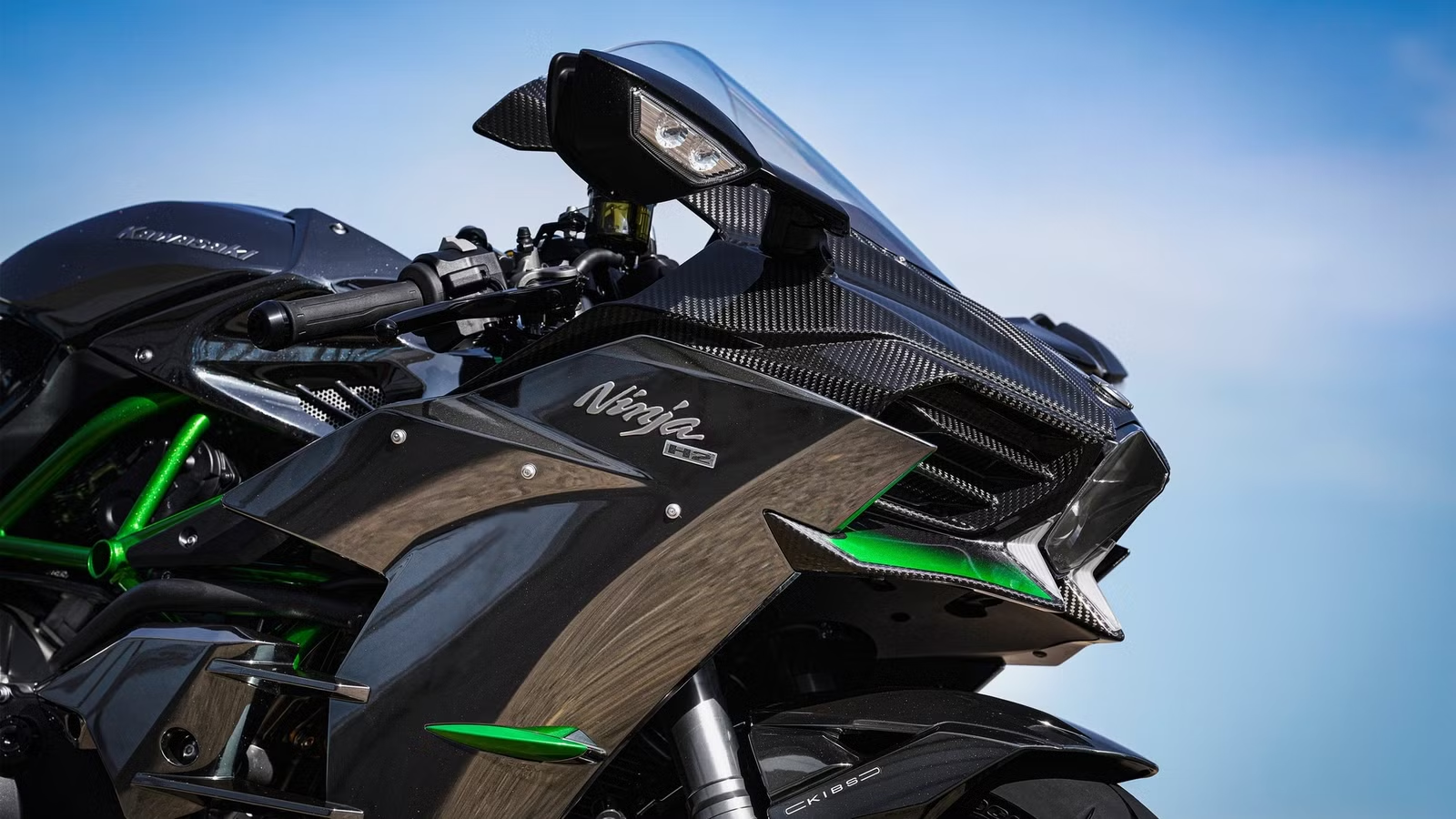
Back in September 2026, Kawasaki revealed the updated Ninja H2 sportbike lineup, confirming the return of the Ninja H2 and Ninja H2R for 2027. Over the past couple of months, we’ve covered the possibility that the road-going Ninja H2 might see a substantial power drop. Announced during the busy EICMA, Kawasaki ended the wait with more details about the updated Ninja H2 and pricing for both H2 sportbikes. Unfortunately for the Ninja H2, this update is a full-circle moment.
2027 Kawasaki Ninja H2 And Ninja H2R Are Already Sold Out For The Year

Kawasaki has updated the Ninja H2 for 2027, and the US market gets only the H2 Carbon edition, which features a carbon-fiber upper cowl. Meanwhile, the track-only Ninja H2R returns unchanged for 2027. Both US-spec models see Mirror Coated Spark Black paintwork.
The Ninja H2 has an MSRP of $39,400, and the Ninja H2R has an MSRP of $64,300. Kawasaki opened orders from November 3 through November 13, but Kawasaki Motors Corp., USA says both bikes are already sold out. Along with the prices, Kawasaki also revealed a host of mechanical and electronic changes, as follows.
US-Spec Kawasaki Ninja H2 Carbon Loses 22 Horsepower

Powering the Kawasaki Ninja H2 Carbon is the same supercharged liter-class engine, but Kawi has made major updates to the internals and the exhaust. The company says these changes are intended to deliver more mid-range torque between 4,000 and 7,000 rpm without sacrificing high-rpm acceleration. They also improve thermal efficiency.
Internal Changes In The Supercharged Mill

For starters, the mill’s compression ratio rises from 8.5:1 to 11.2:1, with a revised piston crown and reduced squish area. These changes also allow a single piston oil jet to replace the older two-unit setup, lowering pump operating rate, reducing engine oil capacity by 500ml, and saving 0.6 pounds. To accommodate the higher compression ratio, the supercharger impeller is also revised to smooth airflow at lower engine speeds, reduce intake air temperature, and suppress knock.
The aluminum intake chamber has also been revised to improve supercharger efficiency, with the volume reduced from 1.5 gallons to 1.3 gallons. The revised construction and a new diffuser layout improve intake funnel nets on the outgoing model and help smooth airflow. Meanwhile, the throttle valves are 4mm narrower at 46mm to improve airflow characteristics. Kawi says the improved valve response helps maintain boost pressure, resulting in better throttle response.

Kawasaki has also revised the intake and exhaust ports for low- to mid-range performance. The cam profiles now feature shorter intake and exhaust durations and reduced valve overlap to achieve the same goal. The ECU settings have also been revised to suit the mechanical changes, resulting in a claimed stronger midrange and a power surge past 8,000 rpm.
The gear ratios are also optimized, with the final reduction ratio changing from 44/18 to 44/17 to improve acceleration below 8,000 rpm. The clutch spring rates have been revised to match the new gear ratios.
A New Exhaust System

As earlier leaked CARB and EPA documents indicated, the Ninja H2 Carbon also features a new exhaust that resembles those of the Z H2 and Ninja H2 SX street models. The Japanese firm says the new exhaust is designed to enhance low- to mid-range torque and improve mass centralization, but it’s safe to assume this update is driven by stringent emissions norms. More on that in a bit.
The headers are 38.1mm in diameter at the cylinder and expand to 42.7mm downstream. The system uses a 360-degree collector layout that pairs cylinders 1-4 and 2-3, along with connector pipes, to improve low- to mid-range performance. The previous pre-silencer chamber gives way to a straighter exhaust layout, with a long collector pipe, larger catalyst, and more compact dimensions. The rear silencer’s capacity has decreased from 2.6 gallons to 2.3 gallons, and it is positioned closer to the bike. Kawasaki says the new silencer is lighter and allows enough cornering clearance.
First Kawasaki To Get Brembo Hypure Calipers And Other Tech Updates

The Kawasaki motorcycle features Brembo Hypure front calipers, the company’s latest-generation high-performance street brakes. The Hypure calipers use a lightweight, asymmetrical design for better rigidity and heat management and are claimed to offer better braking feel and control. The other hardware remains the same: a steel trellis frame with a KYB/Ohlins suspension setup.
The Ninja H2 Carbon also features a new full-color TFT display accompanied by an analog tachometer. There are two selectable display types inspired by aviation, along with newly designed handlebar switches to control them. Traction control has been revised with five modes and a switchable function, and launch control has been updated, too. The bike also gets heated grips, electric cruise control, and new integrated riding modes (Sport, Road, and Rain).
Tying Back To The Emissions Bit

The refinements mean two things for the Kawasaki Ninja H2. First, it can return to the European market. Due to tightening emissions norms, the Ninja H2 was taken off the shelves in Europe after 2021, while it remained available Stateside. With the new detuned engine making 197 horsepower for the EU-spec variant, the Ninja H2 meets Euro5+ standards and returns to Europe.
Second, the Ninja H2 is no longer the two-wheeled top-dawg motorcycle. The Ninja hyperbike has made significant power gains over the years, starting at 200 horsepower in 2015. Today, it returns to that ballpark, with the US-spec model going from 228 hp to 206 hp.
This drops it below many liter-class superbikes. For example, the Aprilia RSV4 1100 makes 220 hp, the Honda CBR1000RR-R Fireblade SP makes 214 hp, and the Ducati Panigale V4 makes 213 hp. What was once designed to decimate naturally aspirated models is now choked down to make fewer ponies than them. At least the Honda V3R 900 E-Compressor is here to carry the supercharged baton forward, so we’ll see whether forced induction is the answer to ever-tightening emissions norms.
2027 Kawasaki Ninja H2 Carbon ABS And H2R Image Gallery:
2027 Kawasaki Ninja H2 Carbon ABS Specifications:
Engine
|
Type |
Four-stroke, supercharged inline-four |
|
Displacement |
998cc |
|
Bore x stroke |
76 x 55 mm |
|
Maximum horsepower |
206 hp @ 11,000 rpm |
|
Maximum torque |
99.5 lb-ft @ 8,500 rpm |
|
Compression ratio |
11.2:1 |
|
Valvetrain |
DOHC, 16 valves |
|
Fueling |
Electronic fuel injection |
|
Exhaust |
4-into-1 |
|
Cooling |
Liquid-cooling |
|
Transmission |
6-speed, return shift, dog-ring |
|
Clutch |
Wet, multiplate, slip-and-assist type |
|
Final drive |
Chain, 44/17 |
Chassis
|
Frame |
Steel trellis |
|
Front suspension; travel |
Fully adjustable 43mm KYB AOS-II USD fork; 4.7 inches |
|
Rear suspension; travel |
Fully adjustable, link-type Ohlins TTX36 gas-charged monoshock with piggyback reservoir; 5.3 inches |
|
Wheels |
Forged aluminum |
|
Front wheel |
17 inches |
|
Rear wheel |
17 inches |
|
Tires |
Bridgestone Battlax RS11 |
|
Front tire |
120/70-17 |
|
Rear tire |
200/55-17 |
|
Front brake |
Dual 330mm semi-floating discs with radial-mount 4-piston Brembo Hypure monobloc calipers |
|
Rear brake |
Single 250mm disc with 2-piston Brembo caliper |
|
ABS |
Standard, cornering-enabled |
|
Electronic rider aids |
Electric cruise control, engine brake control, launch control, cornering traction control, bidirectional quickshifter, power modes, riding modes |
Dimensions & Capacities
|
Wheelbase |
57.3 inches |
|
Rake |
24.5 degrees |
|
Trail |
4.1 inches |
|
Seat height |
32.5 inches |
|
Ground clearance |
5.1 inches |
|
Fuel capacity |
4.5 gallons |
|
Curb weight |
524.8 pounds, full tank of fuel |
Price & Warranty
|
Website |
Kawasaki.com |
|
Price |
$39,400 |
|
Warranty |
12 months limited factory warranty |
|
Service interval |
Every 7,600 miles |
|
Color |
Mirror Coated Spark Black |

Related posts



Latest Post


No Comments