
The Motorcycle That Shows KTM Is More Than Orange Plastics
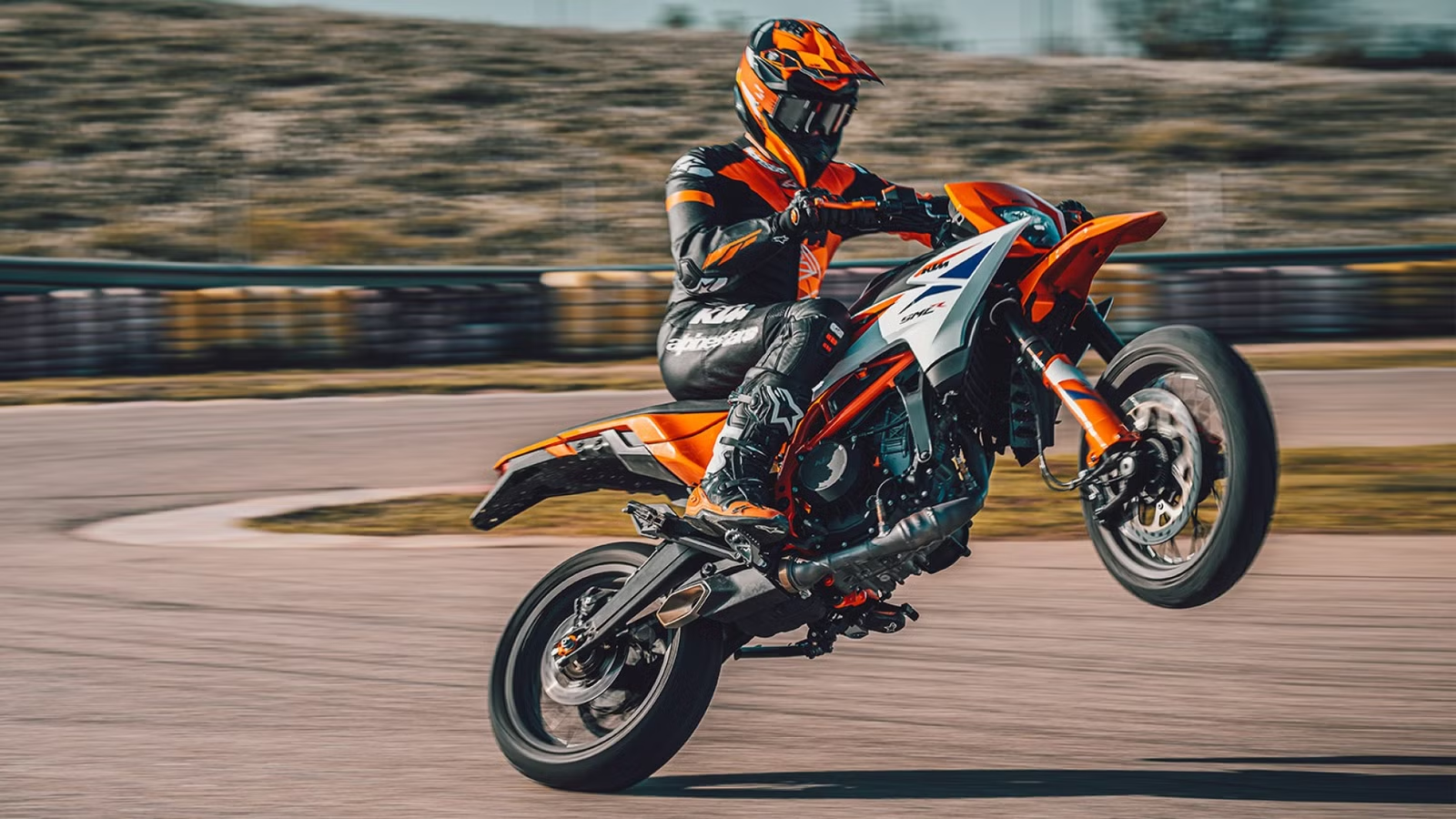
Since its inception, KTM has always carried a reputation for loud graphics, sharp angles, and aggressive styling. Critics often dismiss the brand as style over substance. They argue that Austrian bikes sell purely on loud attitude. Yet, reducing the brand to bright bodywork misses the engineering beneath the surface. KTM built its global identity around uncompromising competition hardware and success in many racing disciplines. The brand’s “Ready to Race” motto is an actual development standard, not just a catchy slogan. Its new bikes are fitting proof of the same, as the bikemaker tries to put its financial woes in the past. A baby supermoto serves as the prime example.
KTM’s Orange Bodywork Hides Racetrack Development Standards

The idea that KTM relies on flashy bodywork falls apart the second you examine how these bikes are engineered. Many rival motorcycle brands take commuter frames, wrap them in modern fairings, and call it a day. KTM does the opposite. The company designs its motorcycles around high-performance chassis dynamics, premium suspension, and lightweight components. The bright body panels are simply the covering for top-tier mechanical hardware. KTM treats displacement as a resource that should be exploited, extracting maximum power and minimal weight out of compact platforms.

That mechanical focus is why KTM dominates the supermotard scene. While Japanese competitors have largely abandoned road-legal supermotos, KTM stuck to its guns and has kept developing the likes of the 690 SMC R. The brand took long-travel suspension from its dirt bikes and matched it with brakes and sticky road rubber from its road-biased bikes. Models like the 690 SMC R earned cult status because they gave street riders a pure, unfiltered performance tool.

KTM never treated supermotos as cosmetic exercises; they engineered them to slide, lean, and stop on the money. This proves its serious focus on performance and the ability to experiment in a niche space, both of which are usually rare in the mass-market-oriented two-wheeler world of today.

The KTM 390 SMC R Brings Hardcore Supermotard Thrills To The Budget Class

That engineering expertise has trickled down into a smaller, accessible package with the KTM 390 SMC R. This bike proves that high performance does not need ten grand or middleweight displacement, and it turns the commute into the best part of the day. Most small bikes feel built to hit a cheap price point, sacrificing quality for mass appeal. The 390 SMC R takes the opposite route: it gives street riders genuine supermoto agility, premium hardware, and race-derived components. It backs up its loud styling with serious mechanical capability.
A $6,049 Base Price Exploits Global 390 Duke Platform Economies Of Scale

The 390 SMC R is the cheapest supermoto you can buy today. Priced at an attractive $6,049 here, this machine proves KTM can deliver value without cutting corners. The low price tag comes from smart platform sharing and intelligent manufacturing rather than cheap components. The 390 SMC R shares its primary trellis frame, electrical system, and core engine castings with the 390 Duke.
This building of multiple models on one platform cuts production and development costs significantly. As a result, higher-spec suspension, brakes, and electronics become more accessible. You get premium hardware at a budget price because the same components are shared across a number of models, and economies of scale always win.
Low-RPM Shove And An 8,500-RPM Redline Fuel Wheelie-Prone Dynamics

The powerplant inside the frame shows that this bike is far more than just bright cosmetic trim. It is powered by the latest LC4c liquid-cooled thumper. Displacing 399 cc with a short stroke, it generates 44.2 horsepower at 8,500 RPM and 28.8 pound-feet of torque at 6,500 RPM. It is mated with a six-speed gearbox with a PASC slipper clutch. The engine might not have the traditional supermoto torque curve, but it offers punchy low-end power to lift the front wheel, while the mid-range is where things get truly interesting. The LC4c is always a bunch of laughs near the redline, which suits a supermoto perfectly. At the same time, it feels practical, capable, and surprisingly fun.
A ChroMoly Steel Trellis And Adjustable Long-Travel Suspension Anchor Urban Hooliganism

The chassis is playful, predictable, and practical, and its hardware is also quite impressive. A chromoly steel trellis frame is paired with an open-lattice die-cast swingarm. There are inverted 43 mm WP Apex open-cartridge inverted forks, and a split-piston rear shock offering over nine inches of wheel travel at both ends. There is compression and rebound damping adjustment at the front, and preload and rebound adjustment at the rear.

The brakes are familiar: a ByBre setup with a 320 mm front disc paired with a radial four-piston caliper, and a 240 mm rear disc with a single-piston caliper. Expect KTM to update these to WP brakes soon, as it has with the 390 Duke. These brakes are mounted on 17-inch aluminum wire-spoke rims and sticky street tires. In a rare visible cost-cutting maneuver, these wheels do not support tubeless tires.
A 33.8-Inch Perch And 355-Pound Weight Deliver Intense Flickability
The 390 SMC R has pure supermoto proportions. It has a 57.2-inch wheelbase, a massive 10.6 inches of ground clearance, and the seat height is 33.8 inches. It weighs 355 pounds fully fueled – this is one of the bikes that prove lightweight motorcycles are more fun — and it can hold a maximum of 2.4 gallons of fuel. These are par for the course, with the long wheelbase offering stability at speed. The seat is quite high for most, but it compensates with a narrow seat and light curb weight.
4.2-Inch TFT And Six-Axis IMU Defy Segment Norms

The 390 SMC R’s low price might make you think that it is down on features to keep the price low, but you’d be wrong. It has a 4.2-inch TFT display that we first saw on the 390 Enduro R: a very different aspect ratio compared to what others use. Bluetooth and navigation are standard features, as is a USB port right next to the screen. Other features include all-LED lighting and graphics that are molded into the plastics. Electronically, this is the most loaded in its segment, thanks to a by-wire throttle and six-axis IMU. You get ride modes, cornering traction control that is switchable, and cornering ABS that can be switched off at the rear.
Japanese Rivals Are Outclassed, Especially At Pricing

The supermoto segment has remained stagnant for years, with only a little life showing when Suzuki came up with the DR-Z4S platform in 2025, and before that when Kawasaki’s KLX300 platform debuted in 2021. The old guard of the segment is the $7,899 Suzuki DR-Z400SM. It has a reputation for bombproof reliability, but you will be sorely disappointed if you want much more from it; it runs on carburetion to this day.

If you want a little more modernity, Suzuki will provide you with the DR-Z4SM, which is surprisingly practical. It offers fuel injection, a by-wire throttle with ride modes, switchable traction control, and inverted front forks. The price goes up a little to $7,999, but ABS isn’t even an option, and it sticks to a five-speed gearbox. The most expensive variant costs an incredible $9,299.

But for the exact same money as the KTM, you can get yourself the Kawasaki KLX300SM. This is an engine with a much more relaxed state of tune. The figures from its 292 cc engine are 25 horsepower, which is nearly 20 down on the 390 SMC R! The Kawasaki will not tackle the highway as well as the KTM, and it too doesn’t offer ABS even as an option.
Source: KTM USA

Related posts






Latest Post


No Comments