
The Sport Bike That Makes The Perfect First Step Into Serious Performance
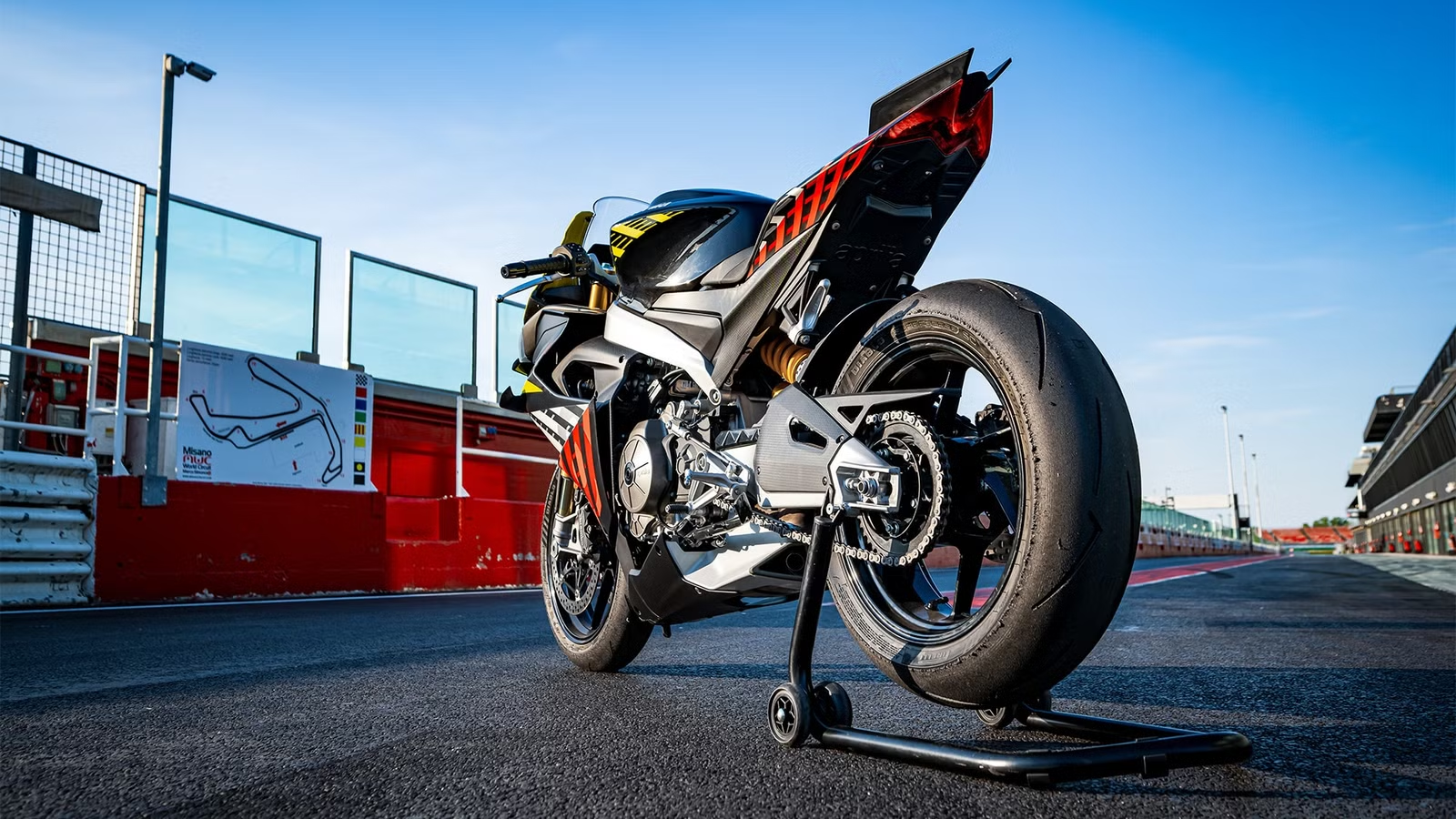
The honeymoon phase with small-displacement sports bikes fades quickly once you start finding their limits. Move up from a small twin and the choices can suddenly jump from manageable to intimidating, with more power, sharper ergonomics, and a bigger price tag. Yet there is a middle ground: a middleweight twin with serious brakes, a proper chassis and electronics borrowed from superbikes without superbike-level commitment. That’s a rarer combination than it sounds, and there are very few bikes that promise the balance. An Aprilia is what we recommend.
The Sport Bike Ladder Has A Missing Rung

After years of languishing, the sports bike space has posted double-digit growth since 2022, and bikes in the 501–750cc range have grown more than 20 percent annually over the past couple of years. Plenty of those buyers are new, too. Yamaha says the number of first-time sport bike buyers doubled after the Yamaha R7 arrived. However, that comfort zone can shrink fast. Graduating riders aren’t only chasing displacement. They want better suspension, stronger brakes, and electronics that actually help. After a few months of carrying more corner speed, you start noticing everything the bike can’t do. A bigger engine alone doesn’t fix that.
The Next Rung Is A Leap, Not A Step

At the other end, the price and performance jump gets serious. Yamaha’s 2026 YZF-R1 starts at $19,199 in the U.S., while the R7 is $9,399. That leaves a sizable gap before the liter-class superbike. Traditional 600cc supersports can make the transition feel even steeper. Yamaha’s YZF-R6, for example, was engineered around high-rpm performance, making its peak power at 14,500 rpm. Fast, focused, and brilliant on a track, that kind of engine character asks more of a rider than a flexible middleweight twin. So the missing rung needs to clear four hurdles: usable power, a proper chassis, modern rider aids, and a price that does not turn a first serious sport bike into a $20,000 commitment.

The Aprilia RS 660 Is The Perfect Bridge Between Starter Bikes And Track Monsters
Base Price: $11,849

Enter the Aprilia RS 660. The company says the 659cc parallel twin draws heavily from the RSV4 1100 superbike’s design and engineering, with half the cylinders. For 2025, Aprilia brought Euro 5+ compliance, enlarged the throttle bodies to 2.05 inches, and raised claimed output to 105 horsepower. Revised aerodynamics added integrated winglets and appendages designed to improve high-speed stability while helping manage hot air around the rider. It is a genuine middleweight performance platform, not simply a smaller motorcycle wearing superbike styling.

Price-wise, Aprilia lists the base model of the middleweight sport bike at $11,849, with the Factory trim at $14,149. Base buyers choose between Blue Marlin and Venom Yellow, while the Factory arrives in Shakedown Yellow. The Factory brings Öhlins suspension to justify the extra moolah. Now, about that sticker. It puts the Aprilia roughly $2,450 to $2,650 above the pack. As always, destination and dealer fees will push the out-the-door number higher.
There’s Serious Performance You Can Actually Use

On paper, the numbers look healthy. Aprilia claims 105 horsepower at 10,400 rpm and 52 lb-ft of torque at 8,400 rpm, with larger 2.05-inch throttle bodies responsible for the bump in power. Think of it as enough horsepower to feel properly quick, but not so much that every throttle twist becomes a negotiation. Where this engine earns its reputation is its mid-range. When the original 100-horsepower version launched, Aprilia said 80 percent of its torque was already on tap from as low as 4,000 rpm. In other words, the rider doesn’t have to wring out the throttle very hard to make progress. This trait impressed reviewers all across, who praised the engine’s flexibility.
A Chassis That Teaches Good Habits

The mechanical package is where the RS 660 further adds laurels to its reputation. Its aluminum twin-spar frame uses the engine as a stressed member, while the bike weighs about 403 pounds fully fueled and has a 32.3-inch seat height, something which is worth a sit-test at the dealer. It uses a 41mm inverted Kayaba fork and a rear shock, both with preload and rebound adjustment. Those details are significant since a suspension setup becomes part of learning how weight transfer, grip and damping affect the motorcycle.
The brakes are equally serious: dual 320mm front discs with four-piston radial Brembo calipers. That is more hardware than a beginner strictly needs, but that is precisely the point. As braking technique improves, the chassis is less likely to become the limiting factor. The Factory trim goes further with a fully-adjustable 43mm Öhlins NIX fork and Öhlins rear shock, but the standard RS 660 already has enough chassis equipment to support a rider who is learning to ride faster.
High-End Electronics Make Learning Faster And Safer

This is where the RS 660 feels most like a superbike in disguise. A six-axis IMU feeds Aprilia’s APRC suite, which bundles traction control, wheelie control, engine braking, engine maps, and cruise control. Five riding modes and launch control round out the list. Cornering ABS comes with three maps plus rear-wheel lift-up mitigation. It is designed to account for lean angle and other chassis inputs rather than treating every stop like a straight-line braking event. Put simply, the bike tailors its braking to how far it’s leaned over.
Aprilia says the system processes lean angle, lateral acceleration, brake pressure, pitch and yaw to balance deceleration and stability. Traction control is adjustable, and it can be switched off entirely, so you can dial the safety net down as your skills grow. Reviewers have pointed out that the rear-wheel output is manageable enough so that experienced riders may turn the electronics off, while anyone still building skills gets a useful tether.

The everyday touches are standard, too. A quick-shifter that works in both directions lets you shift without the clutch, and cruise control gives your right wrist a break on long highway stretches. A 5-inch color display with backlit controls sits in the cockpit. The pitch is visibility: optical bonding and backlit buttons so you can keep your eyes up and your focus on the road.
Overall, this Aprilia is a finely complete package: a 105-horsepower twin, Brembo radial brakes and an aluminum twin-spar chassis, all in one bike. It’s lighter, too: 403 pounds against the R7’s 417. So, is it the perfect first step into serious performance? For riders graduating from a small sport bike, it comes close. It costs more than its rivals, and it isn’t aimed at someone buying their very first motorcycle. If $11,849 is a stretch, the R7 is the sensible alternative, and a very good bike. However, the Aprilia brings more power, less weight, and a real safety net to learn on, all without a leap in intimidation.
Source: Aprilia

Related posts
Latest Post


No Comments