
2026 Kawasaki KLE 500 Review: Passport Not Required
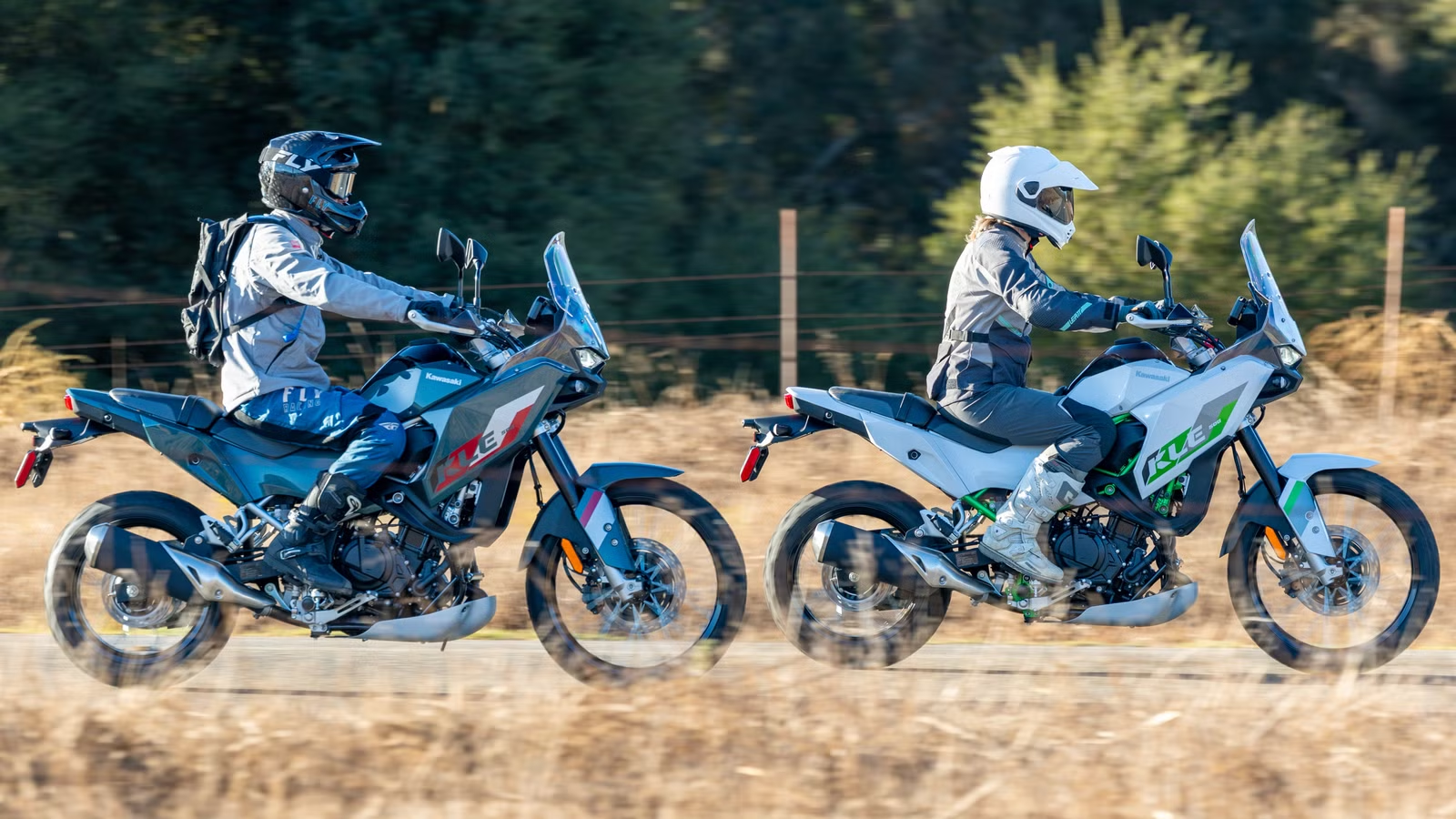
Somewhere in Morocco’s Atlas Mountains, a rider is coaxing a 550-plus-pound flagship ADV across a dry riverbed while an argan-fruit-munching goat supervises. In Peru’s Nasca Desert, another explores the sunbaked pampa hoping to give its sheer cliffs a wide berth, admiring the famous Nasca Lines and regretting that stimulating second cup of coca tea, which does wonders for altitude and absolutely nothing for ledge-side nerves. Stateside, the Backcountry Discovery Route faithful are collecting states like merit badges, while the truly adventurous may manifest ADV destiny by tackling the mostly off-road Trans-America Trail. The numerous stickers on their panniers will tell you, and so, too, will they, at the first opportunity.

These are the trips that decorate desktop wallpapers, make for the proudest stamps in passports, and drain savings accounts with equal enthusiasm.
There is one small snag. Most of us have jobs or families that would take rather great exception to gallivanting across the globe for weeks at a time, much to the dismay of us motorcyclists. The Peruvian expedition remains, for now, an open browser tab.
So, here is my wildly quick fix: some adventure beats no adventure, every single time. If you live in Southern California, for example, a proper escape is as little as a single tank of fuel from your garage. You can be home by dinner, smelling faintly of sagebrush and sunscreen, with your passport right where it belongs. Also, no jet lag.

Cleared for Arrival

That approachable logic is the whole thesis behind Kawasaki’s KLE 500, a nameplate Americans could only admire from afar until this year. The original debuted in 1991 with a 498cc parallel-twin engine borrowed from the GPZ500S sport bike and soldiered on overseas through 2007 without ever reaching a U.S. showroom. We got the legendary KLR650 and a firm handshake from Kawasaki, so it all worked out.
Those early ADVs were simple and a little naive, probably much like us in our youth. Then the segment started overpacking like a bright-eyed first-timer bound for Mongolia: a bigger engine, more horsepower, and layer after layer of electronics, just in case. Somewhere along the way, the bikes outgrew the weekends most of us have (so, too, did their MSRPs, honestly). Now, the pendulum swings back toward basics, because the lightweight ADV segment is at full tilt, and that’s all you’ll need for a quick ADV-shaped escape.

The base 2026 KLE 500 ABS starts at an affordable $6,599. Our SE ABS tester runs $7,499 and swaps the base LCD for a 4.3-inch color TFT, then adds a taller windscreen, metal-reinforced handguards, a larger skid plate, and LED turn signals. Engine, chassis, and suspension are identical.
The Unexpected History of Ranch Dressing

Our trio left Ventura, California, for what would normally be a 200-mile loop, with a decent amount of off-roading on the menu. Here’s the gist: Highway 150 slithers out of Ojai past Lake Casitas, which serves as a good warmup to remember what each lever does on your motorcycle, then tumbles over Casitas Pass toward Carpinteria. Highway 192 threads into Montecito, where privacy hedges outnumber people. Behind one sits The Promised Land, the estate Oprah Winfrey bought in 2001 for a reported $50 million. We did not stop for tea. We were not invited.
Gibraltar Road coils up the Santa Ynez range in a dizzying stack of switchbacks to meet East Camino Cielo on the ridgeline, both providing a glimpse of the expansive views that await later in the ride. Across Highway 154, detour down Stagecoach Road to Cold Spring Tavern for a genuinely tasty tri-tip sandwich, though our midweek adventure meant that the tavern doors were closed, and protein bars would be our feast. Ranch dressing made its commercial restaurant debut here in 1956, after former Alaskan plumber Steve Henson moved to what would become known as Hidden Valley Ranch. For our global audience, you might know it by its far more fitting “Cool American” name on bags of Doritos.

West Camino Cielo, which translates directly to “Sky Road” in Spanish, follows the western crest of the Santa Ynez Mountains. Pavement quits at the Winchester Canyon Gun Club, becoming Forest Road 5N12 for the next several miles. It ends at Refugio Pass, which provides two options: drop to the coast, spitting you out a stone’s throw from Refugio State Beach, or traverse the now somewhat rutted and certainly unmaintained pass to be spit out into the Santa Ynez Valley. From there, the return trip will sort itself out depending on which side of the mountain you choose to traverse.
Steady Eddie on the Pavement

If Ojai’s Highway 150 didn’t cement our feelings about the 451cc engine, then Gibraltar Road certainly did. The conventionally Japanese 180-degree parallel twin is shared with the Ninja 500, Z500, and Eliminator, following the interchangeable “Mr. Potato Head School of Motorcycle Design,” seen across many manufacturers these days. Kawasaki claims 51 horsepower and 31.7 lb-ft, and even the 15/46 final-drive ratio lands within a whisker of the Ninja’s street gearing. The result is one of the industry’s Steady Eddies, building linearly and predictably as revs climb. Where most of its pep registers is when the tach reads north of 6,000 rpm, though it was never meant to hit as hard as the trendy 270-degree-crank crowd that’s become the rage in the p-twin scene.
Up top, things get buzzy, while Kawi unleashes a bevy of strategies to fight back: the counterbalancer, rubber-damped bar mounts and footpeg inserts, and bar-end weights. Curiously, the comfortable seat is where most of the tingle lands.

That soft bottom end means gear choice matters if you want to keep it on the boil, but tic-tacking up Gibraltar or logging freeway miles at speedier paces makes that mostly a nonissue. Above all, it delivers a happy-go-lucky, manageable powerband, even wrung out to the limiter, and that easy-going nature threads through the entire machine.
Electronics are refreshingly scarce. There are no riding modes and no traction control, just switchable ABS and the SE’s 4.3-inch TFT, a familiar screen shared across several Kawasaki models. With power this cordial, traction control is rarely missed on pavement or dirt. The assist and slipper clutch is equally friendly, with a lever light enough for easy feathering through rocky terrain or crawling traffic.
The Dakar-flavored fairing and handguards shelter you well against wind and bush, though with the windscreen in the lowest of three bolt-in positions, a peaked helmet catches buffeting. Raise it if you’re on the taller side. The cockpit is roomy on the road, where the tall handlebars casually prop up your arms while the tall 34.3-inch seat places you in the chassis, nestled behind the high-mounted 4.2-gallon fuel tank. Yet, despite that placement, it never feels top-heavy.

Underpinning it all is an all-new steel trellis frame with a non-adjustable 43mm KYB inverted fork (8.2 inches of travel) and a preload-adjustable linkage shock (7.7 inches). Those numbers inspire confidence; the 7.3-inch ground clearance raises eyebrows. Tube-type 21/17-inch spoked wheels and IRC Trail Winner GP-410 rubber confirm a wide-ranging mission.
On tarmac, the KLE is no fish out of water. It carves with even-keeled gentleness, even eager to give a glimpse of the overgrown supermoto lurking beneath the surface, especially when hustling it through tight switchbacks. The fork resists egregious dive, and the shock handles everything except sun-baked, rippled asphalt. With my 190ish-pound frame aboard, it could use extra rebound damping.
The single 300mm disc and axial-mount Nissin dual-piston caliper are squishy, an unexpected win for novice riders, yet they don’t lack true stopping power. Paired with the dual-piston Nissin caliper and 230mm rear disc, they haul the 428-pound KLE down with plenty of feedback. Experts crave a stout bite, but with ABS disabled at both wheels via the left-bar button, novices are less likely to lock the front in the dirt.
Life in the Sky

Venturing off-piste, the KLE makes its preferences crystal clear. Flowing, semi-maintained fire road, which describes most of West Camino Cielo, is squarely in its wheelhouse. It holds a line faithfully, handy when the Pacific on one side and the Santa Ynez Valley on the other compete for your attention. Stand up, and the bar and pegs fall right where they should, though getting closer to the front end would be nice. This is the Kawi’s happy place. Ours, too.
Push the pace, find chunkier rock, or meet g-outs, and the tune changes. The skid plate answers rock hits with a hollow cast-iron-skillet clang, and loading the chassis through whoops might pick up a shovelful of dirt, which isn’t entirely unusual on 400-plus-pound ADVs. Bottoming the suspenders earns a confirmational clunk.

Sure, the KLE 500 could use firmer compression damping for riders of my weight, and maybe stiffer springs would suit aggressive riders. But stiffen it further, and road comfort suffers, while newer riders must push past their comfort zone off-road just to work the stroke and find grip. The bones of a proper trail buster are here, and the aftermarket is already accommodating, letting owners grow the bike alongside their skills.
Wrapping your head around the p-twin powerband also demands a reset. The hit needed to loft over obstacles or spin the rear lives higher in the revs than converts from single-cylinder engines or punchier twins expect, though there’s still enough grunt to climb and dig out of trouble. The limited ground clearance is also a byproduct of the KLE 500 using a shared streetwise powerplant with no tweaks. A model-specific shallow oil sump like the Aprilia Tuareg 660’s or a dry-sump design like the BMW F 900 GS’s would increase ground clearance, as would rerouting the exhaust from beneath the engine. The hiccup here is that both of those motorcycles are substantially more expensive, and Kawasaki likely couldn’t have added that engineering without pushing the KLE past its approachable price point.

That’s the KLE 500’s design-brief Catch-22, one that several lightweight ADVs deal with. Increase suspension to gain ground clearance in the name of off-road pursuits, and the seat height grows even higher. Photo model Jenny Smith sums up with an astute analysis: “Frustratingly, the low ground clearance is not paired with a low seat height, putting the KLE into the unfortunate position of having little to offer height-challenged riders attracted to its otherwise accessible nature. My 140 pounds weren’t enough to compress the shock with stock preload settings to plant both feet firmly on the ground. I was on the balls of my feet at best, and off-road, especially when turning around or if I had found myself in techy terrain, I was barely dabbing a toe.”
She continues, “Friends with shorter inseams deal with this problem by lowering their bikes, but since the KLE already has limited ground clearance, that also limits off-road potential. All that said, it’s still very manageable off-road due to its svelte weight and narrow waist. If your inseam is 32 inches or above, and you’re either comfortable with a taller seat or heavy enough to squish the suspension, allowing both feet on the ground, you’ll enjoy the heck out of riding forest roads on the KLE.”

Those tube-type wheels deserve a footnote, because it’s not truly an adventure until something bad happens. Midway along the ridge, esteemed colleague Jenny (sadly, I don’t have her ponytail) got a pinch flat from an errant sharp-edged rock on her KLE. It happens to the best of us, folks. Feeling a bit deflated in the unrelenting Southern California heatwave, both figuratively and literally, we did what any good journalist would do and promptly foisted her KLE upon intrepid Kawasaki PR man Brad Puetz. Later, we learned that California black bears frequent the area and are known to sprint up to 30 mph. Knowing that, we knew we’d made the right choice.
All jokes aside, with no repair kit and precarious elements, our best course was limping the KLE back to the Winchester Canyon Gun Club, which rests at the trail’s eastern entrance. Much to our luck, it was open, offering plentiful shade, cold water, and general safety (not just because of the firearms). Never have strangers holding shotguns felt more like a welcome committee. Lesson learned: tubes mean packing tools, tire levers, patch kits, and replacements. But at least tubes can be replaced, whereas a sidewall-gashed tubeless tire might not be repairable.
The Long Way Home

The would-be 200-mile day leaves time to ruminate on parallel-twin rivals, setting aside the single-cylinder offerings from KTM and Royal Enfield for apples-to-apples riffing. In my case, I did the route a couple of times aboard the KLE 500 thanks to scouting missions. So, here’s where my mind went. Honda’s NX500 costs $600 less than our SE, packs a more refined twin, and rolls on cast wheels that give it the edge on pavement. Combine those cast-aluminum hoops with even less suspension travel than the KLE, and the Honda isn’t your ticket to a dusty ‘stache. Looking at the dirt-leaning end, the CFMOTO Ibex 450 and its rebadged Sino-Italian cousin, the Moto Morini Vettore 450, both $6,499, bring tubeless wire-spoke wheels, adjustable suspension, and a torquey 270-degree twin with short gearing. The Vettore does feature a curiously street-oriented riding position that makes standing somewhat awkward. The tradeoff is that their road manners are less savvy. The KLE splits the difference functionally, though in SE trim, not on price. The base model holds that distinction at $6,599.
Adventure is what you make it, and there’s no true yardstick for a great one. Big, small, or in between, motorcycles are arguably the best vehicles for making memories with friends. Melting in the heat for photos is textbook Type 2 fun, enjoyable only in retrospect. Kawasaki’s radiator fan shroud dutifully redirects heat away from your legs, an underappreciated feature until battling the brutal midday sun.
The KLE 500 is honest about its capabilities from the first thumb of the starter to the first highway mile or fire-road excursion. It could tackle Atlas riverbeds or Nasca cliffs, just at a more measured pace, and it certainly isn’t chasing Dakar Rally glory. Better still, it’s built for the forest roads and two-track you’ve been eyeing up on maps for months, the ones where the exotic was hiding just past the freeway exit all along. For riders finding their trail footing, it’s a fine first step, and in base trim, one that leaves enough in the wallet to fund what counts: adventure with the people you call friends.
2026 Kawasaki KLE 500 Review Photo Gallery:
2026 Kawasaki KLE 500 Specifications:
Engine:
|
Type |
Parallel twin |
|
Displacement |
451cc |
|
Bore x stroke |
70.0mm x 58.6mm |
|
Maximum horsepower |
51 horsepower @ 10,000 rpm (claimed) |
|
Maximum torque |
31.7 lb-ft @ 7,500 rpm (claimed) |
|
Compression ratio |
11.3:1 |
|
Valvetrain |
DOHC; 4 valves per cylinders |
|
Fueling |
Digital Fuel Injection (DFI) w/ 32mm throttle bodies; downdraft intake w/ 5.6-liter airbox; TCBI ignition w/ electronic advance. |
|
Exhaust |
Upswept silencer w/ slash-cut muffler cover. |
|
Cooling |
Liquid |
|
Transmission |
6-speed, return shift |
|
Clutch |
Assist & Slipper Clutch. Wet or dry, plate type and cable actuation |
|
Final drive |
Sealed chain, 15/46 ratio (3.067:1) |
Chassis:
|
Frame |
High-tensile steel trellis; aluminum die-cast swingarm |
|
Front suspension; travel |
KYB 43mm cartridge-type inverted telescopic fork; 8.3 inches (210mm). |
|
Rear suspension; travel |
KYB Bottom-link Uni-Trak monoshock w/ adjustable (stepless) spring preload; 7.7 inches. |
|
Wheels |
Wire-spoke, aluminum rims w/ steel spokes. Tube-type. |
|
Front wheel |
21-inch diameter |
|
Rear wheel |
17-inch diameter |
|
Tires |
IRC GP-410. |
|
Front tire |
90/90-21 |
|
Rear tire |
140/70-17 |
|
Front brake |
Single 300mm steel disc w/ 2-piston caliper. Nissin. |
|
Rear brake |
Single 230mm disc w/ 2-piston caliper. Nissin. |
|
ABS |
Standard; Nissin ABS unit, front and rear, switchable off via left-handlebar switch and reset to on at each restart. |
|
Electronic rider aids |
Economical Riding Indicator; selectable on/off ABS; smartphone connectivity via app |
Dimensions & Capacities:
|
Wheelbase |
61.2 inches |
|
Rake |
28.0 degrees |
|
Trail |
4.1 inches |
|
Seat height |
34.3 inches. Laden or unladen basis Not Provided By Manufacturer |
|
Ground clearance |
7.3 inches |
|
Fuel capacity |
4.2 gallons |
|
Curb weight |
427.8 pounds (430.0 pounds, 50-State model) |
Pricing & Warranty:
|
Website |
kawasaki.com |
|
Price |
$7,499 MSRP; $650 destination charge additional (set by dealer) |
|
Warranty |
12 month limited mileage warranty |
|
Service interval |
Oil every 7,456 miles; valve clearance inspection every 14,913 miles. |
|
Color |
Pearl Blizzard White, Metallic Bluish Green |

Related posts

Latest Post


No Comments