
Honda’s “Outdated” Four Still Outclasses Modern Turbo Engines On Power Per Liter
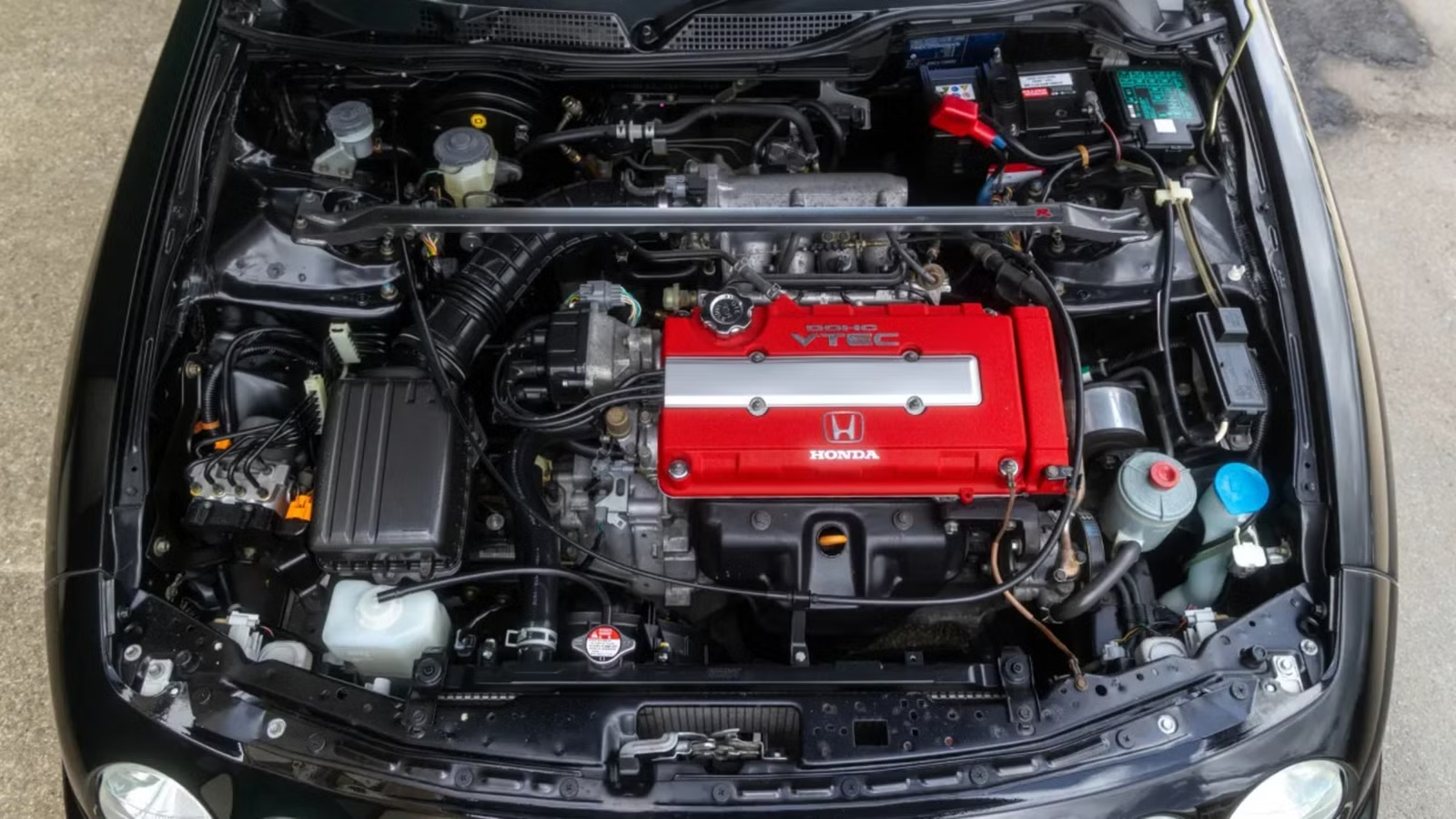
Turbocharging has made horsepower cheap, at least in engineering terms. A modern 2.0-liter four-cylinder can deliver more than 300 horsepower while still starting quietly on a cold morning, passing an emissions test, and pulling hard before the tachometer reaches its halfway point. Thirty years ago, small engines had fewer shortcuts, and one Honda four-cylinder took the difficult route instead. It relied on airflow, compression, obsessive manufacturing, and an almost unreasonable appetite for rpm. The result still makes today’s boosted engines look technically spoiled, even if the stopwatch says otherwise.
Modern Four-Cylinders Have An Easy Way To Make Big Power

Modern performance fours have a powerful ally: pressure. A turbocharger stuffs more air into an engine than atmospheric pressure could deliver on its own, allowing more fuel to burn and more torque to reach the crankshaft. That is how a relatively ordinary displacement now produces numbers that once belonged to large six-cylinder engines and even V8s. The 2026 Honda Civic Type R is a good example—its turbocharged 1,996-cc four makes 315 hp at 6,500 rpm and 310 lb-ft of torque, with Honda listing 25.2 psi of boost. Using the familiar rounded 2.0-liter figure, that works out to about 157.5 hp per liter.
Volkswagen pushes the same idea even further. The current Golf R produces 328 hp from its 2.0-liter turbo four, or roughly 164 hp per liter when calculated against the nominal 2.0-liter displacement. Its actual capacity is 1,984 cc, so the exact figure is slightly higher again. Those numbers matter because both modern engines beat the old Honda at the center of this story in absolute specific output.

There is, however, another way to judge the work required to reach those numbers. A turbo engine does not have to wait for the surrounding atmosphere to fill its cylinders. Its compressor increases the mass of oxygen available for every combustion event. The older Honda had atmospheric pressure, carefully shaped metal, and whatever air the pistons could drag through the intake ports. In simple terms, today’s engines get to take a bigger breath, but Honda’s mystery four became exceptionally good at breathing the same air available to every other naturally aspirated engine.

Making 100 HP Per Liter Without Boost Is The Hard Way

That distinction looked far more dramatic in the mid-1990s. Naturally aspirated production engines making more than 100 horsepower per liter existed, but buyers did not normally find them in relatively affordable front-wheel-drive coupes. Honda’s engine, depending on market specification, had a peak torque of around 131 to 133 lb-ft, and it arrived very high in the rev range. Today’s Civic Type R has more than twice that shove available much earlier, but the old engine instead asked the transmission and the driver’s right hand to keep it spinning where its cylinder head worked best.
VTEC made that usable without turning the car into a miserable racing special at low speed. At lower rpm, relatively mild cam lobes gave the engine sensible valve lift and duration. Higher in the range, an oil-pressure-controlled locking mechanism let the valves follow a more aggressive central cam profile with greater lift and longer duration. The second cam profile allowed the cylinders to keep filling efficiently after a conventional valvetrain would begin choking. Horsepower then did the rest. Since horsepower is tied to torque multiplied by engine speed, modest torque can still create serious power when an engine holds that torque at very high rpm.
That strategy required much more than an exciting camshaft – high engine speed punishes pistons, rods, bearings, valves, and the crank every single second. Manufacturing variation that barely matters in a commuter engine becomes far less funny near 8,500 rpm. Period accounts say Honda‘s extra hand-finishing restricted production to around 25 engines or cars per day, with technicians manually finishing the ports and measuring connecting-rod bolt stretch with micrometers. Whatever this thing was, Honda had decided that the normal way of building an engine was not good enough.
Honda’s Naturally Aspirated B18C Engine Does Turbo Levels Of Power

The engine was the B18C Type R, introduced with the Japanese-market 1995 Honda Integra Type R DC2. Keep in mind this engine had several variations, including the UK B18C6 with 190 PS (about 187 hp) at 7,900 rpm from 1,797 cc. Japan’s Type R B18C was rated at 200 PS at 8,000 rpm, equal to about 197 hp. Converted to a specific power-per-liter ratio, it makes about 109.6 bhp per liter. Period Honda literature lists 8,400 rpm as the JDM engine’s maximum allowable speed, while later references often cite fuel cut closer to 8,600-8,700 rpm.
Honda reached those numbers by treating airflow like a scarce resource. Compression rose to 11.1:1. The Type R lost the base B18C’s dual-runner intake in favor of a straighter, larger single-port design. Honda enlarged the air inlet from 65 to 70 mm and the throttle opening from 60 to 62 mm, altered the valve-seat geometry, increased valve lift and duration, and opened up the exhaust. Even the intake valves became lighter.
But the surprising part is the basic engine geometry underneath it all – the B18C kept an 81-mm bore and used an 87.2-mm stroke, making it a long-stroke design rather than the short-stroke layout normally associated with huge rpm. The calculated piston speed was around 24.4 meters per second at 8,400 rpm, an extraordinary figure for a production engine of the time.

The bottom end had to survive that punishment repeatedly. Honda designed a dedicated fully counterweighted crankshaft with eight balance weights and said the arrangement improved rotational balance by 20 percent. Contemporary technical reporting also described metallurgy that raised the crank’s bend-fatigue limit by around 25 percent.
The automaker fitted stronger, lighter connecting rods and carefully controlled their assembly. The piston skirts received molybdenum coating to cut friction and reduce the risk of scuffing as piston speed climbed. Oil delivery around the piston pin received special attention as well. None of those changes look glamorous beside a bright red valve cover, but they explain why the red valve cover could keep visiting the far end of the tachometer without becoming an expensive red paperweight.
Then came the expensive part: people. Workers manually polished all 16 port areas to remove the small steps left after valve-seat machining. Connecting-rod bolts were tightened according to measured bolt stretch for greater precision. The company developed around 60 Type R-specific engine parts in total. Integra production took place at Honda’s Suzuka plant, and period reporting put the hand-finished Type R production rate at about 25 units per day.
Honda Built The Whole Integra Around Those 1.8 Liters

The DC2 could not rely on torque to erase mistakes. Drop too far out of the power band and 1.8 naturally aspirated liters suddenly remembered that they were only 1.8 liters. The firm therefore built the rest of the Integra around preserving speed. The original Japanese three-door Type R weighed just 1,060 kg in basic form. Close gearing helped the engine land back in its useful rev range after each shift, while the chassis gave the driver enough confidence to carry speed into a corner instead of braking hard and expecting a huge torque wave to fix everything on exit.
Honda’s own weight ledger shows how obsessive that became. Compared with the SiR-G, Type R hardware added roughly 25 kg through items such as the helical limited-slip differential, structural braces, reinforcement, Recaro seats, and spoilers. Engineers then removed about 65 kg elsewhere. The cuts included more than 10 kg of floor sound-deadening material, a smaller battery, lighter wheels, a lighter flywheel, reduced dashboard insulation, and other small changes. Air conditioning represented another 18.7 kg and audio equipment about 5.7 kg when those options were deleted. The rear wiper alone saved roughly 1.9 kg. Other versions used thinner glass and market-dependent equipment deletions. The arithmetic left a roughly 40-kg net reduction despite all the performance hardware Honda had just bolted back in.
Honda also strengthened the shell in the places that mattered. Type R histories note extra spot welds and reinforcement around areas such as the rear shock structure and subframe. There were added performance rods tying key sections of the front and rear structure together. Suspension rates rose, the rear anti-roll bar grew dramatically, and the car sat lower. A torque-sensitive helical limited-slip differential helped the front tires turn engine speed into forward motion instead of one-wheel smoke. Honda paired it with 195/55R15 Bridgestone Potenza RE010 high-grip tires. The contradiction was intentional: engineers removed insulation, accessories, and grams wherever they could, then willingly added metal where rigidity or traction demanded it. Lightness was never the goal by itself. Control was.
That philosophy also explains why engines like this largely disappeared. High rpm increases friction, stress, noise, and the amount of expensive engineering needed to keep everything alive. Tighter emissions rules made cold-start and combustion control more important, while noise regulations became harder to satisfy. Buyers grew accustomed to engines that make useful torque without a downshift and a trip toward 8,000 rpm. Fuel-consumption tests also reward operating an engine efficiently in the rev ranges drivers use most. Turbocharging solved several commercial problems at once: it allowed smaller engines to produce far more torque at low and medium rpm while keeping headline horsepower high without requiring exotic engine speed.
The B18C Isn’t More Powerful Than Today’s Turbo Fours. That’s Why It’s More Interesting

Sure, modern turbo fours win the pure power comparison without effort. A 315-hp Civic Type R makes about 157.5 hp per nominal liter, roughly 51 percent more specific output than a 187-hp UK DC2 at about 104 hp per liter. The 328-hp Golf R, in turn, stretches the gap farther. They also bring vastly more torque: Honda’s current Type R makes 310 lb-ft from 2,600 to 4,000 rpm, while the old European B18C6 managed about 131 lb-ft near the far end of its tachometer. Modern electronic controls, direct injection, turbocharger management, knock sensing, and decades of materials development make those engines faster, cleaner, more flexible, and easier to live with. Pretending otherwise would turn engineering history into fan fiction.
But the modern numbers also explain why the old Honda remains so interesting. Its cylinders received no compressed intake charge, while there was no boost controller increasing oxygen mass whenever more torque was needed. Honda extracted more than 100 horsepower from each naturally aspirated liter by making a long-stroke 1.8 breathe cleanly at engine speeds where normal production fours were already looking for the exit. It used lightweight valves, aggressive cam profiles, special springs, a fully balanced crank, low-friction piston treatment, stronger rods, hand-finished ports, close gearing, and a light chassis to make a fairly small torque figure do remarkable work. Even the pistons were traveling at speeds comparable with contemporary racing-engine territory.
That is the real meaning behind calling the B18C “better” on power per liter. It is not a claim that engineering peaked in 1995 – it plainly did not. Modern fours produce more power, fewer emissions, better fuel economy, easier drivability, and tighter electronic control. However, the B18C marks something narrower and, for enthusiasts, perhaps more fascinating: a high point in the mass-produced, high-specific-output naturally aspirated four-cylinder as an exercise in mechanical discipline. Honda built the Integra around the idea that airflow, low mass, gearing, chassis precision, and relentless rpm could replace displacement and boost. The industry found easier ways to go faster, but few have been as wonderfully complicated.
Source: Honda, Acura

Related posts



Latest Post


No Comments