
1964 Ford F-350 Flatbed Hiding 522 HP Turbo Build
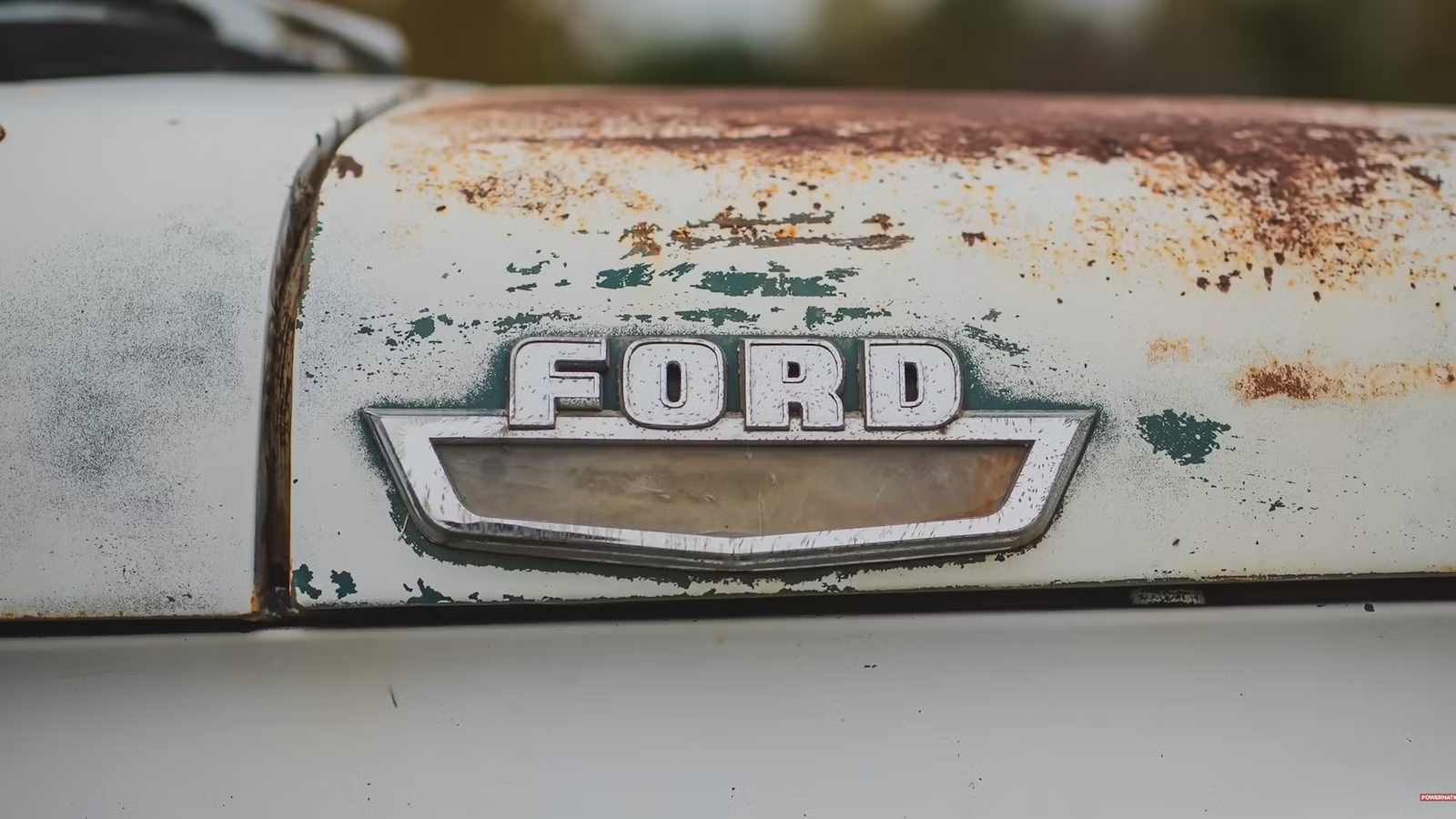
Old work trucks are supposed to be useful, dependable, maybe surprisingly powerful and probably a little slow. Nobody looks at a weather-beaten flatbed and expects serious performance. That’s exactly what makes this one so much fun. Beneath a faded, workaday exterior that screams “barn find” is an engine capable of producing 522 horsepower and 597 lb-ft of torque, numbers that would look perfectly at home in something far newer and far more expensive. Of course, this truck didn’t start life anywhere close to that powerful. Its transformation began with the sort of neglected old machinery that usually ends up disappearing into a field, a barn or somebody’s back lot.
Old Farm Equipment Has A Way Of Disappearing Into Fields And Barns

Most old machinery never gets a dramatic second act. For every piece of old grain silo hardware that becomes the rustic centerpiece of some reality TV redecorating showdown, there are countless other pieces of equipment and machinery being reclaimed by the fields where they sit. That was almost the fate of this truck. By the time Music City Trucks found it, roosters were already taking up residence, and the owner said it hadn’t run in six years. The engine would turn over, but starter fluid and crossed fingers weren’t enough to wake it up. Cleaning out the carburetor and freeing a stuck spring finally did the trick, and the old truck fired up right there on the spot. At that point, getting it running again was already a small victory. What followed was something else entirely.
This 1964 Ford F-350 Was Worth Saving

The truck that could have rotted away where it sat but instead fired up and drove onto the hauler under its own power was a 1964 Ford F-350 flatbed, the kind of heavy-duty old Ford that was built for work first and everything else second. It still had its original 223-cubic-inch inline-six, rated at just 77 horsepower and 134 lb-ft of torque, backed by a BorgWarner T98 four-speed manual. In other words, there was nothing remotely exotic hiding underneath when it lumbered up the ramp for a ride to the shop, carefully, with no working brakes.

That was part of the appeal. This F-350 didn’t need to become some gleaming, over-restored showpiece to be interesting. Marc Christ and Brandon Burke had already proved the old thing could run again, and the flatbed still had the sort of battered honesty that makes an old work vehicle worth keeping around. The owner had even rebuilt the bed at some point so it could carry a pretty substantial water tank. A logical next step would have been to reclaim that old capability. The less practical thought was to decide that 77 horsepower was nowhere near enough.
Ford’s 300 Inline-Six Was Almost Ridiculously Overbuilt

The replacement engine was another Ford inline-six, but that is about where the similarities end. Engine Power’s Frankie Forman and Pat Topolinski built a turbocharged 300-cubic-inch six around some surprisingly ordinary factory hardware, including the original crankshaft and stock connecting rods. They added 4.050-inch pistons, ARP fasteners, a custom camshaft and modern EFI, then bolted a 72 mm Turbonetics turbo onto the whole thing.
With 13.2 psi of boost, the new creation made 522 horsepower and 597 lb-ft of torque on the dyno. The headline numbers are impressive enough, but the factory crank and rods are what make the build feel especially appropriate for an old Ford work truck. The 300 already had a reputation as a durable, low-stressed engine, and this one demonstrated just how much performance could be extracted without replacing every piece of its rotating assembly. Nearly seven times the F-350’s original horsepower was suddenly going into a truck that not too long before was in danger of becoming a henhouse.
Nearly Seven Times The Power Required A Stronger Drivetrain

The engine swap was only part of the job. The original BorgWarner T98 four-speed had spent its life behind 77 hp and 134 lb-ft of torque, not something making nearly 600 lb-ft. Music City Trucks replaced it with a new four-speed manual.
That upgrade didn’t turn the old F-350 into a delicate performance build. It was still a big, scruffy flatbed with all the basic work-truck character intact. The important difference was that the hardware underneath was now ready to support whatever the turbocharged 300 could throw at it. With 597 lb-ft on tap, the drivetrain had gone from handling an old farm truck to being ready to pull its rust-addled brethren from neighboring fields.
`;
}
itemsHtml += `

`;
itemsHtml += `
${price}
${isGreat ? ‘Great price‘ : ”}
${below ? `
${below}
` : ”}
View full listing
${src.title || ”}${src.type !== ‘car_bid’ ? ‘ ‘ + (props.trim || ”) : ”}
`;
if (src.dealername || address) {
itemsHtml += `
${src.dealername ? `${src.dealername}${props.address ? ‘,’ : ”} ` : ”}
${address}
` : ”}
${distance ? `
${distance}
` : ”}
`;
}
itemsHtml += `
`;
}
if (!itemsHtml) return;
section.innerHTML = “;
initCarousel(section);
})
.catch(function () {});
function initCarousel(section) {
var track = section.querySelector(‘.listing-marketplace-carousel__track’);
var container = section.querySelector(‘.listing-marketplace-carousel__items’);
var cards = section.querySelectorAll(‘.listing-marketplace-carousel__item’);
var leftBtn = section.querySelector(‘#carousel-left’);
var rightBtn = section.querySelector(‘#carousel-right’);
var index = 0;
function cardStep() {
var gap = parseFloat(getComputedStyle(container).gap || 0) || 0;
return cards[0].getBoundingClientRect().width + gap;
}
function maxIndex() {
var visible = Math.max(1, Math.floor(track.clientWidth / cards[0].getBoundingClientRect().width));
return Math.max(0, cards.length – visible);
}
function go() {
index = Math.max(0, Math.min(index, maxIndex()));
track.scrollTo({ left: index * cardStep(), top: 0, behavior: ‘smooth’ });
}
var sendCarouselNav = function () {
if (!window._carouselNavFired && window.websiteSentinel && typeof window.websiteSentinel.sendEvent === ‘function’) {
window._carouselNavFired = true;
window.websiteSentinel.sendEvent(‘Car Marketplace’, ‘listingscarousel_nav’, window.location.href);
}
};
rightBtn.addEventListener(‘click’, function () { index++; go(); sendCarouselNav(); });
leftBtn.addEventListener(‘click’, function () { index–; go(); sendCarouselNav(); });
var scrollNavFired = false;
var scrollNavTimeout;
track.addEventListener(‘scroll’, function () {
if (!scrollNavFired) { scrollNavFired = true; sendCarouselNav(); }
clearTimeout(scrollNavTimeout);
scrollNavTimeout = setTimeout(function () { scrollNavFired = false; }, 1000);
});
window.addEventListener(‘resize’, go);
}
}
if (document.readyState === ‘complete’) {
setTimeout(init, 200);
} else {
window.addEventListener(‘load’, function () { setTimeout(init, 200); });
}
}());
There is a reason this build works better as a sleeper than another spotless old pickup with big wheels and fresh paint. Nothing about this F-350 advertises what happened underneath. The flatbed still looks like it belongs on a farm, the body still wears its age honestly, and the whole truck gives off the impression that its next job involves a broken fence post or a tractor recovery mission, not a Cars and Coffee event.
That visual mismatch is kind of the point. A polished restomod usually reveals what it is before the engine ever starts. This truck does the opposite. It still looks like an old piece of equipment that escaped a field by sheer luck, except now there is a turbocharged Ford 300 under the hood with enough power to make the old flatbed genuinely ridiculous. It’s everything a real sleeper is supposed to be.

Related posts




Latest Post


No Comments