
Ford Built a Fuel-Sipping 1969 Mustang Nobody Remembers
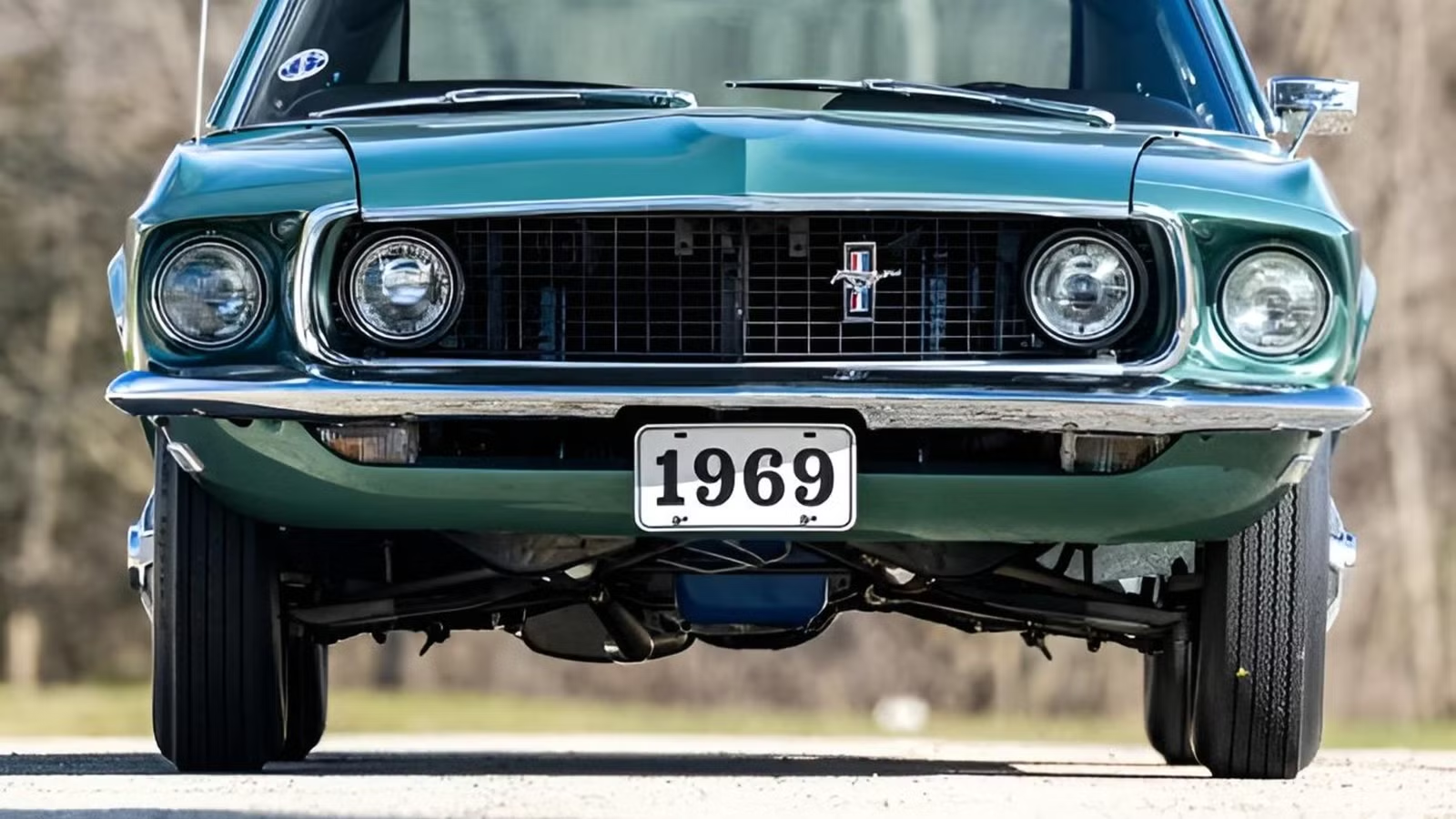
For many, the 1969 Ford Mustang was the zenith of the first generation’s influence. It was a year when the Mustang underwent its second facelift in a single generation, sprouting legends like the Boss 429 and the Mach 1, while cementing its legacy as the ultimate pony car. The big names with the big engines hog most of the spotlight, but if you’re curious which ‘69 Mustang is the rarest, well, the answer is none of them.
1969: The Year the Ford Mustang Went Hardcore

Walk into a Ford dealership in the spring of 1969, and the showroom floor was bursting at the seams with high-displacement machismo. The track-focused Boss 302s, built to homologate Trans-Am hardware, often mingled with the Boss 429, a car built around the same basic engine Ford raced in the NASCAR Grand Nationals and NHRA Super Stock drag racing. Even lower on the totem pole, the drag-strip-slaying 428 Cobra Jet, the handling-focused Mach 1, and the overshadowed but brilliant GT meant the Mustang had the most robust lineup of any car in the world in 1969.
On the styling front, the Gen-I Mustang’s second facelift was a massive pivot toward a longer, lower, and sportier aesthetic. Quad headlights emerged, with two of them moved to the grille; bulging rear quarter scoops added a much wider visual stance; and the desirable SportsRoof fastback silhouette gave the illusion the car was in motion even when it was standing still. In every way, the second facelift set the tone for what Ford’s designers aspired to revive when they revamped the Mustang in the mid-2000s. In that way, the styling was timeless, and sales reflected it.
Almost 300,000 Mustangs were built in 1969. For context, that massive single-year production run nearly equals the first six years of 2020s Mustang production combined. Among them was enough variation in powertrains, trims, and options packages to fill a novel in just that one model year. Still, not all of them were speed demons, not by a longshot.
The Duality of Mustangs, Some Were Just Normal

Even at what most would call peak Mustang, you don’t move that kind of inventory by dropping huge V8s into every unit you sell. Even if most Mustangs were V8s that year, most of them were mundane fare like the small block 302 or the 351 Windsor engines. In fact, roughly 80 percent of all Mustangs built in 1969 were V8s, with most being F-Code 302 V8s with two-barrel carburetors, H-Code 351s with two-barrel carbs, or M-Code 351s with four-barrel carburetors.
The upper echelon of Mustang hardware was a comparatively tiny corner of the market, but the sheer amount of horsepower on display made its reach far greater than its sales figures would indicate on their own. Meanwhile, there was another portion of the Mustang fleet that garnered neither a majority of sales nor headlines—a segment that showed a more conservative and frugal side of the pony car family that didn’t get nearly as much love.

We’re talking about the side with fuel-sipping straight-six engines in the “Thriftpower” family, either 200 cubic inches or 250 depending on what you picked. They represented the absolute entry point to the Mustang line, selling for a shade under $1,200 less in modern money than the equivalent 302. That might not sound like much, but the difference in fuel savings right before a massive oil crisis a few years later probably paid dividends to the people who bought them new. In one case, Ford doubled down on an efficient Mustang trim, but did so in such small numbers that it became the rarest of the breed in its most coveted model year.
1969 Mustang E: The Hypermiling Anti Hero That’s Rarer Than a Boss 429

Contrary to what you might believe, fuel economy wasn’t irrelevant to the American auto industry in the muscle car years. Sure, the global oil crisis was still a few years away by 1969, but the Mobil Oil Corporation had been running an annual Mobil Economy Run, sanctioned by the United States Auto Club, for over 30 years by then. Just like quarter-mile drag numbers, the Mobil Economy Run touted high MPGs as a point of bragging rights for OEMs that participated.
Runs always began in Los Angeles and ended somewhere along the eastern seaboard, depending on the year. It was for this reason, to enter the 1969 Mobil Economy Run, that the Mustang E was born. To turn an icon of V8 power into a cross-country hypermiler, engineers had to throw out the muscle car playbook. In its place was the 250-cubic-inch variant of the Thriftpower straight-six, lovingly mounted inside a body code 63D two-door SportsRoof. With a 2.33 ratio rear end, a revamped cooling system with a 17-inch fan, a specialized low-stall torque converter paired with a modified SelectShift automatic transmission, and a factory AC delete, the Mustang E was profoundly efficient for a pony car.

Factory 9.5:1 compression and a fuel-sipping one-barrel carburetor sapped horsepower but maximized fuel efficiency to the tune of 13.7 MPG in the city and 19 on the highway. Granted, that’s still pretty terrible by 2026’s standards. But compared to a two-barrel 351 Windsor-equipped Mustang from that same model year, it was a whopping 26.6 percent better on fuel economy on the high side of things. Of course, the Mustang E was decidedly slow, taking over 13.1 seconds to reach 60 mph and crossing the quarter-mile eventually.
The Rarest ‘69 Mustang of Them All

In the end, Ford produced 96 Mustang Es in 1969, fulfilling the production requirements necessary to homologate the car into the Mobil Economy Run and not be labeled a one-off prototype. Unfortunately, the rug was pulled out before the green flag ever dropped. The organizers ultimately canceled the 1969 Mobil Economy Run. Today, only a handful survive, with most being blissfully unaware of how rare it really is.
Source: Mecum Auctions, Mustang Specs

Related posts



Latest Post


No Comments