
The Pennsylvania Chevy Dealer Who Hacked GM’s Paperwork To Force A 427 Camaro
It’s 1969: The Beatles’ Yellow Submarine is on the radio, Easy Rider is in theaters, and you’re rocking a first-gen V8 Mustang. Your buddy’s saving for a Corvette with a big block V8 that’ll smoke you.

One day, he shows up in a Camaro. You ask, “I thought you were holding out for the 427?”
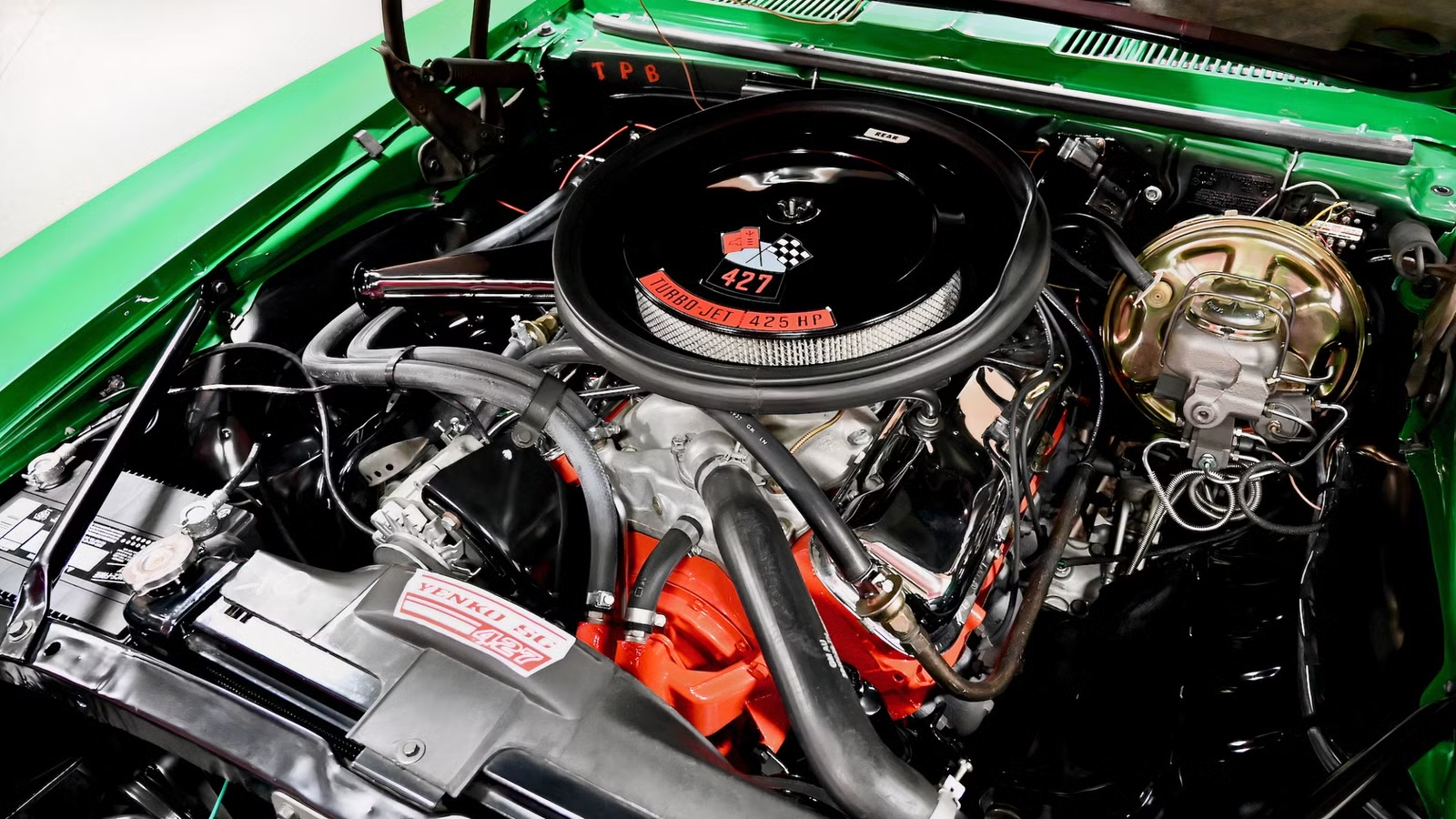
He just grins and pops the hood, revealing the L72 V8.
“What lunatic did you hire for this engine swap?”

He shakes his head. “Factory, with a warranty.”
“But…Chevrolet doesn’t build this car.”
“They built one for me.”
Chevrolet Built The Camaro To Fight The Mustang, Then Banned Its Best Engine
Ford revealed the Mustang mid-year in 1964. On day one, the Blue Oval was swamped with approximately 22,000 orders. By the end of the year, it had sold 263,434 of the cars. By the end of 1965, it had built a million Mustangs in just 18 months. GM was panicking.
General Motors’ answer to the pony car craze was the 1967 Chevrolet Camaro. It had all the style of the Mustang, and similar nimble handling. Its 108-inch wheelbase was identical to the Mustang. The heaviest Camaro’s curb weight was approximately 300 pounds above the heaviest Mustang’s. Both were available with a 4-speed manual. The 1967 Mustang with a 390 V8 made just 320 horsepower and struggled to 60 mph in 7.3 seconds. So the 1967 Camaro, with its 375 horsepower, 396 V8 and 6-second time to 60 mph, was a genuine technological improvement. But GM company brass held the new Camaro back from burying the Mustang forever.

GM has always insisted that its Corvette is Chevrolet’s flagship. And it had ground rules to protect the king. GM’s corporate rules barred Chevrolet from installing engines larger than 400 cubic inches in small and mid-size passenger cars, including the Camaro. Cheaper models were forbidden from challenging the Corvette’s performance image. So even while Ford engineers were hard at work on the Boss 302 and eventually the Boss 429, Chevy had no official plan to strike back.
1967: Don Yenko Spent Years Building Big Block Camaros The Hard Way

When GM explained there would be no big-block Camaros to sell, many dealerships complained about the missed opportunity. But where other dealers saw a tragedy, Don Yenko saw an opportunity. Yenko Chevrolet of Canonsburg, Pennsylvania immediately began advertising big block 1967 Camaros. How would they come up with these cars? They’d figure it out.
The dealership ordered top-trim Camaros, pulled the 396 V8, and installed “L72” V8s instead. This was a big-block 427 motor GM offered in the Corvette and some full-size cars. It had a cast iron block, an 11.0:1 compression ratio, and made 425 horsepower at 5,600 rpm and 460 lb-ft at 4,000 rpm. Yenko sourced them through Chevrolet’s High Performance Parts program. Finally, Yenko finished off its 427 Camaros with dealership badges. Historian Vince Emme concludes that the dealership sold 54 of the engine-swapped cars in 1967.
1968: Yenko Streamlined His Business

For the 1968 model year, Don Yenko discovered something interesting. GM had entire option packages that didn’t appear in the brochure. But if you knew the right “ Central Office Production Order” system code, you could pencil them in on the order form. Most codes were aimed at fleets configuring taxis or police cars. But COPO 9737 upgraded the Camaro with a “Sports Car Conversion” package. This included heavy-duty suspension components, a 140 mph speedometer, and a larger carb. Another option added the 4.10 PosiTraction rear end. Yenko sold an estimated 64 engine-swapped 1968 Camaros, adding this conversion package to improve performance.
Don Yenko also began chatting with Vince Piggins, head of Production Promotions at GM. Yenko learned that Piggins could lobby the company to create new COPO codes, and entire new powertrain combinations. The two of them began planning something big. “Big block” big.
1969: A Simple Paperwork Hack Forced GM To Build 427 Camaros With A Factory Warranty

Yenko didn’t build any engine-swapped 1969 Camaros in-house. Instead, the dealership ordered “double COPO Camaros” from GM. COPO 9737 meant these cars yet again came with the Sports Car Conversion, which now included 15 x 7 Rally wheels and a 13/16” front stabilizer shaft. The all-new COPO 9561 meant these cars never got the “L78” engine, but had the “L72” 427 V8 installed at the factory instead. GM also upgraded to a 4-core radiator, installed high-performance suspension with special springs and shocks to handle the extra weight, and offered an eye-catching ZL2 cowl hood option.
The Origins Of COPO 9561

Fred Gibb was a drag racer out of Illinois. He and Piggins had reportedly been lobbying for a factory-built big block Camaro to run at AHRA’s opener in Phoenix in January 1969. GM had allowed him to order COPO Novas in the past, and obliged him once more with his special-order Camaros. The result was COPO 9560, a code to order expensive, aluminum-block, racing-grade 427 V8s installed in Camaros at the factory.
While Fred Gibb’s ZL1 project created COPO 9560, Chevrolet also approved a more practical version: COPO 9561, which installed the cast-iron L72 427. That was the code Yenko had been waiting for. He began scribbling COPO 9561 down on countless order forms.
By 1969, Chevy fans across the Northeast were whispering the name, “Yenko Camaro.” Perhaps they’d seen one trounce some poor Mopar at a street race. Perhaps they just knew someone with one of these gnarly machines. Whatever the reason, they flooded the Canonsburg dealership, money in hand. The final year of the Yenko Camaro was handily its best. Don Yenko ordered 201 double-COPO 1969 cars and badged them as “Yenko/SC”—which stood for Supercar.
Double-COPO “Supercar” Camaros Were Special

With improved suspension and factory-installed 427 engines, Yenko Camaros delivered serious performance. On street tires, they hit 60 mph in about 5.4 seconds and continued on through the 1/4-mile in the low 13-second range.
Yenko famously converted the prototype to open headers and installed drag slicks before visiting the track. The car did an 11.94 second 1/4 mile at 114.5 mph. The way the dealership’s marketing team told the story, track officials were in such shock that they paused all racing to check their timing equipment.
The COPO Change Unleashed 1,000+ Big Block Camaros

Once selling a 427-powered Camaro was as easy as penciling in “COPO 9561” on a custom order form, other dealers and knowledgeable buyers began requesting the same factory-built combination. According to the Camaro Research Group, GM built 1,015 COPO 9561 Camaros in 1969—all powered by the L72 V8. This breaks down as 193 automatic transmission cars and 822 four-speed cars.
If 201 of these were destined for Yenko in Canonsburg, what about the other 814? They were ordered through other dealerships. Unlike with the 1969 ZL1 Camaros, Chevrolet didn’t keep a master registry of COPO 9561 cars. Supposed COPO 9561 cars do come up for auction occasionally. To prove they weren’t just engine-swapped later, sellers often present original dealer invoices or build sheets.
The Legacy Of The Big Block Camaros

According to the CRG, the 814 non-Yenko COPO cars didn’t all go to a single dealership. Berger Chevrolet sold about 50. Scuncio Chevrolet sold about 20. Other dealerships that have records of selling COPO 9561 cars include Byrne Bros., Dale Chevrolet, Queen City Chevrolet, Funston Chevrolet, Indian River Chevrolet, Malcolm Konner Chevrolet, and Baldwin Chevrolet.
General Motors never advertised its 427-powered Camaro options, which were available only by custom order. These dealerships did all the advertising for Chevy. This makes the final sales number especially impressive. Think about it this way: Ford installed its big-block 429 in a 1969 Boss Mustang and launched a coordinated marketing campaign to sell the car. It moved just 859 of them in 1969. That number plummeted to 499 in 1970.

For the 1970 model year, Chevrolet designed an entirely new generation of the Camaro. With rising insurance premiums and stricter emissions regulations, automakers had to de-tune V8s, and fewer customers wanted big-block pony cars. Yenko pivoted to a 350 Yenko Deuce Nova. He would also build custom Vegas. He eventually shifted to selling performance aftermarket parts instead of building entire custom cars.
Sources: General Motors, HowStuffWorks, Ford

Related posts


Latest Post


No Comments