
The Touring Bike Owners Keep Riding Long After Everyone Else Trades In
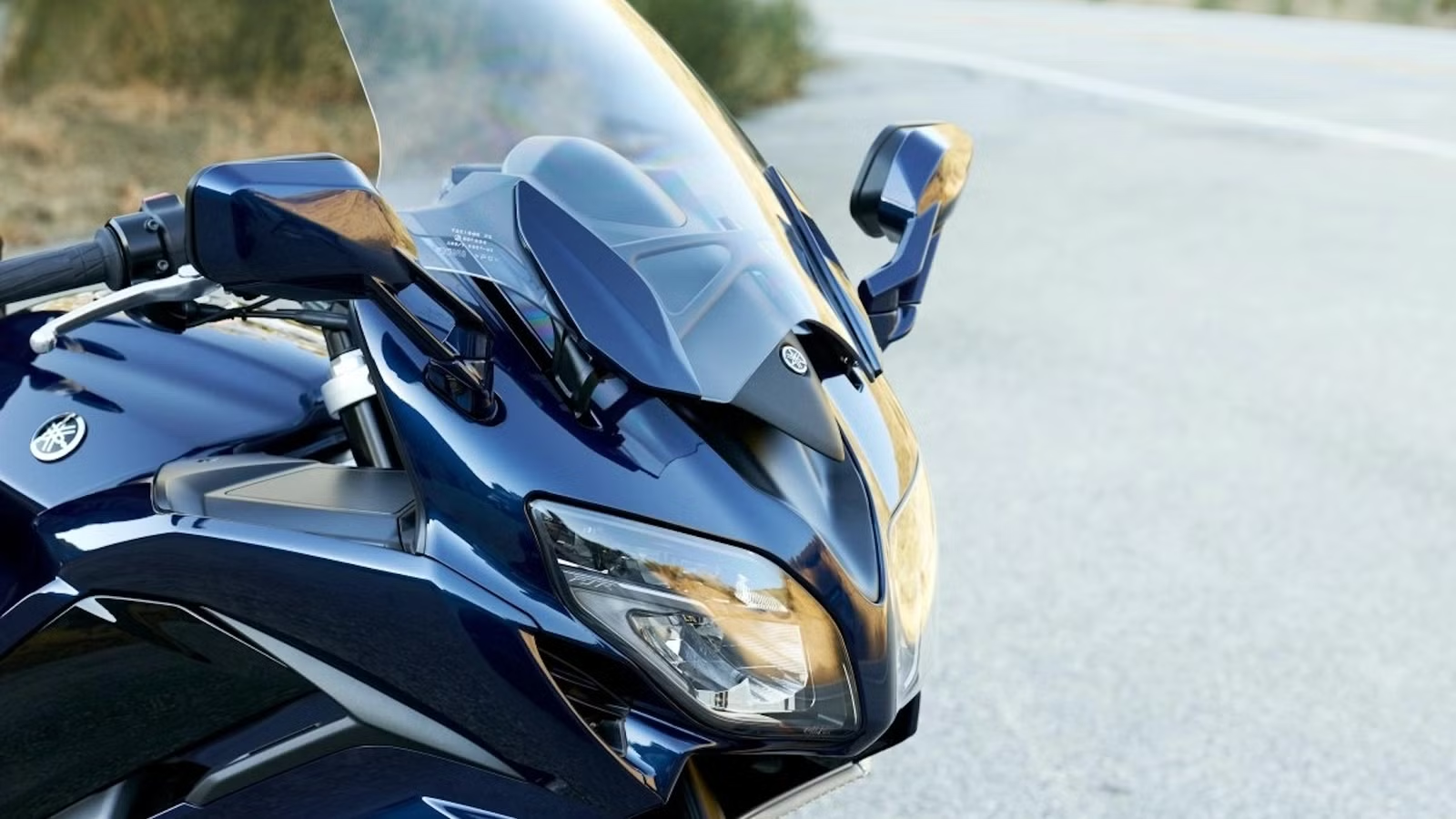
Travel on a motorcycle has never been quite so compelling. With the rise and rise of the ADV segment, many riders have discovered the advantages of these dual-purpose machines. Unfortunately, the advantages can pale in comparison to all the compromises you need to make. Touring bikes, on the other hand, are quite literally designed from the ground up to get ridden across the country. Only some of these make sense in the long-term, though, and a certain Yamaha does that well.
The Strange Dichotomy Of Luxurious Motorcycles

A motorcycle is supposed to offer a more connected experience. By its very nature, to achieve this objective, it should not be too comfortable. So there is a strange imaginary balance between comfortable, but not too comfortable, that high-end touring bikes need to find. While V-twins offer a natural auditory reminder that you are indeed on a motorcycle, as well as some level of vibration through the bars, some smoother-running tourers can actually lose this essence.

A great example of this is the previous generation Honda Gold Wing. It quickly became the “Gold Standard” for touring motorcycles, but the wind protection was so good that it lost a little feeling. Honda actually scaled back the wind protection a little on the latest version of the bike, in an effort to make it feel more like a motorcycle. The bike in question strikes a near-perfect balance in this regard, and offers impressive value on the used market.
The 2016 Yamaha FJR1300 Is The Definition Of Affordable Luxury
Price Range: $6,000 – $10,000


At this price point, the Yamaha FJR1300 is pretty hard to beat. The bike can still be bought new (2024 model), and will cost around twice as much. Admittedly, the new bike has electronic suspension, and for some that will be a desirable feature. For others, this kind of value will be pretty hard to pass on. Trade value is currently sitting at $6,380, and the resale value is pegged at just over the $9k mark. As is the case with pretty much any touring bike, service history is more important than the mileage.
The FJR1300 Has A Proven Inline-Four
Power: 141 Horsepower

This inline-four lump can trace its roots back to the 80s. The FJ1100 quickly evolved into the FJ1200, a large-displacement superbike meant to take the fight to the speed queens of the day. It was never quite as fast as its competitors, but one over many fans, mostly thanks to the impressive balance it offered between reliability, comfort, and outright speed. The FJ1200 was discontinued in the 90s, but the model line was revived as a dedicated sport tourer in the early 00s with the original FJR1300. Naturally, the engine was thoroughly revised and given liquid cooling, among a myriad of other internal changes, and power went up to 141 horsepower.
Designed For Covering Distance At Speed

This immensely smooth engine has proven to be just as robust as its predecessor, and enjoyed a virtually trouble-free two-decade-long production run. With power sent to the rear via shaft drive, it is also relatively light on maintenance. Over the years, these bikes have proven more than up to the task of racking up over 100,000 miles, and while not exactly considered high-performance motorcycles these days, they certainly aren’t slow, either.
The 2016 Version Of The FJR1300 Got An Important Update

By 2016, the FJR1300 had been in production for 15 years, but this model year got a small but significant update. It was the first time the bike got a sixth gear, and along with the sixth gear, it also got a slipper clutch. The rest of the bike was more or less unchanged, and it was only recently discontinued. While getting an older bike for less is possible, it might take a while to get used to the fact that there are only 5 gears, which is a little odd for a long-haul tourer like this.
Other than that, these bikes only got a few minor cosmetic updates through the years, and are not much different. Build quality is very good, and even though the 2016 model is now a decade old, owners tend to look after these machines, and finding one in good shape won’t be all that hard. That said, $10k is still a fair amount of money for a used motorcycle, and there will always be a temptation to consider taking a chance on one of the bikes that look a little rough around the edges that are selling for less than the prescribed retail value.
Beware Of Neglect When Buying A Used FJR

With this being a big, 635-pound motorcycle, it can be extremely dangerous in the wrong condition. Taking a punt on a bike with no service record, or at least some form of documentation from the previous owner, is a risk not worth taking. You would be better off looking at an older model, and simply learning to live with the fact that it only has a 5-speed transmission.
The main reason we called out the base model and not the version with electronic suspension is that that is the one and only thing that goes wrong on these bikes. It is also something that will cost more to replace (apparently, once it goes wrong you can’t simply fix it) than what the bike is worth. So you will most likely just end up spending an extra $1k or so on a future problem.
Other than that, you will be well served to ask questions about the shaft drive. Dealers like saying it is a “maintenance-free” drivetrain, but that is not completely true. It certainly doesn’t need as much love and affection as a chain, but it is not maintenance-free. Most owners will be quick to share which gear oil they prefer, or at the very least confirm when the next service will be due. For the most part, the FJR1300 is a pretty safe purchase, because people just tend to keep these bikes for longer and take better care of them.
Source: KBB

Related posts

Latest Post


No Comments