
10 Forgotten V12 Engines Collectors Quietly Hunt For Today
As the pinnacle of automotive engineering, the V12 is known for its exceptionally smooth performance, and its effortless power and torque. Hence why you’ll equally find a V12 engine in luxury grand tourers and in high-performance supercars. The V12 is gradually being phased out by stricter emissions regulations and the growing shift toward electrification, leaving it synonymous with just a handful of manufacturers, namely Ferrari, Lamborghini, and Rolls-Royce. But seasoned collectors know there’s far more to the V12 than what’s left of it today. Here are the 10 forgotten V12 engines collectors quietly hunt for today.
10
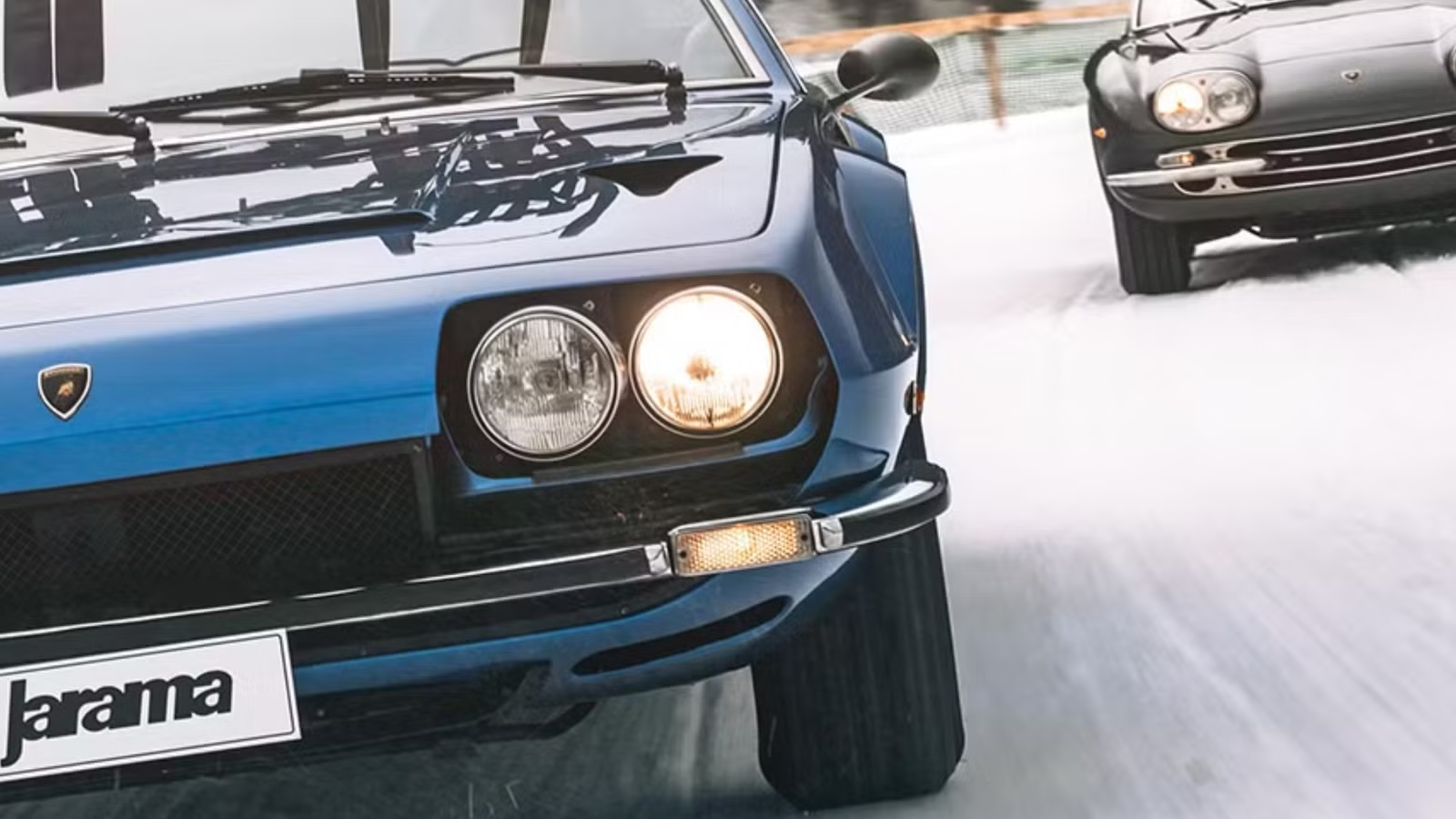
Lamborghini Jarama, 4.0-Liter V12
Production Years: 1970–1978

The Bizzarrini-derived Lamborghini V12 goes beyond the revered Miura and Countach. Commissioned by Ferruccio Lamborghini in 1963, the Lamborghini V12 owes its inception to Giotto Bizzarrini, who was tasked with building a powerful and advanced V12 engine for Lamborghini’s first production car, the 350 GT. The 350 GT was revealed at the Geneva Motor Show the following year, and featured the first iteration of the iconic V12 with a displacement of 3.5 liters and a power output of about 315 horsepower (350 CV). It is the same foundational Bizzarrini V12 architecture that was subsequently used in subsequent V12 models. Over the years, displacement was increased to 4.0 liters, and it is in this form that the V12 was fitted in the 1970 Lamborghini Jarama, the 2+2 grand tourer limited to 327 units (177 Jarama GT, 150 Jarama GTS). The Jarama was technically derived from the Islero and the 400 GT, but with an increase in power over the older grand tourers. As one of Lamborghini’s final front-engine V12 GTs, the Jarama was one of Ferruccio Lamborghini’s favorites, and remains an overlooked classic from Lamborghini.
9
Jaguar E-Type Series 3, 5.3-liter V12
Production Years: 1971–1975

Jaguar’s all-aluminum 5.3-liter V12 production engine was first introduced in the 1971 E-Type Series 3, replacing the previous E-Type models’ straight-six engines. Producing 272 hp, the V12 didn’t drastically increase the power output over the previous engine, but did offer more torque for quicker acceleration, going from 0 to 60 mph in under seven seconds. The V12 offered a more linear power delivery throughout the rev range, making the E-Type more refined and effortless to drive than its predecessors.

Though the 5.3-liter V12 did give the E-Type Series 3 quite the performance upgrade, the larger engine and the adoption of the 2+2 seating configuration transformed the sleek, short wheelbase design into a longer wheelbase E-Type, making the V12 E-Type less popular in terms of design.
8
Mercedes-Benz 600 SEL, 6.0-liter V12 (M120)
Production Years: 1991–1993

Mercedes-Benz debuted its 600 SEL (W140) in 1991, giving it a refined, all-aluminum 6.0-liter, 48-valve, naturally aspirated V12 engine. The M120 V12 produced 402 hp and 426 lb-ft of torque, with an acceleration from 0 to 60 mph in about 6.0 to 6.3 seconds. With plenty of torque to work with, the 600 SEL delivered the smooth and effortless performance expected of a top-of-the-line luxury sedan. Manufacturers regularly update their luxury sedans in order to offer their top customers the latest technologies, engineering, and comfort features, making these once-revered luxury sedans too often forgotten.
7
BMW 850CSi, 5.6-liter V12 (S70)
Production Years: 1992 – 1996

While Mercedes-Benz boasted its M120, BMW introduced the S70 in 1992, fitted in the high-performance flagship 850CSi to make it one of the most capable driver’s cars of its era. The 5.6-liter naturally aspirated V12 produced 375 hp and 406 lb-ft of torque. Unlike the standard 8 Series’ M70 engine, the 850CSi’s engine was enlarged from the base 5.0-liter displacement and had a more aggressive valve timing. The 850CSi also featured chassis and suspension upgrades, and was given a more aerodynamic look. The 850CSi’s desirability stems from its rarity, with just 1,510 examples produced worldwide and only 225 units allocated to the United States between 1994 and 1995. The S70 engine served as the base for the S70/2 V12 that powered the McLaren F1, making it even more desirable.
6
Ferrari 456 GT, 5.5-liter V12 (F116)
Production Years: 1992 – 1998

The 456 GT isn’t the most talked about Ferrari, but it should be. Understated, perhaps even underappreciated, the 456 GT lived in the shadow of the manufacturer’s more popular cars at the time, such as the F40 or the mid-engine Testarossa. Yet despite its lesser-known name, it introduced Ferrari’s F116, a 5.5-liter 65-degree DOHC V12, producing 436 hp and 406 lb-ft of torque. Though not as popular as the manufacturer’s mid-engined V12s, the 456 GT offered outstanding characteristics that helped pave the way for the front-engined Ferrari that followed. With the engine at the front and the gearbox at the back, the transaxle gave the 456 GT a near-perfect weight distribution. This improved balance made the 456 GT deliver on both its grand touring capabilities and its sports car abilities, with reduced front-end weight, improved traction, and an overall engaging driving experience. While Ferrari’s Colombo V12 or F140 often steal the spotlight, the F116 is one of the prancing horse’s most overlooked V12 engines.
5
Toyota Century, 5.0-liter V12 (1GZ-FE)
Production Years: 1997 – 2017

V12 engines and JDMs should perhaps be antonyms, with the exception of one Japanese car. When Toyota launched the second-generation Century in 1997, it became Japan’s only production car to feature a V12 engine. The Century’s 1GZ-FE was a naturally aspirated 5.0-liter DOHC V12, producing 276 hp and 355 lb-ft of torque, and though the power output feels quite low for a V12, these numbers were deliberately capped to comply with Japan’s Gentlemen’s Agreement. The 1GZ-FE’s strength was never outright performance, but refinement and effortless torque. The Century’s V12 featured independent management systems for each bank of six cylinders, each with its own ECU, intake manifolds, and fuel injection systems, allowing the car to continue running if one cylinder bank failed. Built for the Japanese market and synonymous with prestige, the Toyota Century and its 1GZ-FE V12 is gathering strong interest from collectors.
4
Mercedes-Benz SL73 AMG, 7.3-liter V12
Production Years: 1999 – 2001

While the Mercedes-Benz 600 SEL’s V12 offered comfort and luxury, the 7.3-liter V12 fitted in the SL73 AMG represented the pinnacle of AMG’s engineering in the 90s. Increasing the M120’s displacement from 6.0 liters to 7.3 liters, the SL73 AMG’s V12 produced 518 hp and 553 lb-ft of torque. Under the SL73 AMG’s hood, the M120 was much punchier, providing plenty of torque at low revs for 0-60 mph acceleration of under 4.7 seconds, all while keeping its refinement to stay true to the SL’s (R129) grand touring character. With the SL’s understated looks, you’d almost forget there’s a V12 hidden under the AMG’s hood. Forty to fifty units were ever produced according to RM Sotheby’s, making the SL73 AMG one of the most collectible models, and its V12 engine one of the largest naturally aspirated V12 engines ever fitted to a production Mercedes-Benz.
3
Aston Martin DB7 Vantage, 6.0-liter V12
Production Years: 1999 – 2004

The 1999 Aston Martin DB7 Vantage marked a new era for the British carmaker, as the DB7 became the first production Aston Martin powered by a V12. Jointly developed by Ford (Ford Research and Vehicle Technology Group) and legendary Formula One engine supplier Cosworth, the 6.0-liter 60-degree V12 generated 420 hp and 400 lb-ft of torque. Delivering smooth and linear power along a distinctive exhaust note, the V12 transformed the refined DB7 into an exciting grand tourer that claimed a top speed of 184 mph (296 km/h). With over 4,000 units built, the V12-powered DB7 Vantage remains a significant milestone in Aston Martin’s history, as it laid the foundation for Aston Martin’s V12-powered production cars that followed.
2
Lamborghini Diablo VT 6.0, 6.0-liter V12
Production Years: 2000 – 2001

The original Lamborghini V12 first appeared in the 1963 350 GT, but the 6.0-liter V12 fitted in the 2000 Lamborghini Diablo VT 6.0 represents one of the ultimate evolutions of the Italian manufacturer’s legendary Bizzarrini-derived V12, before its end with the Murcielago. For the Diablo VT, displacement was enlarged to 6.0 liters, with the engine producing 550 hp and 457 lb-ft of torque. Unlike earlier Diablo variants, the 6.0-liter engine benefited from extensive revisions under Audi ownership, including redesigned intake and exhaust systems, stronger internal components, and enhanced cooling, which resulted in sharper throttle response and improved drivability. Combined with updated all-wheel drive, a stiffer chassis, a modernized interior, and limited to 337 units, the Diablo VT 6.0 became one of the most advanced and coveted versions of Lamborghini’s iconic supercar.
1
BMW 760Li (E65) V12 (N73)
Production years: 2003–2008

Launched in 2003, the BMW 760Li (E65) introduced a bold new design that contrasted with its predecessor, the more classic-looking E38. Fitted with a V12 engine, the long-wheelbase model was BMW’s ultimate luxury flagship. The N73 engine was a 60-degree, all-aluminum 6.0-liter DOHC V12 producing 438 hp and 443 lb-ft of torque, allowing the 760Li to propel from 0 to 60 mph in 5.5 to 5.8 seconds. As one would expect, BMW’s N73 directly challenged the slightly more powerful twin-turbo M275 V12 from Mercedes-Benz. BMW introduced advanced engineering to its flagship executive sedan with direct fuel injection, double VANOS, and Valvetronic to improve performance and efficiency. The N73 was also used in the Rolls-Royce Phantom VII, with the engine enlarged to 6.75 liters. Produced in relatively small numbers compared to the six- and eight-cylinder variants, the V12-powered 760Li is an overlooked flagship that symbolizes BMW’s last naturally aspirated V12 engine.
Sources: Lamborghini, Mercedes-Benz, BMW, Ferrari, Toyota, Aston Martin, Jaguar

Related posts


Latest Post


No Comments