
Yamaha’s Most Complete Motorcycle Isn’t The One Most Riders Buy
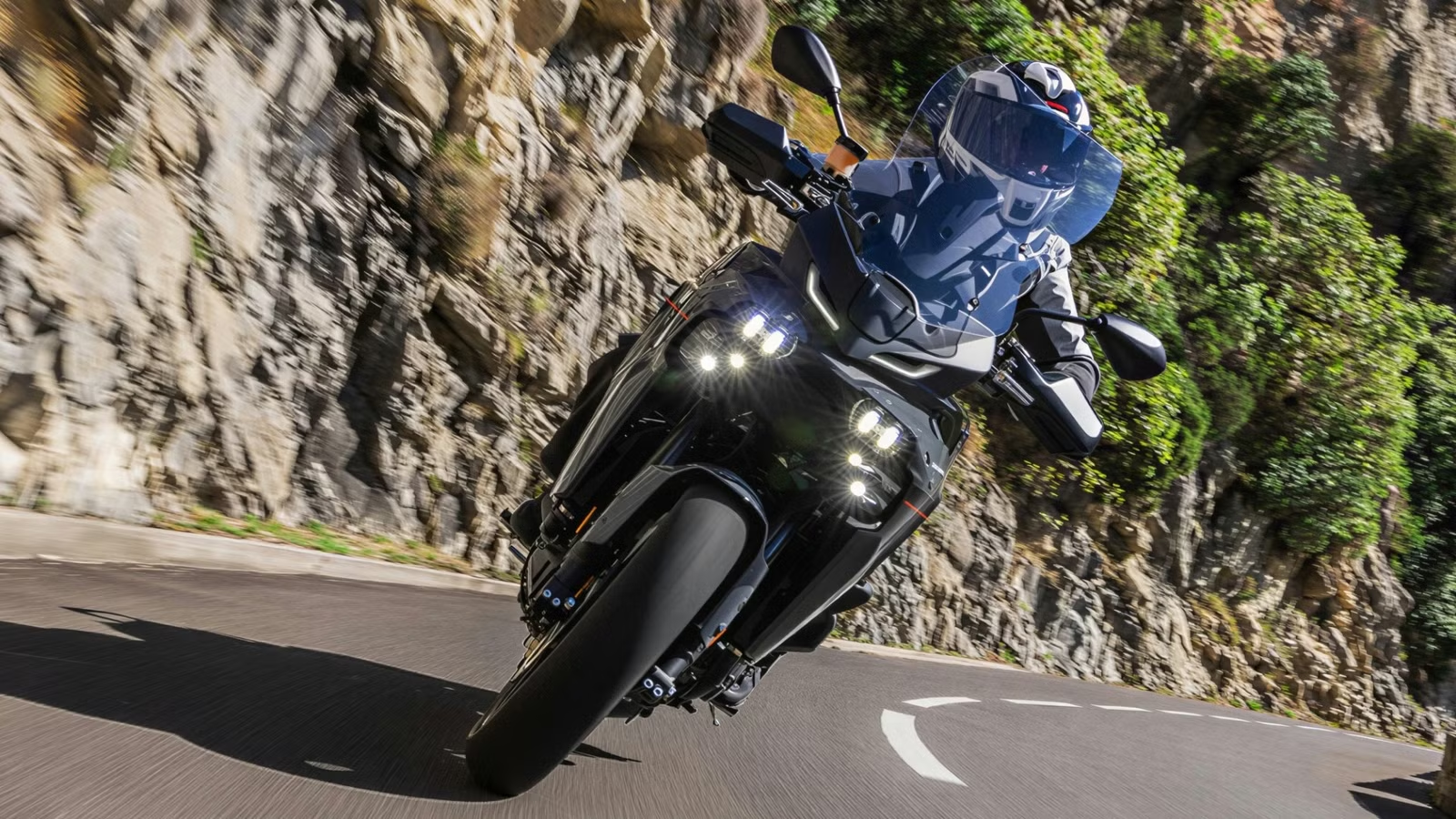
Imagine having a bike that can do it all, so you never need to decide between a sports bike or a comfy tourer. Add a Yamaha badge to it, and the whole proposition is even more tempting. After all, Yamaha brings handling finesse and dependability, along with sharp styling. However, the brand’s most complete motorcycle is a somewhat underrated model in its lineup based on the CP3 powerhouse. Price, performance, and versatility are all of its USPs.
Most Yamaha Motorcycles Can’t Be Considered “Complete”

Yamaha offers 24 different motorcycle models in the US, ranging from small-displacement dual sports to big-bore sports tourers. In the lineup, there’s something for every kind of motorcyclist with every level of experience. And many of these motorcycles are quite popular in their respective segments. In fact, some have even become the benchmarks and fan favorites in the segments.

Take the MT-07, among the most popular and friendly middleweight nakeds that’s considered the spiritual successor to the legendary Suzuki SV650. Or the Tenere 700 that changed how middleweight adventure bikes are built. Even the small-displacement V Star 250 belongs here, which has been puttering around for years, helping new riders get into the hobby. But as good as these bikes are, most of them aren’t a complete package.
Makings Of A Complete Motorcycle

What even is a complete motorcycle, though? Essentially, it’s a bike that can do everything, including commuting, sporty riding, and touring. A complete motorcycle is versatile enough to stay in your one-bike garage for years to come. While they may not be the fastest or the most luxurious, they do sit in the center of the motorcycle Venn diagram. In Yamaha’s case, that complete package is represented by the Tracer 9 sports tourer, offering a range of versatility that no other Yamaha offers.

The Tracer 9 Is The Most Versatile Bike With The Tuning Fork Mark

Whenever you think of a touring bike, even if it’s the sports touring kind, you’re bound to think of a bike that focuses first on long-distance comfort and then on everything else, like sporty handling or performance. However, the Tracer 9 is not among those boring sports tourers that have come to define what should otherwise be a fun and exciting sub-segment of the touring class. That’s thanks to what the Tracer 9 offers; it puts long-distance comfort and exciting performance at the same level, turning into a complete package that can do it all.

Everything on the Tracer 9 is designed with that split-personality nature in mind. The CP3 engine, Deltabox frame, and suspension are designed to offer a balance of thrilling performance and the civility of a tourer. It’s complemented by long-distance-focused ergonomics, plenty of rider aids that add confidence, and a sharp, sporty styling that’s a departure from your grandpa’s touring bike. It’s this nature that makes the Tracer 9 such a complete package in Yamaha’s lineup.
The Tracer 9 Undercuts Its Sporty Rivals

What makes the Tracer 9 even better is its pricing, starting at $12,599. That’s aggressive for what the bike has to offer, and the only rival that undercuts it is the Honda NT1100 DCT at $11,999. The NT1100 is good for those looking for a versatile crossover; it’s also the only option in the segment with a standard automatic transmission. However, the NT1100 is anything but sporty; it’s tuned for comfort and a sedate riding experience, thanks to its Africa Twin-derived underpinnings that don’t quite have the same edge as the Tracer 9.

The closest rival to the Tracer 9, instead, is the Triumph Tiger Sport 800, starting at $12,845. Like the Tracer 9, the Tiger Sport 800 features a dependable inline-triple engine and capable underpinnings, offering a sporty ride. However, you’ll have to spend $14,695 for the Tour model, which brings side cases and a top box, considerably higher than the Tracer 9, which gets side cases as standard. You’re essentially getting less for more with the Tiger Sport 800. The F 900 XR is also a rival, but it is simply inferior in several aspects.
The Mutable CP3 Engine Can Handle Everything

At the heart of the Tracer 9 is the highly acclaimed 890cc CP3 inline-triple with a crossplane crankshaft. On this bike, the engine is tuned to deliver 117 horsepower and 68 pound-feet of torque. Yamaha says the engine delivers broad, linear torque in the low- to mid-range, making the bike feel at home in the city and out on the highway. The engine also features lightweight forged pistons.

A glorious aural experience is part of the experience as well. Yamaha says the bike’s intake is designed to amplify the wail from the intake, which should complement the engine’s odd firing order. Elsewhere, claimed fuel economy is 48 miles per gallon, giving the bike a range of up to 240 miles between fuel stops. Finally, the engine is mated to a six-speed gearbox with an assist and slipper clutch.
Agility In The Corners Meets Stability On The Highway

The Yamaha Tracer 9 tips the scales at 483 pounds, and that’s made possible thanks to its lightweight underpinnings, especially the chassis. A lightweight CF die-cast aluminum Deltabox frame (essentially a sports bike frame known for rigidity and feedback) is paired with a long subframe that offers more space for the rider and pillion compared to its sportier siblings. The Tracer 9 also gets a model-specific swingarm that’s longer, offering better highway stability.
High-Performance KYB Suspension Can Be Set Up As Per The Occasion

The bike runs 41mm KYB inverted forks and a monoshock. Both ends are adjustable, letting you set up the bike for everyday riding, two-up touring, or canyon carving. Yamaha says the rear linkage design improves rear tire traction while improving chassis positioning and load distribution during corners. The suspension holds lightweight SpinForged wheels, with the rear wheel claimed to decrease the moment of inertia by 11 percent. Rounding out the underpinnings package are dual 298mm front discs and a single 267mm rear disc. There’s also a Nissin radial master cylinder.
Set Up For All Kinds Of Riding, Backed By Advanced Electronics

Both the engine and underpinnings show that the bike is designed to do it all. The same is true of the bike’s comfort; it’s designed for the real world. It features a comfort seat that’s designed for long-distance comfort, complemented by a wide handlebar and mid-set pegs. Sitting at either 33.3 inches or 33.9 inches, the riding triangle should feel neutral yet commanding for most motorcyclists.

Meanwhile, the large front cowl and manually adjustable windscreen should take care of the wind and bugs on the highway. Near this, you also get a convenient smartphone box with a USB-C socket. At the rear lie color-matched hard side cases, each of which can accommodate a full-face helmet. The cases are mounted to a fully-floating carrier system.
A Healthy Tech Package

Adding cherry to this do-it-all cake is a host of electronics that make the rider safer and better. It starts with the full LED light setup with cornering function and self-canceling turn indicators. The bike also features a six-axis IMU, enabling cornering-enabled ABS and traction control, slide control, front wheel lift control, back slip regulator, and brake control system. The Power Delivery Mode (PWR) and Yamaha Variable Speed Limiter (YVSL) let you fine-tune the bike’s power delivery and top speed, respectively.

Combine everything, and you’ll see how the Tracer 9 is bigger than the sum of its parts. Everything, from the bike’s CP3 engine to the sports-bike-derived frame, is tuned to be versatile and practical. It offers long-distance comfort without losing its sporty edge. It can chill with you on a highway and thrill you on a mountain road. That’s perhaps why the Tracer 9 is among the best executions in the sports touring segment. It lives up to the sport touring title.
Source: Yamaha

Related posts
Latest Post


No Comments