
Why the supercar elite aren’t scared of China’s 1500bhp EVs

Denza and GWM are going after European stalwarts with mega-power supercars – and it could be a good thing

Denza has premium aspirations for its European launch. First to arrive is a GT aimed at the Porsche Panamera, followed by a Defender 110-rivalling 4×4.
Adding to the brand positioning is a design centre in Milan, celebrity ambassador Daniel Craig and the Denza Z, a Porsche 911-priced 2+2 sports car. Except it’s an EV with 1584bhp.
Denza isn’t the first Chinese brand to launch a high-powered, competitively priced assault at the established sports and supercar brands. BYD stablemate Yangwang demonstrated the 1287bhp U9 at the 2024 Goodwood Festival of Speed, only to return this year with a Xtreme version with approaching 3000bhp. Back in 2017, the Nio EP9 used 1342bhp to claim a Nürburgring lap record.

Do Porsche, Ferrari, Lamborghini and McLaren view these insanely powerful newcomers as a competitive threat? And if not, should they? After all, BYD, SAIC, Chery and Geely are much more than a threat in the mainstream car market.
Other than perhaps some concern in the Chinese market, where domestic premium brands are growing in popularity at the expense of European marques, my hunch is that there isn’t much sleep being lost. Complacency? I think it’s more nuanced than that.
Firstly, the global demand for electric sports cars (two doors, sub-£100,000) is practically zero. Despite the outrageous performance, buyers aren’t convinced emotionally or financially – ie concerns over residual values. This a problem for European brands (Rimac, Pininfarina and Lotus) as much it is Chinese competitors.
Then there’s the fact that initial impressions of the Denza Z conclude that beyond the power, it isn’t a holistic finessed product. While it’s easy to conclude that for all Denza’s knowhow in electric powertrains it lacks the capability to deliver dynamic engagement, I don’t think this is the reason Europe isn’t overly concerned.
That Chinese products are often epitomised by segment-leading technology but lacking the dynamic and HMI sophistication of European brands is more to do with what China sees as the priority in achieving commercial advantage in the mainstream (pace of development) than any inherent inability. If Denza concluded that improved dynamic capability were the key to success in the sports car market, it would simply deploy or acquire this.
Maybe more concerning to the supercar set is GWM’s forthcoming effort. So far only the underpinnings have been seen, with the finished car due in 2027, but the GF is a more familiar recipe: a mid-engined, 4.0-litre twin-turbocharged V8 PHEV with carbonfiibre construction and a power-to-weight ratio of 670bhp per tonne, achieved through low-ish mass as much as high power.
GWM is reportedly targeting Ferrari and developing a GT3 competition variant. Surely there will be some sitting-up-and-taking-notice now in Maranello and Woking.
What can history tell us? China isn’t the first Asian disruptor. Japan in the 1970s and Korea in the 1990s honed the ‘lead with value and evolve up’ model. In the sports and supercar space, Japan has created several icons: Toyota 2000GT, original Honda NSX, Nissan GT-R, Lexus LFA. While Korea has yet to land an equivalent halo, Hyundai’s N division has demonstrated real dynamic credibility.
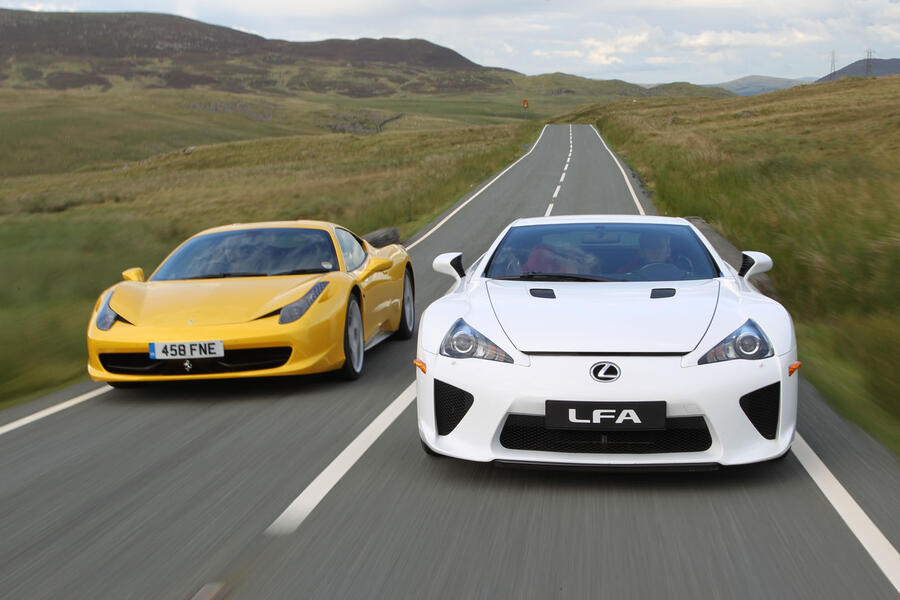
Yet despite these cars’ reputation, no Japanese brand has established a regular seat at the supercar table. Others have joined it over the past quarter-century, Pagani and Koenigsegg delivering the performance and technical credentials, emotional appeal and pricing power. Key to their brand appeal, as with Ferrari, Lamborghini, Porsche and McLaren, is singularity of the mission and the founder story.
Brand ambition and positioning is the reason I believe the legacy brands aren’t phased by the arrival of another all-singing, all-dancing model from a newly launched brand. This isn’t corporate snobbishness; it’s about the role the sports or supercar plays in the product range.
For BYD and GWM, these halo models are part of the brand plan, not the plan itself. They are about establishing credibility for the broader brand roster, and to do so they must be linked to the rest of the portfolio, an association that will naturally limit demand for the supercar itself.
It’s also possible that once credibility has been sufficiently demonstrated, the supercar may take a sabbatical. As with the Japanese, we could see generational flashes of brilliance, not a consistent presence in the sector.
Perhaps the risk of Denza etc present is more technical exposure than commercial market share. A company focused on making a statement, at the potential cost of profitability on a limited volume model, may drive innovation that embarrasses the establishment. Think the NSX to Ferrari’s 348. But then also remember how strongly Ferrari responded with the 355. This is the positive impact of competition.
Rather than being concerned, I reckon Porsche, Ferrari and the likes welcome it – for competition makes you stronger.

Related posts


Latest Post


No Comments