
Why Second-Gen Toyota 4Runners Are Getting Expensive And What Buyers Should Check
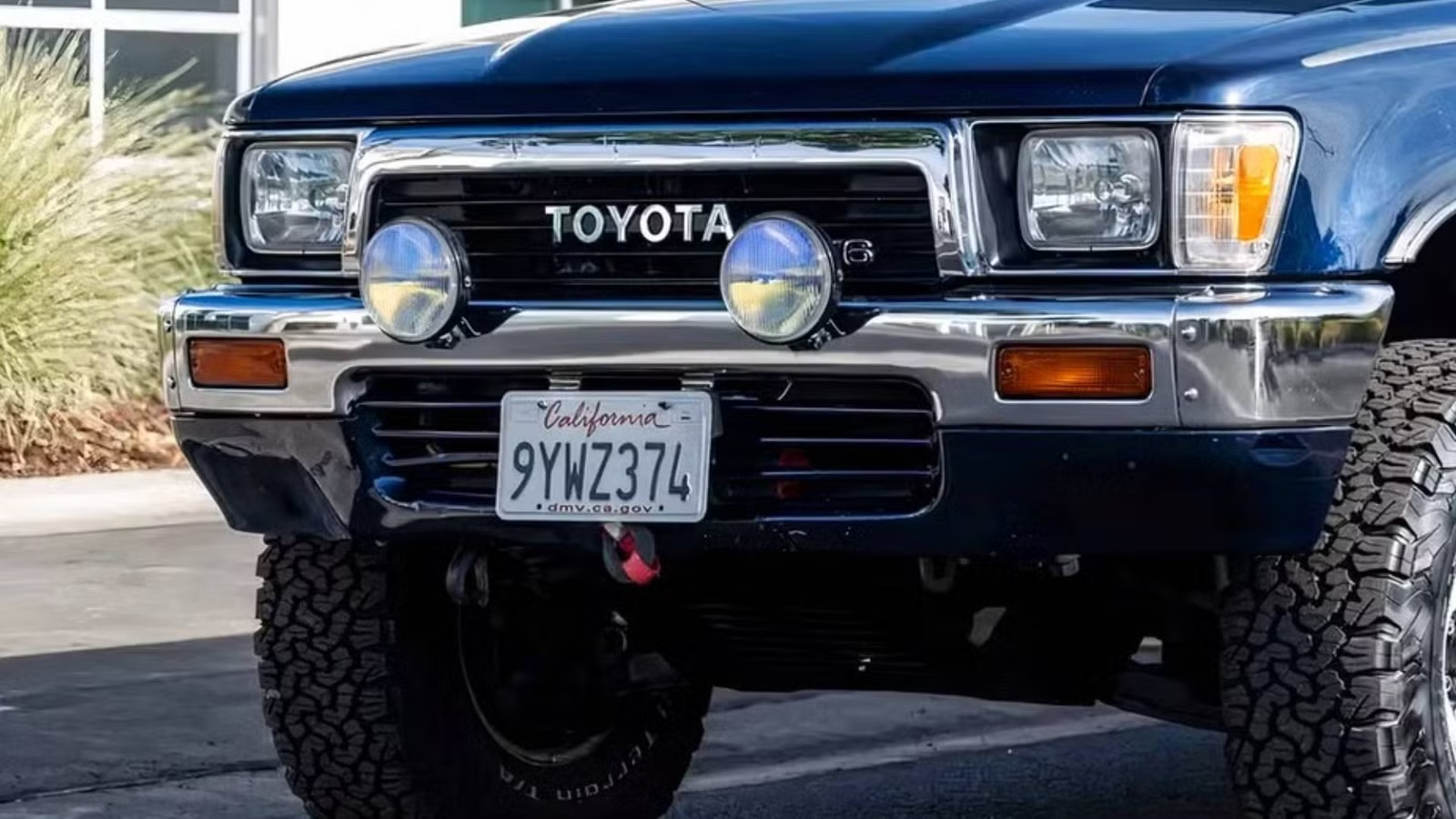
A 219,000-mile 1990 Toyota 4Runner just sold for $17,750. That would be eye-catching enough on its own, but the sale came one week after Hagerty added the entire 1990–1995 generation to its collector-car valuation guide on September 8, 2026. If you follow our broader Toyota coverage, you already know the brand has no shortage of cult favorites, while cars such as the Century Coupe concept show how heavily Toyota still leans on heritage. The interesting part here isn’t simply that old Toyotas can get expensive. It is figuring out why one second-gen 4Runner is worth collector money while another is just an old SUV with a famous badge.
Second-Gen 4Runners Are Becoming Collectible

The second-generation 4Runner arrived for 1990 and lasted through 1995, and today it looks like somebody bottled an entire era of Toyota SUV design. The squared-off body, upright proportions, simple cabin, and old-school four-wheel-drive hardware hit differently now that so many modern SUVs have gone smoother, quieter, and more complicated. According to Toyota’s 4Runner history, this generation added rear doors for easier rear-seat access and replaced the first-gen truck’s removable fiberglass roof with a fixed body. For buyers who remember when these things were simply used trucks sitting in driveways, school parking lots, and trailheads, seeing a clean one today can trigger the automotive equivalent of finding an old mixtape you forgot you loved.
Nostalgia gets people looking. It does not automatically make every sun-faded 4Runner with tired seats a collector car. The collector guide puts a typical good-condition 1990 V6 SR5 at around $10,500, yet individual examples can sail well past that number depending on mileage, transmission, originality, condition, modifications, and history. That is where this market gets fun. A five-speed survivor with excellent records can attract a completely different buyer than a lifted automatic that spent decades doing actual truck things. Same generation, same badge, wildly different story. The 4Runner may have earned its invitation to the collector-car party, but some examples are arriving in pressed shirts while others are still wearing muddy boots.

We have seen this kind of reevaluation happen with other Japanese cars and trucks from the 1990s. Once clean survivors start thinning out, something that spent years as ordinary used transportation can suddenly look a lot more special. The second-gen 4Runner has an especially strong nostalgia lever because its appeal is tied to an entire flavor of old Toyota: straightforward, useful, a little agricultural, and built before “SUV” became shorthand for almost everything with extra ground clearance. But memory only opens the wallet. Condition, specification, originality, and documented history determine how far it opens.

Mileage Alone Does Not Decide What A 4Runner Is Worth

The most useful comparison is sitting right there in the 1990 model year. The 219,000-mile SR5 used Toyota’s 3.0-liter 3VZ-E V6, factory rated at 150 horsepower and 180 lb-ft, with a four-speed automatic and dual-range transfer case. It also had a suspension lift, front winch, secondary fuel tank, refinished bodywork, and prior damage listed on its Carfax report. That is not a low-mile museum piece pretending it never left the garage.
Now put it beside the 34,000-mile 1990 SR5 V6 that sold in January 2026. That truck paired the same basic V6 output with a five-speed manual and dual-range transfer case, while its listing included a handwritten mileage log, service records, a clean Carfax report, and one-owner history through 2025. The winning bid was $28,250, while the recorded transaction figure was $29,662 once the buyer’s fee was included. That distinction matters when comparing auction results because the hammer price and total transaction figure are not always the same number.

What you should not do is look at the roughly $10,500 gap between those trucks and decide 185,000 fewer miles are worth exactly $10,500. Too many things changed at once. The low-mile truck was a five-speed with cleaner history and stronger documentation; the 219,000-mile example was an automatic with prior damage, modifications, and major mechanical work already behind it. The same problem comes up with the 4Runner’s 4×4 rivals like the Nissan Pathfinder, Mitsubishi Montero, and Isuzu Trooper: trim, drivetrain, condition, originality, rust, and service history can put two apparently similar old SUVs in very different price brackets. The model gets you into the neighborhood. The individual truck tells you which house you’re actually buying.
The 3VZ-E V6 Has A Head-Gasket History To Check

This is where the old “Toyota equals bulletproof” line runs into something less romantic: paperwork. Toyota documented two different head-gasket programs for certain 3VZ-E-powered vehicles: an earlier Special Policy Adjustment and the later V06 Special Service Campaign. The Toyota campaign documentation shows that the earlier adjustment covered certain 1988-through-early-1990 trucks and 4Runners, while V06 covered specified late-1990-through-early-1995 trucks, 4Runners, and T100s. The key word is specified. Not every 3VZ-E 4Runner was covered, no matter what somebody in a forum thread swears happened to his uncle’s truck in 1997.
The $17,750 truck shows why checking the VIN matters. Its VIN is JT3VN39W7L0023865. For 1990 4×4 4Runners with VN39J or VN39W in the VIN, the earlier adjustment covered serial numbers 0000001 through 0031089. V06 starts at 0031090 and runs through 0180701, with another range from 8000000 through 8076027. This truck’s serial number, 0023865, puts it in the earlier Special Policy Adjustment range, not V06. One digit can completely change which program applies, so this is not the place for the classic used-car diagnosis of “eh, close enough.”
Both Toyota head-gasket programs are expired now, so buyers aren’t checking VINs because a free repair is still waiting at the dealership. They’re checking because the VIN tells them what history to investigate next. Toyota’s earlier instructions called for replacing both head gaskets even if only one side leaked, while also checking the cylinder heads and block for warpage or erosion. If a seller says, “Yeah, the heads were done,” that is useful. An invoice showing exactly what was done, when, and by whom is a whole lot better.
What To Check Before Buying A Second-Gen 4Runner

Start with the exact engine and VIN. Second-gen buyers had four-cylinder and V6 choices, so the 3VZ-E campaign history does not cast a shadow over every 1990–1995 4Runner. On a V6, compare the VIN against Toyota’s published ranges and then look for paperwork. If cylinder-head work appears in the history, check what was actually done instead of assuming the phrase means a complete campaign-style repair. Cooling-system records matter too, as do timing-belt and water-pump records. Old invoices can be boring reading until one of them saves you several thousand dollars.
Then inspect the rest of the vehicle like the 30-plus-year-old 4×4 it is. Check for rust and previous body repair, then look for fluid leaks, steering play, suspension wear, uneven tire wear, tired brakes, and signs that the truck has spent serious time off-road. Test the automatic or manual transmission properly, and make sure four-wheel drive and low range actually engage. Modifications deserve the same scrutiny. A lift, winch, auxiliary tank, bigger tires, or aftermarket wiring can make a 4Runner much better at the job you bought it for—or turn it into somebody else’s unfinished weekend project. “Modified” does not automatically mean “better,” and it definitely does not mean “worth more.”

At $17,750, the 219,000-mile auction truck starts making more sense. Its cylinder head was serviced in 2023, along with the timing belt, water pump, spark plugs and wires, distributor cap, and rotor; then the four-speed automatic and dual-range transfer case were rebuilt in 2025. That does not erase 219,000 miles, previous damage, or years of modifications. But it changes the question from “How on earth did this thing make it this far?” to “What has already been fixed, and what could hit me next?” On an old 4Runner, that paper trail can be the difference between buying a well-used survivor and inheriting somebody else’s expensive mystery. Buy the truck in front of you, not the legend around it. The Toyota badge gets your attention; the VIN, inspection, and receipts decide whether your wallet should follow.
Sources: Toyota

Related posts




Latest Post


No Comments