
Why Pontiac Hid 421 Cubic Inches in a Family Wagon
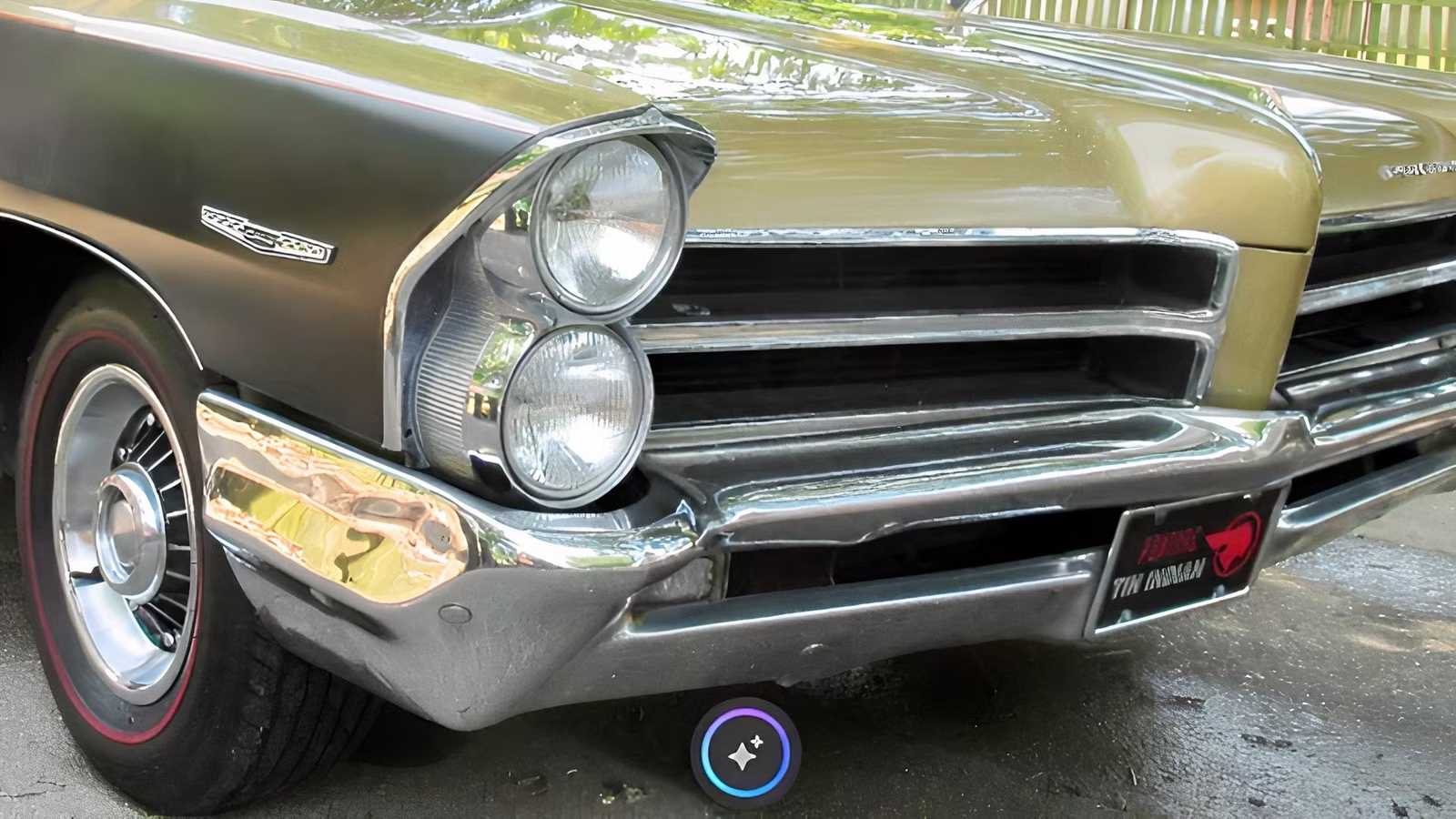
In the late summer of 1963, the Pontiac GTO hit American roads and changed the course of its domestic auto industry. As a result, it’s somewhat difficult to put a spotlight on the rest of Pontiac’s lineup from around the same time. Never mind that the GTO itself was a performance offshoot of the Tempest-based LeMans, all that matters to most folks is that those three letters appear on the front grille. There’s not enough bandwidth to appreciate the smaller stuff, let alone a wagon. That is a real shame, because on at least one occasion, a Pontiac wagon gave the GTO a serious run for its money.
The Catalina: Pontiac’s Bread and Butter for Decades

Long before it started hiding massive drag-strip potential, the Catalina was the absolute backbone of Pontiac’s full-size lineup. The nameplate started life in 1950 as a high-end trim level for the long-standing Chieftain, and later for the Star Chief, Pontiac’s equivalent of the Chevy Bel Air. In that role, the Catalina was a pillarless hardtop meant to add a splash of refinement, almost Buick- or Olds-like in its execution. By 1959, the Catalina had diversified into a standalone model with a 389-cubic-inch V8, serving as Pontiac’s entry-level full-size car.
The Catalina was a key player in forging the design language that ultimately birthed the GTO. By 1963, it sported stacked quad headlights and a similar dual-pane grille broken up by a Pontiac badge right in the middle. Before long, this was a design cue that most of the Pontiac line would incorporate, a hallmark of the work done by Pontiac’s design team, spearheaded by figures such as Pete Estes and the timeless John DeLorean. Still, the real transformative period for the Catalina began in 1965. That year, the entire full-size range received a major redesign, riding on striking new “Coke-bottle” styling and a sprawling 121-inch wheelbase.
Too big to be a traditional muscle car but certainly styled like one, the third-generation Catalina was far closer to a gentleman’s GT car or even a luxury car by this stage. For a brand traditionally positioned below Oldsmobile and Buick, the Catalina punched above its weight with a supple ride, plush seats, and a road presence that rivaled its pricier sister brands. It was huge, imposing, and pretty stylish for something so enormous. Yet, because there wasn’t a specific set of badges on the car, it hardly ever gets noticed.

The 2+2 Package & The Missing Badge

Right around the time the GTO was overshadowing the rest of the Pontiac lineup, the brand was developing something just as special but nowhere near as celebrated within its full-size lineup. The goal was simple: take the Catalina family, install performance hardware under the hood, and sell it to the public right alongside the smaller GTO. Enter the W51 order code, better known as the 2+2 trim.
As an official options package selected directly from the dealer that added exclusive exterior louvers, heavy-duty suspension, and a 421-cubic-inch Pontiac V8 with a base four-barrel carburetor, the W51 package certainly made the Catalina feel GTO-like. For a little extra money, you could opt for three Rochester 2G two-barrel carburetors instead of one four-barrel, the iconic Tri-Power arrangement which helped the burly engine breathe just a little bit better. Based on three carburetors arranged in a row, the center unit handled daily driving and idling while the outer two activated via vacuum or mechanical linkages under wide-open throttle. Complete with 2+2 badging all around, these W51 Catalinas were some of the most famous Pontiacs of the era without a GTO nameplate attached.

Officially released as a hardtop or a convertible, you’ll notice that the option of a long-roof wagon wasn’t included. At least, as an official 2+2. Well, not on paper, it didn’t, but in reality, you could get pretty darn close if you walked into a Pontiac dealership with a select group of production orders in mind.
The 1965 Catalina Safari: Pontiac’s Own Exclusive Muscle Wagon

It may not have been a legitimate 2+2, and it was the muscle car equivalent of ordering from the à la carte menu. Still, if you were so inclined, you could order the same Tri-Power 421 V8, heavy-duty suspension, and all the performance hardware of a 2+2 inside a Catalina Safari wagon if you were the kind of person who did burnouts on the way to your child’s soccer practice. With over 350 hp on tap and a massive 461 lb-ft of torque, you could buy a Pontiac wagon in 1965 that was nearly as fast off the line as a GTO.
Better still, the car could seat between six and nine people, depending on whether you selected the rear-facing third-row seats. Add well over 100 cubic feet of cargo storage with both rows of seats folded away, and a Catalina Safari was just as capable of hauling cargo as it was driving quickly down the highway.
A Unicorn Wagon You Could Haul Groceries With

In the end, the complexity of the ordering process required to configure a Catalina Safari wagon like a muscle car meant almost nobody actually did it. Out of over a quarter-million Catalinas Pontiac built in 1965, it is thought that as few as ten to 15 of them were configured like a 2+2 hardtop or convertible. Unlike those 2+2s, seen as some of the most valuable Pontiacs of the 1960s not related to the GTO, a mundane wagon with no badges denoting it as special depreciated as if it were powered by a normal 350 or 389-cubic-inch engine.
If one were to show up, numbers-matching and in drivable condition, it would not be shocking to see one roll across the auction block and sell for six figures. Today, only two Catalina Safari 421 V8 wagons are known to survive, one four-speed and one automatic. Wouldn’t it be nice to be one of the owners.
Source: Hagerty

Related posts




Latest Post


No Comments